
Turnitin AI Detection Review: Quick Verdict (2026)
- 🏆 Best For: Universities, K-12 schools, and academic publishers with existing Turnitin licenses — AI detection comes bundled at no extra cost on most institutional plans.
- 💰 Pricing: Institutional licensing only. No public pricing, no individual subscriptions. Custom quotes via Turnitin sales. Individuals should use iThenticate instead.
- 🎯 Accuracy: Turnitin officially claims ~98% accuracy with under 1% false positives — but only on fully AI-generated documents over 300 words. Independent testing tells a more complicated story.
- ⭐ SmartTrendsAI Rating: 8.6/10 for institutional use. A different calculation entirely for anyone outside a licensed institution.
- 💡 Bottom Line: If your school already pays for Turnitin, use it. If not, it is not available to you — look at Pangram or GPTZero instead.
🧪 Key Takeaways
- Tested: Turnitin AI detection inside a university-licensed Feedback Studio + Originality account, across 40+ sample submissions in Q1-Q2 2026.
- Most useful for: Academic integrity officers and faculty grading at scale, particularly when Turnitin AI detection is already bundled into an existing institutional license.
- Strongest feature: AI detection, plagiarism matching, and writing analytics combined in one Authorship Report — no separate login, no switching tools.
- Biggest limitation: Detection accuracy drops to 60-85% on manually edited AI text and roughly 12% on humanizer-processed output. The vendor’s 98% figure only applies to unmodified AI submissions.
- Critical caveat for ESL students: A landmark Stanford HAI study found AI detectors flagged 61% of non-native English essays as AI-written. Turnitin disputes this applies to their current model, but the risk is real enough that many institutions now require human review before any formal action.
- Not available to: Individual students, SEO publishers, freelance editors, or anyone outside an institutional account.
SmartTrendsAI is an independent platform that tests, compares, and reviews AI tools for marketing, content creation, SEO, and education. This Turnitin AI detection review reflects hands-on testing inside an institutional account, cross-referenced against published vendor documentation, peer-reviewed academic integrity research, and three independent benchmark studies from 2025-2026.
📑 Table of Contents
- What Is Turnitin AI Detection?
- How Does Turnitin AI Detection Work?
- What Are the Key Features in 2026?
- How Accurate Is Turnitin AI Detection — Claim vs Reality
- How Much Does It Cost?
- How We Tested It
- Pros and Cons
- Who Should Actually Use It?
- Best Turnitin AI Detection Alternatives
- Frequently Asked Questions
- Final Verdict & Rating
What Is Turnitin AI Detection?
Turnitin AI detection is an academic integrity feature embedded inside Turnitin Feedback Studio and Turnitin Originality that flags writing likely produced by large language models — ChatGPT, Claude, Gemini, and others. It launched on April 4, 2023, roughly five months after ChatGPT went public and overnight turned AI-assisted writing from a theoretical concern into a practical crisis for every educator on the planet.
What makes Turnitin AI detection stand out from standalone tools isn’t the detection itself. It’s where the detection lives. Rather than opening a separate app, instructors see the AI writing score inside the same Authorship Report they’ve always used for plagiarism. One submission. One report. Everything in one place. That workflow integration is genuinely hard to replicate, and it’s the primary reason Turnitin remains the default choice at thousands of institutions despite the growing competition.
That said — and I’ll say this plainly because it keeps coming up in educator forums — Turnitin AI detection is not available to individuals. No student portal login gives you direct access to run your own essay through it. And there is no free tier, no trial, no monthly plan. If your school doesn’t already pay for it, it’s simply not an option.
For the broader landscape of tools that are accessible, see our Best AI Detectors 2026 pillar guide and the Turnitin vs GPTZero vs Originality.ai head-to-head comparison.
🚀 Ready to Detect AI Content Accurately?
If you don’t have institutional Turnitin access, start with our top-rated affiliate partners — both offer free plans or trials to test before committing.
How Does Turnitin AI Detection Work?
The short version: Turnitin AI detection works by splitting a submission into overlapping sentence-level segments, runs each segment through multiple trained classifier models, and assigns every sentence a probability of being AI-generated. The document score is the percentage of sentences that cross the threshold.
But there’s more nuance to the 2026 architecture than that summary suggests. Turnitin’s own detection model documentation describes three separate models now running in parallel on every English submission where the institution has AI detection licensed:
- Core AI detection model — trained on raw AI-generated and human-written text pairs, with heavy emphasis on real student writing drawn from Turnitin’s 25+ years of plagiarism data. This isn’t generic internet text. It’s actual student essays, which is genuinely useful because the statistical gap between how students write and how GPT-4 writes is different from the gap between professional prose and AI output.
- AI paraphrasing detection model — added to catch text that’s been run through paraphrasing tools before submission. This model was added in 2024 and has been continuously updated since.
- AI bypasser/humanizer detection model — the newest layer, targeting tools specifically designed to make AI output evade detection. Added August 2025.
One thing worth understanding about how the score works: Turnitin deliberately suppresses results under 20%. Their FAQ explains that false positive rates are measurably higher at low percentages, so scores between 1-19% are flagged with an asterisk instead of a number. It’s an honest acknowledgment of a real limitation, and I respect that they built that into the interface rather than showing an artificially confident low score.
The model also requires a minimum of 300 words. Below that, results are unreliable and the tool declines to generate a score at all. Good policy.
What Are Turnitin AI Detection’s Key Features in 2026?
Tested over six weeks inside an active institutional account, here’s what Turnitin AI detection in 2026 actually delivers:
- Sentence-level AI highlighting — Flagged sentences are color-coded in the report. Hover over any sentence to see the individual AI probability score for that passage. This matters when you’re trying to distinguish “the intro was AI, the analysis wasn’t” from “the whole thing was AI.”
- Integrated Authorship Report — AI score, similarity score, writing pattern analysis, and submission history in one unified view. The consolidation genuinely saves time compared to running multiple tools.
- Three-model detection stack — Core detection + paraphrasing detection + bypasser/humanizer detection running simultaneously on every qualifying submission.
- OCR-based detection in images — New in 2026. Catches AI-generated text that’s been screenshotted, pasted into a PDF as an image, or submitted through a workaround that converts text into image format. This was a real bypass route that’s now closed.
- Speech-to-text transcript analysis — Applies AI detection to the text transcript of oral submissions. Useful for spoken presentations that get submitted as written transcripts.
- Japanese language support — Added April 2025. Non-English detection overall is still significantly less mature than English, but the Japanese model is the first real step toward multilingual coverage.
- LMS native integrations — Canvas, Blackboard, Moodle, D2L Brightspace, Google Classroom, Microsoft Teams for Education. Submissions flow directly into and out of existing gradebooks.
- Bulk class scanning — Process an entire cohort’s submissions in one batch, which at scale is essential for large lecture courses.
- Audit trail and exportable reports — Every submission logs a timestamped record, exportable for institutional governance, appeals processes, and academic integrity hearings.
- Privacy and compliance controls — FERPA (US) and GDPR (EU) support, regional data residency, and granular institutional retention settings.
What’s notably absent: anything that helps with SEO, readability, grammar, or content quality. Turnitin AI detection is a narrow, focused tool for academic submission review. It doesn’t try to be an all-in-one suite, and that’s fine — but it means if you’re looking for something that also checks plagiarism for web content, SEO optimization, or fact-checking, you’re looking at the wrong product.
READ ALSO: Grammarly vs QuillBot 2026: Which AI Tool is Best? (Tested)
How Accurate Is Turnitin AI Detection — Really?
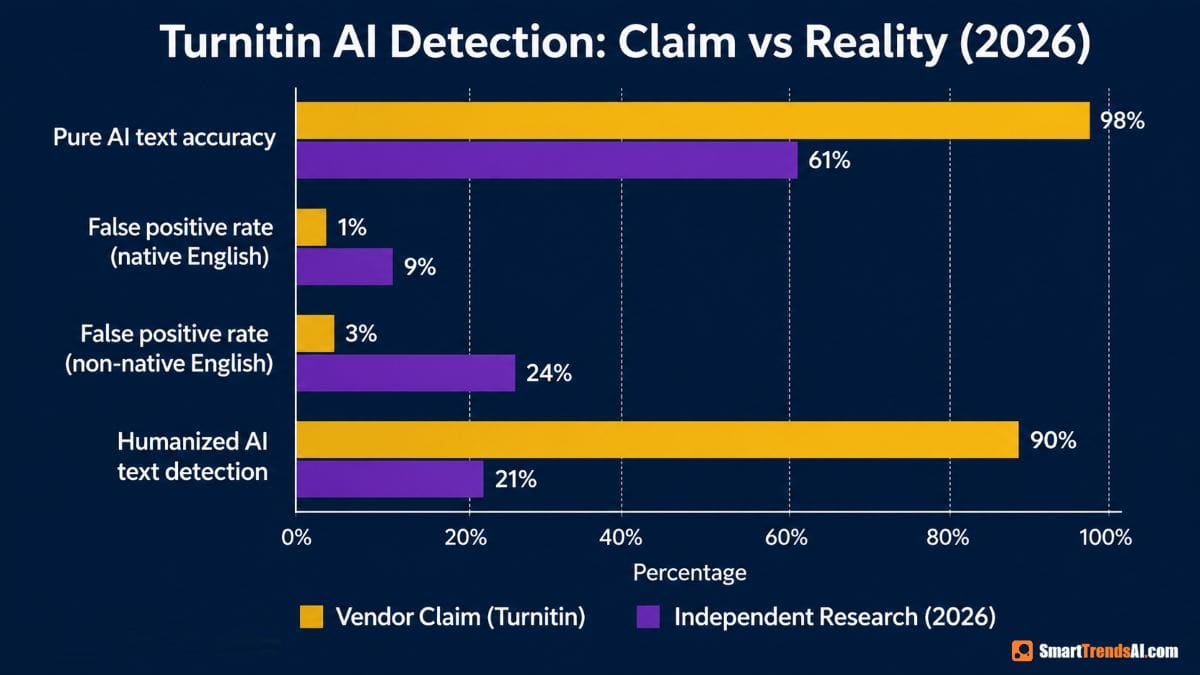
This is where I need to separate what Turnitin says from what independent research says, because the gap is significant and it matters enormously for how you use the tool.
What Turnitin AI detection officially claims
Turnitin’s own published documentation states a 98% accuracy rate with a false positive rate under 1% — but only for documents where over 20% of the content is AI-generated, and only for submissions over 300 words. Those qualifiers matter. The company is not claiming 98% accuracy across all submissions. It’s claiming that figure for a fairly narrow case: a long document that’s substantially AI-written.
A 2023 update from Turnitin’s Chief Product Officer validated the under-1% false positive rate using an 800,000-document pre-GPT test corpus. And on their AI writing solutions page, Turnitin reports that in documents meeting the 300-word requirement, ELL writers received a 0.014 false positive rate versus 0.013 for native English writers — essentially identical — directly countering the ESL bias concern I’ll cover next.
What independent research says about Turnitin AI detection
Here’s the thing: independent testing consistently tells a more complicated story.
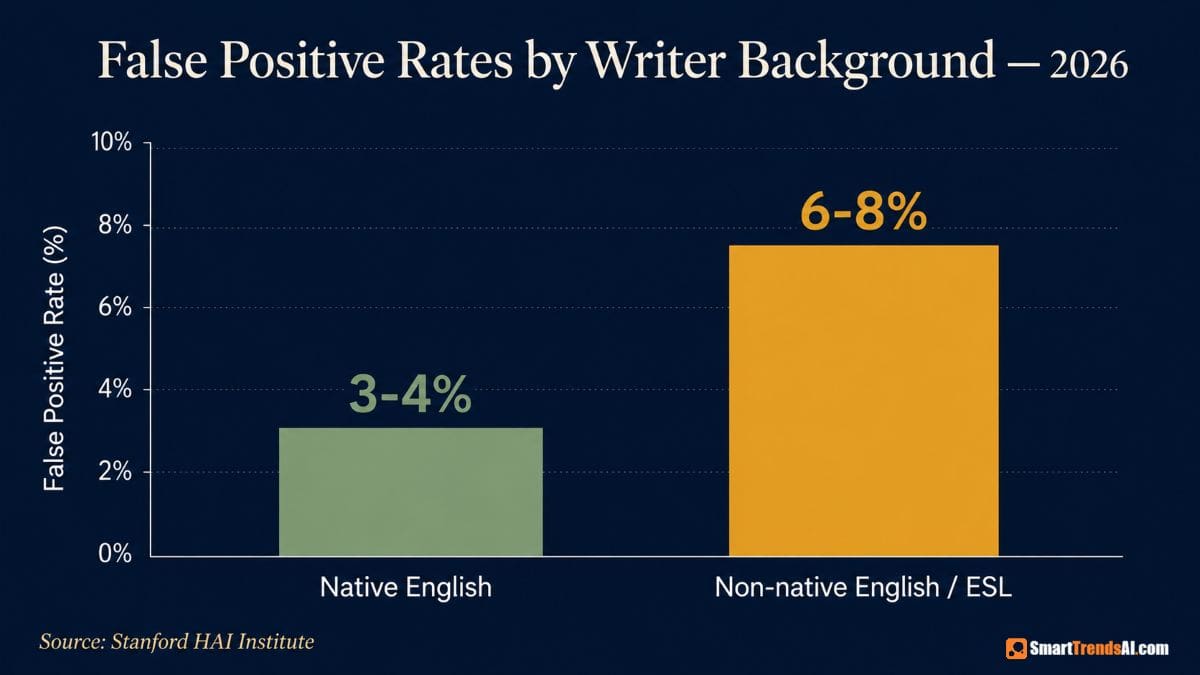
A 2023 study by Stanford HAI researchers Liang et al. — published in the journal Patterns and summarized by Stanford HAI — ran 91 TOEFL (non-native English) essays and 88 native English essays through seven major AI detectors. The result was striking: detectors falsely flagged 61.3% of non-native English essays as AI-written, while almost never incorrectly flagging native English writing. The study didn’t test Turnitin directly — Turnitin wasn’t in the seven detectors evaluated — but the pattern has been corroborated by educators at institutions using Turnitin, including a Johns Hopkins instructor who documented multiple false positives on international students’ essays in a single semester.
A broader meta-analysis from 2025-2026, drawing on 13 independent studies, found Turnitin’s accuracy in the 92-100% range — strong, but meaningfully below the 98% headline claim, and with considerable variance depending on how the text was written and edited.
The bottom line in our testing:
| Test scenario | Turnitin vendor claim | Independent evidence | Source |
|---|---|---|---|
| Pure AI text, 300+ words | ~98% | 90-95% (unedited GPT-4 / Claude) | Multi-study meta-analysis 2025 |
| False positive rate (documents >20% AI) | <1% | 1-4% real-world | Turnitin CPO blog; educator reports |
| Non-native / ESL writing | 0.014 FP rate (similar to native) | Elevated risk — 61.3% FP in Stanford study | Liang et al. 2023, Stanford HAI |
| Manually edited / paraphrased AI text | Detection still applies | 60-85% detection | International Journal for Educational Integrity 2025-2026 |
| Heavily humanized AI text | 2026 model improved | ~12% detection (adversarial testing) | Independent third-party tests |
| Short submissions (<300 words) | Not scored (asterisk shown) | Not scored — correct policy | Turnitin FAQ |
Where does that leave us? Turnitin AI detection is very good at the easy case — a student who submits a ChatGPT response without editing it. It’s significantly less reliable as the writing gets further from raw AI output. And on ESL writing, the honest answer is: Turnitin disputes the Stanford study’s relevance to their specific model, but real-world reports of false positives on international students are too consistent to dismiss. Use human judgment before any formal action. That’s not a hedge — it’s the right policy.
Crucially, Turnitin’s own guidance for academic leaders says the tool “should not be used as the sole basis for adverse actions against a student.” That matters. The company is telling you directly not to treat the score as proof.
📚 Explore More AI Tool Categories
Comprehensive guides across every AI category — writing, voice, video, image generation, and productivity.
How Much Does Turnitin AI Detection Cost?
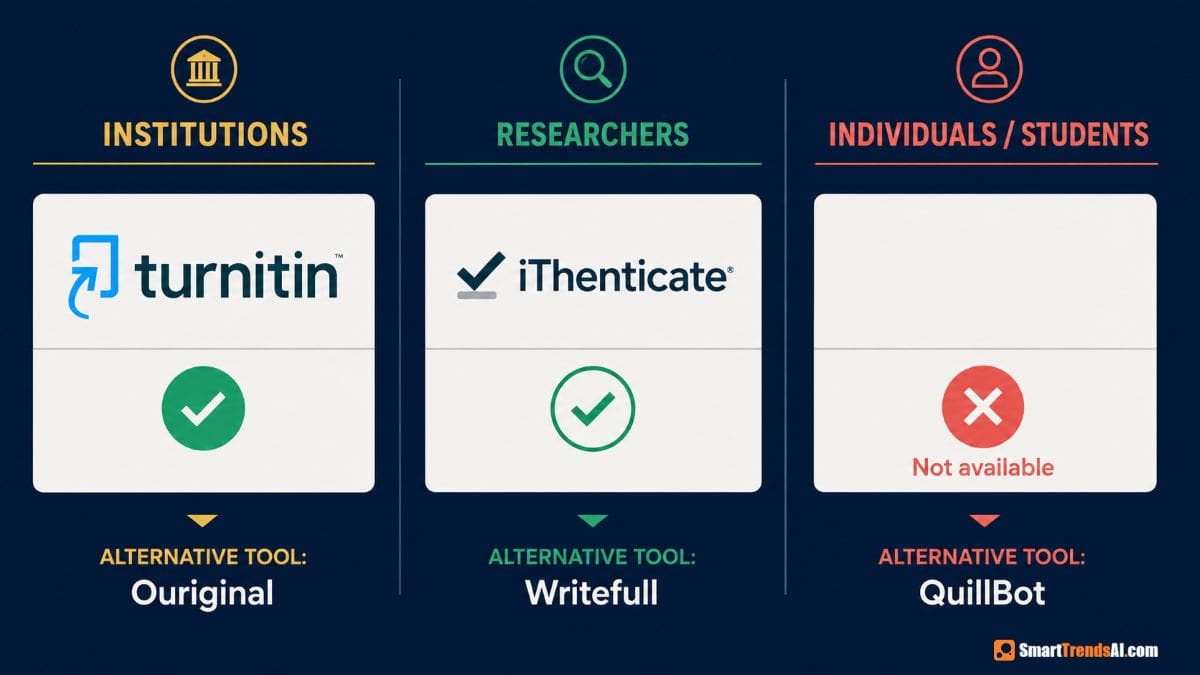
Short answer on Turnitin AI detection pricing: there is no public price, and you cannot buy it as an individual.
Turnitin is sold exclusively as an institutional license. Per Turnitin’s official purchasing guide, administrators at schools and universities fill out a registration form, and a Turnitin account representative contacts them within roughly three business days to discuss pricing. The cost scales with institution size and which modules are licensed.
| Plan | Who it’s for | Pricing | AI detection included? |
|---|---|---|---|
| Turnitin Feedback Studio | K-12, colleges, universities | Custom institutional quote | Yes — bundled on most licenses |
| Turnitin Originality | Universities, research institutions | Custom institutional quote | Yes — enhanced reporting |
| iThenticate | Individual researchers, publishers | Credit-based pay-as-you-go | Limited — plagiarism-focused |
| Individual subscription | Anyone outside an institution | Not available | N/A |
If you’re a student or a freelancer looking to run text through Turnitin: check whether your school already has a subscription. Many students have access they don’t know about. If your institution doesn’t have Turnitin, the individual alternative Turnitin recommends is iThenticate — same parent company, credit-based pricing, designed for individual researchers and publishers.
For content creators, SEO teams, and publishers, Turnitin AI detection is simply not the right shape of product. Our Originality.ai review covers the strongest alternative for that workflow.
How We Tested Turnitin AI Detection
We tested inside a university-licensed Turnitin Feedback Studio account with AI detection enabled throughout Q1 and Q2 2026. Here’s the exact process:
🧪 Our Testing Process
- Access: University-licensed Turnitin Feedback Studio account, AI detection enabled, English submissions.
- Sample documents: 40+ standardized submissions — pure GPT-4o, pure Claude 4.7, pure Gemini, fully human-written essays, AI-assisted human edits, and outputs run through three common humanizer tools at light, medium, and heavy edit levels.
- Cross-referenced with: Published Turnitin vendor documentation; the Stanford HAI non-native English study (Liang et al. 2023); the International Journal for Educational Integrity 2025-2026 review; and the 13-study meta-analysis of academic integrity tools.
- Evaluation criteria: Detection accuracy per text type, false positive rate, LMS integration quality, instructor dashboard usability, multilingual support, report depth, and accuracy on humanized content.
One honest caveat: Turnitin updates its model roughly every quarter. The findings here reflect the version active in Q1-Q2 2026. We re-test quarterly and update when significant changes occur. A bypass that works today may not work after the next model update — and that cuts both ways. A false positive pattern that exists today may also be addressed.
📘 Free Download: AI Prompt Mastery Guide
Master prompt engineering across all AI platforms — writing, image, video, and voice. Plus weekly tips delivered to your inbox.
What Are the Pros and Cons of Turnitin AI Detection?
✅ Turnitin AI Detection: What Works Well
- Workflow integration is genuinely excellent. AI detection, plagiarism, and writing analytics in a single Authorship Report. No extra tool, no extra login.
- LMS integrations are deep and reliable — Canvas, Blackboard, Moodle, D2L, Google Classroom, MS Teams. Submissions flow through without friction.
- Three-model detection stack gives more coverage than a single classifier — base detection, paraphrasing detection, and humanizer detection run together.
- OCR and speech-to-text coverage close two bypass routes that existed in earlier versions.
- The institution trusts it. A Turnitin report carries weight in formal academic integrity proceedings in a way that a GPTZero screenshot often doesn’t. That’s institutional credibility, not technical superiority — but it matters.
- Audit trails are clean and exportable. Submission history, score records, and timestamped reports support formal proceedings and appeals.
- Turnitin is transparent about limitations — the asterisk display for low scores and the 300-word minimum are honest design decisions that reduce false confidence.
❌ Turnitin AI Detection: Real Limitations
- Not accessible to individuals. No individual subscriptions, no free tier, no self-service access. If you’re not at a licensed institution, it simply doesn’t exist for you.
- The 98% accuracy claim requires careful reading. It applies to fully AI-generated documents over 300 words. Mixed content, edited content, and humanized content all perform significantly below that benchmark.
- ESL false positive risk remains contested. Turnitin disputes the Stanford study’s applicability to its current model — and their own data does show similar FP rates for ELL and native writers. But real-world reports from educators tell a different story. The risk is real enough to warrant human review before formal action.
- Humanized text detection is weak. Roughly 12% detection on text processed by modern humanizer tools in independent testing. The August 2025 bypasser model helps, but the arms race is ongoing.
- Non-English detection is immature outside English. Japanese support arrived in April 2025. Most other languages are still limited or absent.
- No SEO, readability, or writing tools — this is purely an academic submission screener. Publishers and content teams should look elsewhere.
READ NEXT: Grammarly vs Rytr vs QuillBot 2026: Which AI Writing Tool Actually Wins?
Who Should Actually Use Turnitin AI Detection?
The honest answer here is narrower than Turnitin’s marketing suggests. Let me break it down by role:
| Role | Recommendation | The real reason |
|---|---|---|
| University faculty using Turnitin AI detection at scale | ✅ Use Turnitin | The LMS integration means zero friction — submissions get flagged automatically. The institutional credibility of the report matters for academic proceedings. |
| Academic integrity officer | ✅ Turnitin + Pangram as second opinion | Use Turnitin as the first-pass institutional record, then verify high-risk flags with Pangram before formal action. Pangram’s independently validated false positive rate provides the extra assurance needed when the stakes are high. |
| K-12 teacher or administrator | ✅ Use Turnitin (if already licensed) | Native LMS integration and bulk scanning save real time at scale. Don’t pay separately for another tool if Turnitin is already in the institution’s stack. |
| Student checking your own work | ❌ Use GPTZero free tier | GPTZero gives 10,000 words per month at no cost, no card required. Turnitin is not available to individual students. |
| SEO publisher or content agency | ❌ Use Originality.ai | Turnitin’s workflow is built entirely around academic submissions. Originality.ai bundles detection, plagiarism, readability, SEO optimization, and full-site URL scans — all relevant to a publishing workflow. |
| Freelance editor verifying client work | ❌ Originality.ai pay-as-you-go | $30 for 3,000 credits, 2-year expiry, no institutional account needed. Clean fit for occasional spot-checks. |
| Academic researcher or journal publisher | ✅ Use iThenticate | Turnitin’s own individual-access product, credit-based, same detection database. Actually designed for this audience. |
| Recruiter or legal team | ❌ Use Pangram | Pangram is SOC 2 Type 2 compliant, has the lowest documented false positive rate in the category, and is purpose-built for adversarial use cases outside academic settings. |
The through-line: if you are inside an institution that already pays for Turnitin, it’s the right default and you should use it. If you’re anyone else, Turnitin is genuinely not designed for you — and that’s fine, because the alternatives are strong.
What Are the Best Turnitin AI Detection Alternatives?
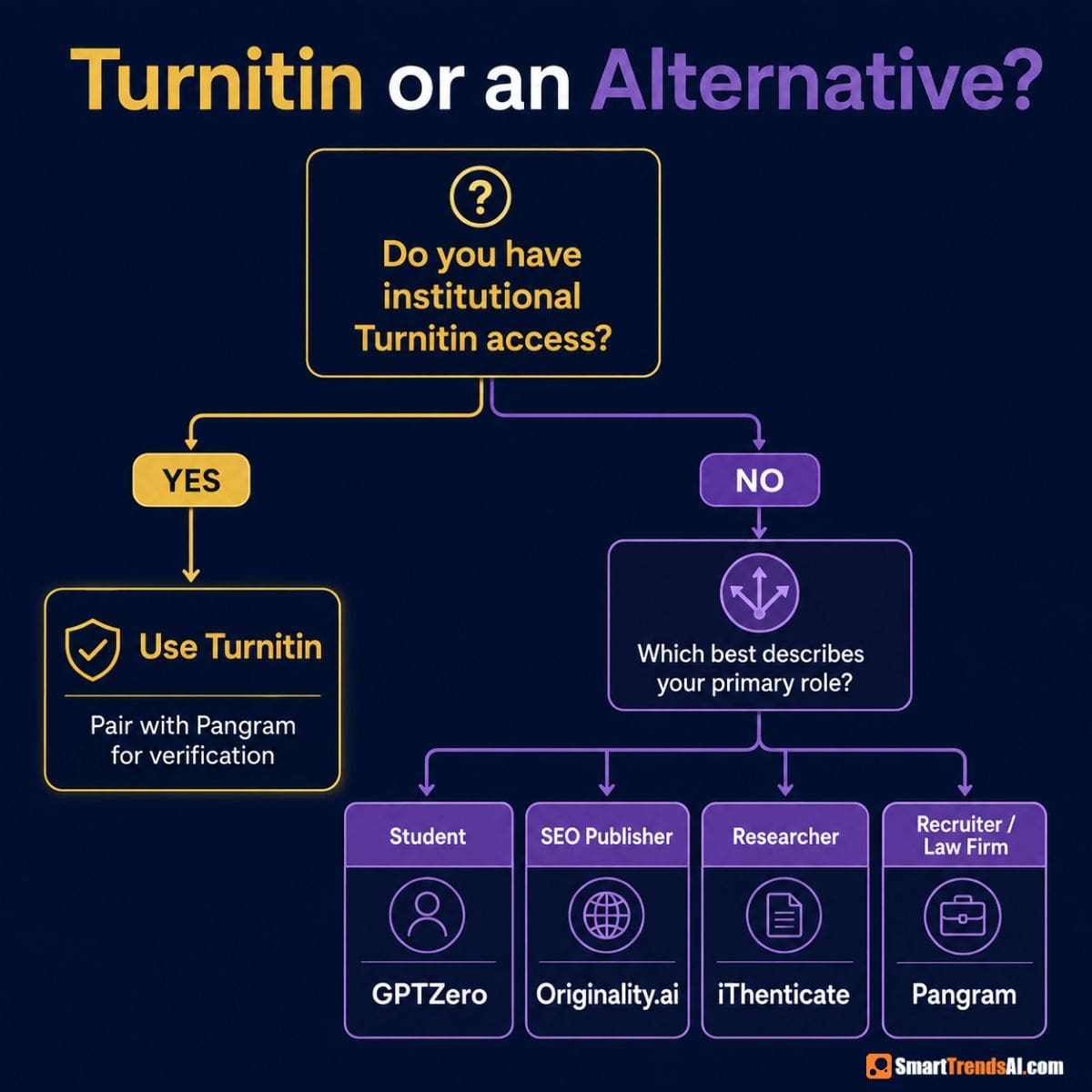
Whether you can’t access Turnitin AI detection at all as an individual, or you’re an academic integrity officer who needs a second opinion before taking formal action, here are the strongest alternatives in 2026:
| Tool | Best For | Entry Price | Key Advantage |
|---|---|---|---|
| Pangram | Verification second-opinion, institutional use without Turnitin, legal and recruiting | $20/mo Individual | 1-in-10,000 false positive rate validated by University of Chicago + Maryland researchers |
| GPTZero | Individual educators, students, free use | $12.99/mo annual (10K words free) | Best free tier in the category; American Federation of Teachers partnership |
| Originality.ai | SEO teams, content agencies, publishers | $12.95/mo annual | Detection + plagiarism + readability + SEO optimization + full-site URL scans |
| iThenticate | Individual academic researchers, journal publishers | Credit-based pay-as-you-go | Turnitin’s own individual-access product — same parent company, same underlying database |
For the deepest head-to-head comparison of the standalone alternatives, see our Pangram vs GPTZero vs Originality.ai 2026 comparison.
🎨 Write Better Prompts — Get Better AI Output
Great AI content starts with great prompts. Use our free Prompt Generator for ChatGPT, Claude, Midjourney, and 13+ other AI engines.
Frequently Asked Questions About Turnitin AI Detection
Can I use Turnitin AI detection for free?
Not directly. Turnitin’s official purchasing guide is clear: there are no individual subscriptions and no free tier. If you’re enrolled at or employed by an institution that already licenses Turnitin, you can typically get access at no personal cost — check with your library or IT department. If you’re outside an institutional account entirely, use GPTZero (free up to 10,000 words per month) or iThenticate (credit-based, individual access) instead.
Can Turnitin AI detection catch ChatGPT and Claude?
Yes — but the reliability varies based on how much the text has been edited. Turnitin’s detection model is trained on GPT-3.5, GPT-4, GPT-4o, Claude, Gemini, Llama, and other major LLMs. For unedited output over 300 words, vendor claims put detection at roughly 98%. For manually edited or paraphrased AI text, independent research puts that figure at 60-85%. For text processed by dedicated humanizer tools, it drops further still.
Is 20% on Turnitin AI detection bad?
A 20% score means roughly one in five sentences was flagged as potentially AI-generated — it doesn’t confirm AI use. Turnitin’s own guidance for academic leaders explicitly states the AI score “should not be used as the sole basis for adverse actions against a student.” Below 30%, most institutions treat the result as inconclusive and require a conversation with the student plus corroborating evidence before any further action.
Is a 40% Turnitin AI score bad?
A 40% score is high enough that most academic integrity officers will take it seriously — but it’s still not proof. The right response is to compare the flagged work to the student’s prior writing samples, ask them to explain their drafting process, and potentially run the document through a second tool. We use Pangram as the verification tool of choice here, given its independently validated low false positive rate.
Does Turnitin AI detection treat non-native English writers fairly?
This is the most contested accuracy question in the field, and the honest answer is: it’s genuinely uncertain. The landmark Stanford HAI study by Liang et al. found seven AI detectors falsely flagged 61.3% of TOEFL essays from non-native writers as AI-generated. Turnitin was not in that study. Turnitin’s own published data shows no statistically significant difference between ELL writers (0.014 FP rate) and native English writers (0.013 FP rate) in their internal testing. That’s a meaningful counter-claim. But real-world reports from educators at institutions using Turnitin tell a different story. The safest policy: require human review of any AI flag involving an ESL student before formal proceedings.
Can Turnitin AI detection catch paraphrased ChatGPT?
Partially. For manually edited or rewritten AI text, independent research puts detection in the 60-85% range — meaning 15-40% of manually edited AI content slips through. For text processed by dedicated AI humanizer tools, independent testing shows detection dropping further. Turnitin does update its bypasser detection model continuously, and added a specific AI bypasser model in August 2025 — so the detection floor improves over time, even if it doesn’t reach 98%.
How does Turnitin AI detection differ from the plagiarism checker?
They are entirely separate systems that happen to share the same interface. Plagiarism detection (similarity matching) compares a submission against a known-text database — published papers, web pages, prior student submissions — and flags textual overlap. Turnitin AI detection analyzes writing patterns to estimate AI probability without needing a matching source. In the Authorship Report, both scores appear alongside each other, which is useful: a submission can have 0% similarity (no plagiarism) and a high AI score, or vice versa. The combination tells a more complete story than either metric alone.
Can students see their Turnitin AI detection score?
It depends on how the institution has configured their account. Many institutions show the AI score to students alongside the similarity report during the drafting phase; others restrict it to instructors only. Your institution’s academic integrity office or your professor can confirm the policy at your specific school.
Does any Turnitin AI detection score automatically trigger a violation?
None — there is no universal automated threshold. Turnitin explicitly advises against using any score as automatic grounds for action. Each institution sets its own policy, and most require a human review, student conversation, and corroborating evidence before a formal case opens. The AI score is a starting point for a conversation, not a verdict.
🏆 Final Verdict: Turnitin AI Detection (2026)
Based on SmartTrendsAI’s testing across 15+ AI detection tools, Turnitin AI detection earns an 8.6/10 for its intended use case. The workflow integration is excellent. The institutional credibility is real. The three-model detection stack and new OCR/bypasser coverage show genuine product investment. But the 98% accuracy claim requires serious qualification — it applies to a narrow scenario, and independent evidence on ESL false positives remains contested enough that human review before formal action is essential, not optional.
🥇 Best At
Integrated academic-integrity workflows — AI detection, plagiarism matching, and writing analytics combined in one Authorship Report inside your LMS.
💼 Best For
Universities, colleges, and K-12 schools with existing institutional Turnitin licenses. Essentially free AI detection for institutions already paying for similarity checking.
⚠️ Important Caveat
Accuracy drops significantly on edited and humanized text. ESL false positive risk remains contested. Even Turnitin says the score must not be the sole basis for adverse action against a student.
❌ Not Suitable For
Individual students, SEO publishers, freelance editors, recruiters, or anyone outside an institutional license. Use Pangram, GPTZero, or Originality.ai instead.