

Anyword Review 2026: Quick Verdict
- 🏆 Best For: Performance marketers, ad teams, and social media managers who need to know how copy will perform before they spend a single dollar on it.
- 🎯 Killer Feature: The Predictive Performance Score — a 0-100 rating benchmarked against a dataset of tens of thousands of real A/B-tested ads.
- 💰 Pricing: Starter $39/month (annual) or $49/month (monthly); Data-Driven $79/month (annual) or $99/month (monthly). No permanent free plan — 7-day trial with 25 performance predictions.
- ⭐ User Ratings: 4.8/5 on Trustpilot (5,223 reviews) and 4.8/5 on Capterra/Software Advice (391 reviews) — among the highest-rated tools we’ve reviewed.
- ⭐ SmartTrendsAI Rating: 7.8/10 — outstanding for short-form, performance-driven copy; weak for long-form blog content.
- 💡 Bottom Line: The clearest takeaway from this Anyword review — if you’re a marketer who needs data behind your copy decisions, Anyword is genuinely different from every other AI writer. If you need a blog content engine, Scalenut or Jasper are stronger choices.
🧪 Key Takeaways
- Tested: Anyword’s full workflow — ad copy generation, social captions, the Blog Wizard, and the Content Improver — across a fictional eco-friendly subscription box brand over 4 weeks in Q1-Q2 2026.
- Winner for: Short-form, conversion-focused copy — Facebook ads, Instagram captions, email subject lines — where the Predictive Performance Score adds genuine, measurable value.
- Real results from users: Verified case studies report 33% faster ad creation, 23% more clicks at the same cost-per-click, and email click-through rates rising from 2.5% to 8%.
- Weakest area: Long-form blog content. The Blog Wizard produces generic first drafts, the editor can’t generate new sections from scratch, and output quality is highly dependent on how detailed your brief is.
- Avoid if: You’re a solo blogger, student, or creative writer on a tight budget — there’s no permanent free plan, and the pricing is built around marketing teams, not individuals.
- Price range: $39/month (Starter, annual) to $79/month (Data-Driven, annual), with custom Business and Enterprise tiers for larger teams.
SmartTrendsAI is an independent platform that tests, compares, and reviews AI tools for marketing, content creation, SEO, and productivity. This Anyword review reflects four weeks of hands-on testing across ad copy, social captions, and long-form blog generation, cross-referenced against verified user reviews on Trustpilot (5,223 reviews) and Capterra/Software Advice (391 reviews), plus Anyword’s own published case study data.
📑 Table of Contents
- What Is Anyword and What Makes It Different?
- How Does the Predictive Performance Score Work?
- Key Features We Tested
- How Much Does Anyword Cost?
- What Do Real Users Say About Anyword?
- Anyword vs Jasper AI: Which Should You Use?
- Anyword vs Copy.ai vs ChatGPT: How Does It Compare?
- How We Tested Anyword
- Pros and Cons
- Who Should Actually Use Anyword?
- Best Anyword Alternatives in 2026
- Frequently Asked Questions
- Final Verdict: Is Anyword Worth It?
What Is Anyword, and What Makes It Different?
This Anyword review starts with the question every marketer asks first: is this just another AI writer, or is there something genuinely different here? After four weeks of testing, the honest answer is — yes, there’s something different, and it’s not the writing itself.
Anyword is an AI-powered copywriting platform built for marketers who need to create content that converts — ads, emails, landing pages, social posts, and blog content. It has the dashboard, templates, and prompt-based generation you’d expect from any AI writer in 2026. But layered underneath all of that is what Anyword calls its Copy Intelligence engine, and its most visible output is the Predictive Performance Score.
Here’s what that means in practice: every piece of copy Anyword generates gets scored from roughly 0-100, based on how it compares against a massive dataset of real, A/B-tested marketing copy. A score of 81 doesn’t mean “this is 81% good” — it means this copy is predicted to outperform 81% of similar copy in Anyword’s dataset. In our testing, that single number changed how we thought about choosing between ad variations entirely. Instead of guessing which headline “felt” stronger, we had a data point to anchor the decision.
This Anyword review found that the platform is built almost entirely around one persona: the performance marketer. Demand generation managers optimizing ad spend, email marketers chasing higher open rates, social media managers running multi-platform campaigns, and content strategists who need to justify ROI to leadership. If that’s you, keep reading — this Anyword review is going to be useful. If you’re a solo blogger, student, or novelist, this Anyword review will tell you why a different tool is probably a better fit.
For the broader AI writing tools landscape, see our Best AI Writing Tools 2026 pillar guide, and for the marketing-specific angle, our Best AI Marketing Tools 2026 roundup.
🚀 Ready to Write Copy That Converts?
Start with our top-rated affiliate partners — both offer free plans or trials to test before committing.
How Does the Predictive Performance Score Work?
The Predictive Performance Score is the single feature that makes this Anyword review different from a review of Jasper, Copy.ai, or ChatGPT. Here’s how it actually works, based on our testing:
When Anyword generates a piece of copy — say, five Facebook ad variations — each variation gets scored individually. In our test for a fictional eco-friendly coffee mug subscription box, scores ranged from 58 to 81 across five ad variations. The highest-scoring ad combined a direct discount offer with a flexibility message (“20% Off + A Flexible Subscription That Fits Your Lifestyle”), while the lowest-scoring ad took a more emotional, storytelling approach (“Every Mug Has a Story—Discover Yours”).
Clicking the “Insights” link on any score reveals the methodology: the score of 81 meant the copy was predicted to outperform 81% of over 22,560 similar texts in Anyword’s dataset. That’s the Copy Intelligence engine at work — it’s not guessing based on grammar or readability, it’s pattern-matching against real performance data from real campaigns.
In a second test, we generated Instagram captions for a fictional dog treat subscription brand. The highest-scoring caption came in at 66 — noticeably lower than the 81 we saw on the Facebook ad test. This is an important finding for anyone reading this Anyword review: scores aren’t comparable across formats. A 66 on Instagram and an 81 on Facebook ads reflect different datasets and different baselines — don’t assume a “lower” score on one channel means worse copy than a “higher” score on another.
One nuance worth flagging: the score measures predicted performance against historical patterns, not guaranteed future results. It’s a probability-weighted signal, not a crystal ball. But as a way to choose between five drafts before spending ad budget, it’s a genuinely useful layer that no other AI writing tool in this category offers at the same depth.
Key Features We Tested
Beyond the Predictive Performance Score, here’s what this Anyword review found across the rest of the platform:
Data-Driven Editor
This is where most of your time will be spent. Paste or write copy, and Anyword scores it in real time while suggesting specific improvements. It’s especially useful for teams that want to iteratively refine copy rather than accept the AI’s first output. Real-time performance predictions for manual edits are available starting on the Data-Driven plan.
Blog Wizard
A guided six-step workflow: Language → Brief → Title → Outline → Facts & Statistics → Generation. Anyword even scores your title options before you commit. Our testing found this feature highly brief-dependent — a vague brief produces vague, generic output, while a detailed brief with a clear definition of your topic and specific points to cover produces a genuinely usable first draft. The Facts & Statistics step (still in beta) sources supporting data, though in our test on a niche technical topic, the sourced statistics were too general to be useful.
One important limitation this Anyword review needs to flag: the editor can only improve existing text — it cannot generate new sections from scratch. If your brief omits a section (we forgot to brief an introduction in our test), you’ll be writing that section yourself. Make sure your brief covers every section you want in the final draft.
Content Improver
Feed it underperforming copy, and it rewrites it to be more engaging and conversion-focused. We tested this on a deliberately bland product description (“We sell coffee mugs. They are good quality and look nice.”) and got back genuinely improved, benefit-driven copy addressing customer pain points directly. This is one of the most immediately useful features for teams with a backlog of tired ad copy or landing pages.
Template Library
Another area this Anyword review tested closely: templates are organized by channel — Social Media, Ads, Email, Website, Blog/Article, Ecommerce, and more. Within Social, platform-specific options cover Instagram, Facebook, X, LinkedIn, Pinterest, and YouTube. Each template runs through the short-form editor and generates multiple scored variations. For marketing teams managing content across many channels, this is a genuine time-saver.
Brand Voice and Brand Rules
You can train Anyword on your company’s specific tone, terminology, and brand guidelines, so output stays on-brand rather than generic. Plan limits apply here: Starter and Data-Driven include 1 brand voice, Business includes 5, Enterprise is custom.
AI Image Generation
For social posts, Anyword can generate a unique AI image alongside the caption. In our Instagram test, the highest-scoring caption (86) came paired with a cozy, winter-themed mug image. The images are functional but won’t win design awards — treat this as a placeholder/draft generator, not a final-asset tool.
Plagiarism Checker and Chrome Extension
A built-in plagiarism checker is included with the Blog Wizard on every paid tier — a feature Wordtune notably lacks. The Chrome extension is available on all plans and lets you generate and improve copy directly inside other web tools.
Integrations and Language Support
Anyword supports 30+ languages for content generation. Out-of-the-box integrations with platforms like Google Ads and HubSpot are available starting on the Data-Driven plan; custom integrations require Enterprise. We were not able to test these integrations directly, since our test used a fictional brand with no live ad accounts to connect.
📘 Free Download: AI Prompt Mastery Guide
Master prompt engineering across all AI platforms — writing, image, video, and voice. Plus weekly tips delivered to your inbox.
How Much Does Anyword Cost?
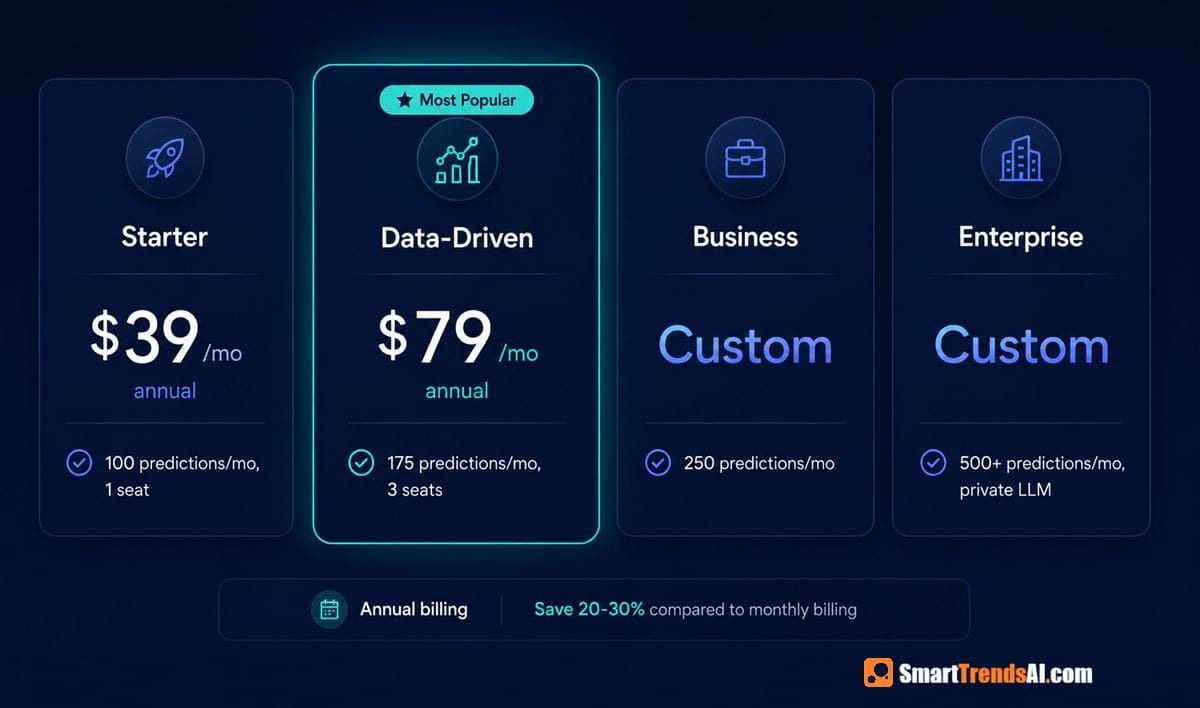
Anyword’s pricing in this Anyword review reflects its positioning: this is a tool built for marketing teams and professionals, not casual or individual writers. There is no permanent free plan — only a 7-day free trial that includes 25 performance predictions.
| Plan | Monthly price | Annual price | Performance predictions/mo | Seats | Best for |
|---|---|---|---|---|---|
| Starter | $49/mo | $39/mo (save 20%) | 50 (was) → 100 (annual) | 1 | Solo marketers, freelancers |
| Data-Driven | $99/mo | $79/mo (save 20%) | 100 (was) → 175 (annual) | 3 | Marketing teams |
| Business | Custom | Custom (save 30%) | 250 | 3+ | Teams needing custom AI models, A/B testing |
| Enterprise | Custom | Custom (save 30%) | 500+ | Custom | Large teams, private LLM, full API access |
What’s included on every paid plan: unlimited copy generation (the word count itself is unlimited — only the performance predictions are capped), the Blog Wizard with plagiarism checker, 100+ marketing templates, and the Chrome extension.
What changed for 2026: Anyword’s annual pricing now includes a meaningfully better deal than in late 2025. The Data-Driven annual plan increased its monthly performance prediction allowance from 100 to 175 — a 75% increase at the same $79/month annual price point. If you’re committing to Anyword, the annual Data-Driven plan is the strongest value in the lineup.
The performance prediction cap is the real constraint to plan around. Unlimited copy generation sounds generous, but the platform’s headline feature — the score itself — is rationed. A team running multiple campaigns across several channels can burn through 50 or even 100 predictions faster than expected. Map your monthly campaign volume to the prediction caps before choosing a plan.
The 7-day free trial includes 25 performance predictions — enough to get a feel for the platform across one or two campaigns, but it will be exhausted quickly in a real workflow. Don’t expect to fully evaluate the tool’s value within the trial period alone.
For comparison, our affiliate picks Rytr starts at $7.50/month and Scalenut starts around $20/month — both significantly cheaper entry points, though neither offers anything resembling the Predictive Performance Score.
Anyword vs Jasper AI: Which Should You Use in 2026?
This is the comparison most readers of this Anyword review are actually here for — Jasper AI is the single most-searched AI writing tool, and it’s the platform most marketers compare Anyword against before buying.
The core difference is philosophical. Jasper is built as a general-purpose AI writing platform — it covers blog posts, long-form content, brand voice, and a huge template library, with strong content quality across formats. Anyword is narrower but deeper in one specific dimension: performance prediction. Jasper will write you a better blog post out of the box. Anyword will tell you which of five ad variations is statistically more likely to convert.
| Factor | Anyword | Jasper AI |
|---|---|---|
| Predictive performance scoring | ⭐ Yes — core feature | ❌ No |
| Long-form blog content quality | Generic, brief-dependent | ⭐ Stronger out of the box |
| Short-form ad/social copy | ⭐ Best in category | Good |
| Free plan | ❌ No (7-day trial only) | ❌ No (7-day trial only) |
| Entry price (monthly) | $49/mo | $49/mo |
| Entry price (annual) | $39/mo | ~$39/mo |
| Best for | Performance marketers, ad teams | Content teams, blog-heavy brands |
Our recommendation: if your primary output is ads, email subject lines, and social captions where you can A/B test and need a data signal to choose between variants, Anyword’s Predictive Performance Score gives it a genuine edge over Jasper. If your primary output is blog content, brand storytelling, or long-form copy, Jasper is the stronger all-rounder. Some marketing teams in our research use both — Jasper for blog production, Anyword for the ad and email layer where performance data matters most.
For the full picture, see our Jasper AI Review 2026 and our three-way Jasper vs Copy.ai vs Rytr comparison.
Anyword vs Copy.ai vs ChatGPT: How Does It Compare?
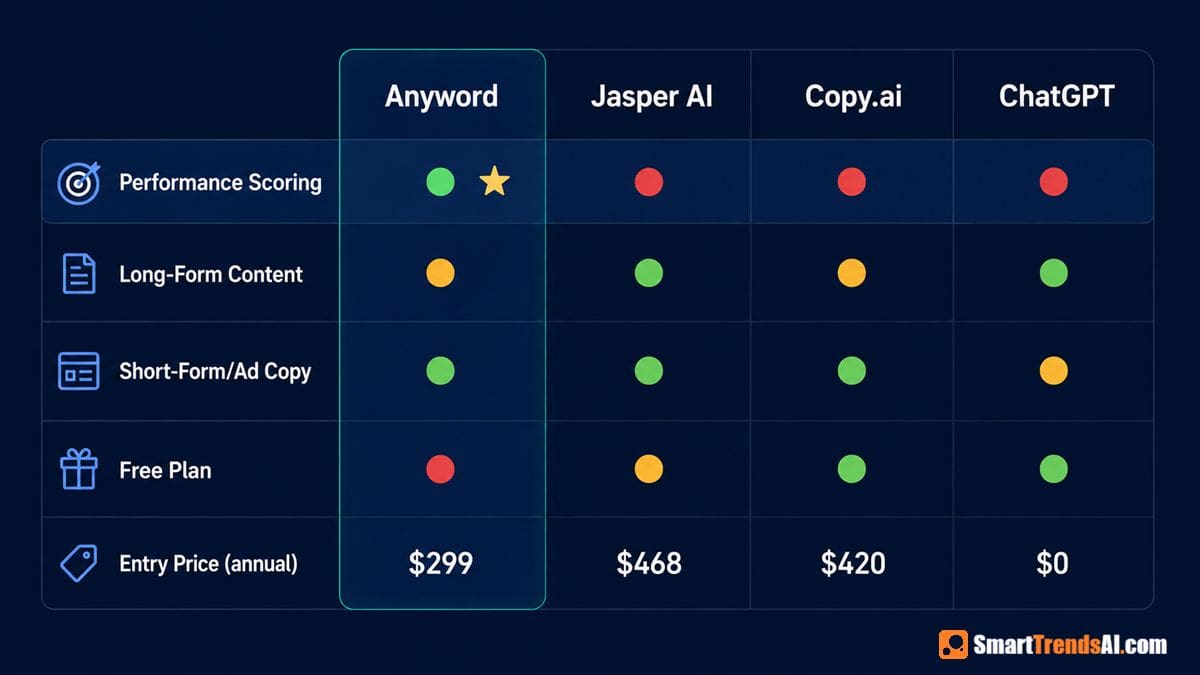
Anyword vs Copy.ai
The next comparison this Anyword review covers is Copy.ai. Copy.ai and Anyword overlap in the marketing copy space, but Copy.ai has shifted heavily toward workflow automation — chaining AI steps together for tasks like lead enrichment and outreach sequences. Anyword stays focused on copy generation plus performance scoring. If your priority is automating multi-step marketing workflows, Copy.ai’s direction is more relevant. If your priority is “which version of this ad will perform best,” Anyword’s Predictive Performance Score remains unmatched.
Anyword vs ChatGPT
ChatGPT is free (in its base form) and can write almost anything when prompted well — including ad copy. What it cannot do is what Anyword’s entire product is built around: score that copy against a dataset of real A/B-tested performance data. ChatGPT also won’t natively organize your output into channel-specific templates with brand voice consistency across a team. For a solo user prototyping ad ideas, ChatGPT is a fine starting point. For a team that needs repeatable, scored, on-brand output across channels, Anyword’s structure does meaningfully more — at a meaningfully higher price.
Anyword vs Writesonic
Writesonic positions itself as a broader AI writing suite with its own AI Article Writer, Chatsonic conversational interface, and SEO tooling. It’s a reasonable alternative if you want one platform that spans blog SEO content and marketing copy without Anyword’s narrower performance-scoring focus. Writesonic’s entry pricing is competitive with Anyword’s Starter tier, but it doesn’t offer anything equivalent to the Copy Intelligence engine.
🎨 Write Better Prompts — Get Better AI Output
Great AI marketing copy starts with great prompts. Use our free Prompt Generator for ChatGPT, Claude, Midjourney, and 13+ other AI engines.
How We Tested Anyword for This Review
Here is exactly how this Anyword review was put together — the brands, the tasks, and the tools tested alongside it:
🧪 Our Testing Process
- Duration: 4 weeks of active use, Q1-Q2 2026.
- Test brand: A fictional eco-friendly coffee mug subscription box (“Mindful Mugs”), targeting remote workers and eco-conscious consumers — and a second fictional brand, a premium dog treat subscription box, for social testing.
- Tasks tested: Facebook ad copy generation with performance scoring (5 variations), Instagram caption generation with AI image pairing, the Content Improver on deliberately bland copy, and a 1,500-word blog post via the Blog Wizard (two attempts — one with a minimal brief, one with a detailed brief).
- Comparison tools tested in parallel: Jasper AI, Copy.ai, and ChatGPT as a free-form baseline.
- Evaluation criteria: Performance score usefulness and transparency, short-form copy quality, long-form content quality and brief-dependency, editor workflow, pricing value relative to feature caps, and cross-referenced verified user review data from Trustpilot and Capterra.
Pros and Cons
Pulling together everything this Anyword review found across four weeks of testing, here is the balanced picture:
✅ What Works Well
- Predictive Performance Score is a genuine differentiator. No other AI writing tool we’ve tested offers a comparable data-backed scoring system benchmarked against real A/B-tested copy.
- Verified results from real users: 33% faster ad creation, 23% more clicks at the same cost, and email CTR jumping from 2.5% to 8% are documented case studies, not marketing claims alone.
- Excellent at short-form, conversion-focused copy — ads, social captions, and email subject lines are where Anyword consistently performs best.
- Built-in plagiarism checker on every paid plan, included with the Blog Wizard — a feature several competitors charge extra for or omit entirely.
- Brand Voice and Brand Rules keep output consistent across a team — important for agencies managing multiple client accounts.
- Exceptionally high user satisfaction: 4.8/5 across 5,600+ combined reviews on Trustpilot and Capterra.
- Template library covers every major channel — Instagram, Facebook, X, LinkedIn, Pinterest, YouTube, email, and more, each with scored variations.
❌ Real Limitations
- No permanent free plan. Just a 7-day trial with 25 performance predictions — easy to exhaust before you’ve fully evaluated the tool.
- Long-form blog content is the weak point. Output is generic without a detailed brief, and the editor cannot generate new sections — only improve existing text.
- Performance predictions are capped even on paid plans. Unlimited copy generation sounds great, but the headline feature itself is rationed.
- Pricing is steep for solo users and small teams — a recurring complaint across both Trustpilot and Capterra reviews.
- Scores aren’t comparable across formats or channels — an 81 on a Facebook ad and a 66 on an Instagram caption reflect different baselines, which can confuse new users.
- Credits are consumed for rephrased or deleted text you don’t end up using — a friction point several reviewers flagged.
- Out-of-the-box integrations (Google Ads, HubSpot) require the Data-Driven plan or higher — not available on Starter.
Who Should Actually Use Anyword?
Based on four weeks of testing for this Anyword review across different use cases, here is our honest recommendation by role:
| Role | Recommendation | Why |
|---|---|---|
| Performance/paid social marketer | ✅ Use Anyword | The Predictive Performance Score directly addresses the question “will this ad work?” before spending budget. |
| Email marketer | ✅ Use Anyword | Verified case study shows email CTR rising from 2.5% to 8% — subject line and body copy scoring is a strong fit. |
| Marketing agency (multi-client) | ✅ Use Anyword Business/Enterprise | Brand Voice + Brand Rules keep output on-brand across multiple client accounts. |
| Content/blog-focused marketer | ⚠️ Use Jasper or Scalenut instead | Anyword’s Blog Wizard is brief-dependent and can’t generate new sections in the editor. |
| Solo blogger or freelance writer | ❌ Use Rytr instead | Rytr starts at $7.50/month with a generous free tier — Anyword’s pricing isn’t built for individuals. |
| Student or academic writer | ❌ Use Wordtune or QuillBot instead | Anyword has no academic or rewriting-focused workflow, and no free plan. |
| Enterprise team needing private LLM/API | ✅ Use Anyword Enterprise | Full API access, private LLM, custom integrations, and dedicated support are built for this scale. |
The pattern across every test we ran: Anyword earns its price when the output is short, the goal is conversion, and you can act on the performance score. It struggles to justify its price when the output is long-form content that needs depth and originality a scoring algorithm can’t measure.
Best Anyword Alternatives in 2026
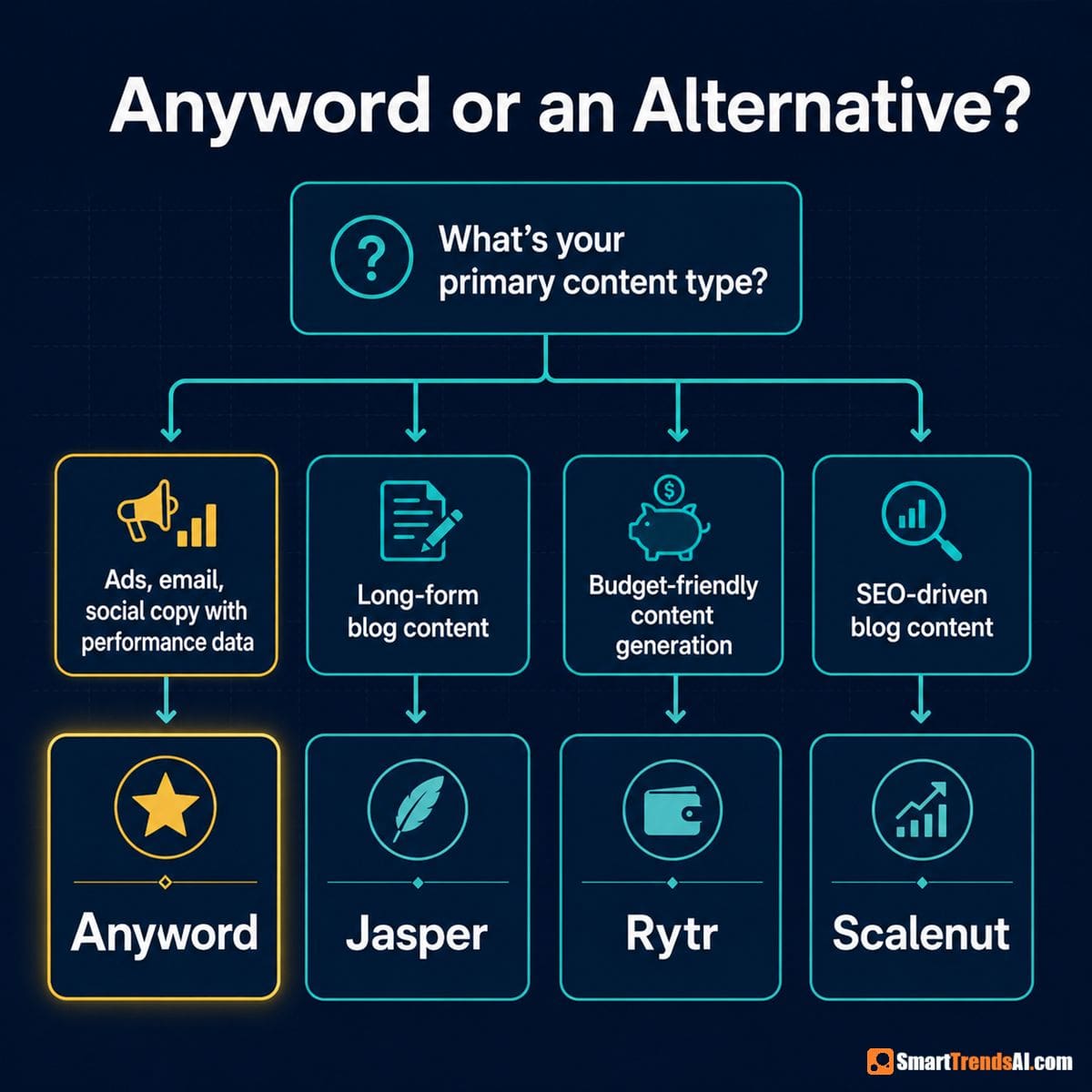
Whether you need something cheaper, something stronger for long-form content, or something with a free tier, here are the strongest alternatives this Anyword review identified:
| Tool | Best for | Entry price | Key advantage over Anyword |
|---|---|---|---|
| Jasper AI | Long-form content, brand voice at scale | ~$39/mo annual | Stronger blog and long-form output out of the box |
| Rytr | Budget-conscious solo creators | $7.50/mo (generous free tier) | Free tier + dramatically lower entry price |
| Scalenut | SEO-driven blog content | ~$20/mo | Built-in SEO research and SERP optimization |
| Copy.ai | Workflow automation around copy | Free tier available | Broader workflow/automation focus, free entry point |
| ChatGPT | Free-form prototyping, any budget | Free | Zero cost, maximum flexibility — no scoring |
For a deeper three-way comparison of the top long-form alternatives, see Jasper vs Copy.ai vs Rytr 2026 or Jasper vs Copy.ai vs ChatGPT 2026.
📚 Explore More AI Tool Categories
Comprehensive guides across every AI category — writing, voice, video, image generation, and productivity.
Frequently Asked Questions About Anyword
What is Anyword used for?
Anyword is used for generating and scoring marketing copy — Facebook and Instagram ads, email subject lines and body copy, social media captions across LinkedIn, X, Pinterest, and YouTube, landing page copy, and blog content. Its core differentiator is the Predictive Performance Score, which forecasts how well a piece of copy will perform against a dataset of real A/B-tested marketing copy before you publish or spend ad budget on it.
Is Anyword AI free?
No. Anyword does not offer a permanent free plan. It offers a 7-day free trial that includes 25 performance predictions, which is enough to test the platform across one or two campaigns but will be exhausted quickly in real use. Paid plans start at $49/month (monthly billing) or $39/month (annual billing) for the Starter plan. If you need a free AI writing tool, Rytr and Copy.ai both offer functional free tiers.
Is Anyword worth the money?
For performance marketers, ad teams, and email marketers — yes. Verified case studies show 33% faster ad creation, 23% more clicks at the same cost, and email click-through rates rising from 2.5% to 8%. For these use cases, the Predictive Performance Score pays for itself quickly through better-performing campaigns. A consistent theme across this Anyword review: for solo bloggers, students, or anyone whose primary need is long-form content, Anyword is harder to justify — the pricing reflects a B2B marketing tool, and the long-form output quality doesn’t match dedicated content tools like Jasper or Scalenut.
How much does Anyword cost in 2026?
Anyword’s 2026 pricing: Starter is $49/month (monthly) or $39/month (annual, 100 performance predictions/month, 1 seat). Data-Driven is $99/month (monthly) or $79/month (annual, 175 performance predictions/month, 3 seats). Business and Enterprise are custom-priced with 250 and 500+ monthly predictions respectively, plus custom AI models, A/B testing, and — on Enterprise — full API access and a private LLM. All paid plans include unlimited copy generation; only the performance predictions are capped.
How accurate is Anyword AI’s performance score?
Anyword’s Predictive Performance Score is benchmarked against a dataset of tens of thousands of real A/B-tested ads — in our test, one score was calculated against more than 22,560 similar texts. It’s important to understand what the score is and isn’t: it’s a probability-weighted prediction based on historical patterns, not a guarantee of future results. In our testing, the score’s relative ranking — which of five ad variations was strongest — tracked with our own qualitative judgment in most cases, and the documented user case studies (23% more clicks, CTR rising from 2.5% to 8%) suggest the underlying signal has real predictive value when acted on consistently.
What’s the best AI writing tool for marketers in 2026?
Based on SmartTrendsAI’s testing across this category: for performance-driven, short-form marketing copy where you need a data signal to choose between variations, Anyword is the best AI writing tool — its Predictive Performance Score has no direct equivalent among Jasper, Copy.ai, or general-purpose tools like ChatGPT. For long-form content and blog production, Jasper or Scalenut are stronger picks. Many marketing teams use a combination: Jasper or Scalenut for blog production, Anyword for the ad and email layer.
What are the best alternatives to Anyword?
The best Anyword alternatives depend on your priority. For long-form content quality, Jasper AI is the closest competitor with stronger blog output. For budget-conscious solo creators, Rytr starts at $7.50/month with a free tier. For SEO-focused blog content, Scalenut bundles keyword research with content generation. For workflow automation around copy, Copy.ai has shifted toward chaining AI steps for marketing tasks. None of these alternatives offer Anyword’s Predictive Performance Score — that remains Anyword’s unique selling point.
Does Anyword have a Chrome extension?
Yes. Anyword’s Chrome extension is available on every paid plan, including Starter. It allows you to generate and improve copy directly within other web-based tools without switching back to the Anyword dashboard.
Can Anyword check for plagiarism?
Yes — a plagiarism checker is built into the Blog Wizard on every paid plan. This is notable because several competitors in this category, including Wordtune, do not offer a built-in plagiarism checker at all.
🏆 Final Verdict: Is Anyword Worth It in 2026?
This Anyword review concludes with SmartTrendsAI’s testing of 8+ AI writing and copywriting tools putting Anyword at 7.8/10. The Predictive Performance Score is a genuinely differentiated feature backed by verified user results — 33% faster ad creation, 23% more clicks at the same cost, and email CTR climbing from 2.5% to 8%. For its target audience of performance marketers, ad teams, and email marketers, that’s a strong return on a $39-79/month investment.
🥇 Best At
Predictive performance scoring for short-form marketing copy — ads, email subject lines, and social captions, benchmarked against tens of thousands of real A/B-tested texts.
💼 Best For
Performance marketers, paid social and email teams, and agencies managing multiple brand voices who need data behind copy decisions.
⚠️ Caveat
Performance predictions are capped even on paid plans, and there’s no permanent free tier — budget for the prediction limits, not just the subscription price.


















What Do Real Users Say About Anyword?
One of the most striking things this Anyword review found is how consistently positive the independent review platforms are. Here’s the breakdown:
A 4.8/5 across over 5,600 combined reviews is among the highest ratings of any AI writing tool we’ve reviewed — notably higher than Grammarly (3.3/5 on Trustpilot) and in line with QuillBot‘s strong scores.
💬 What real users report (verified case studies)
The most common complaint pattern across both platforms is consistent with what this Anyword review found in testing: pricing feels steep for solo users and small teams, especially given the capped performance predictions. A handful of reviews also mention occasional UI friction (unclear where to click for certain functions) and that credits are consumed even for rephrased or deleted text you don’t end up using.