
DeepSeek AI Review 2026: Quick Verdict
- 🏆 Best At: Price-to-performance ratio and API economics — DeepSeek V4-Flash at $0.14/million input tokens is the cheapest frontier-tier model available anywhere in 2026.
- 🆓 Free Tier: Yes — the DeepSeek chatbot is completely free with no premium plan required. Unlimited usage with dynamic rate limiting during peak periods.
- 💰 API Pricing: V4-Flash: $0.14/M input, $0.28/M output; V4-Pro: $0.435/M input, $0.87/M output. Both with 1M token context window and 99% cache discount.
- ⚠️ Critical Warning: DeepSeek collects extensive personal data — including chat history, device data, and location — and its privacy policy raises serious concerns about data sharing with Beijing. The US House Select Committee on the CCP called it “the CCP’s latest tool for spying, stealing, and subverting US export control restrictions.”
- ⭐ SmartTrendsAI Rating: 6.5/10 — outstanding API value for developers, but the privacy situation is a hard blocker for most personal and business users.
- 💡 Bottom Line: DeepSeek AI is the best-priced AI model in 2026. It is not the safest, nor the most capable. If privacy matters to you, use ChatGPT or Claude instead.
🧪 Key Takeaways
- Tested: DeepSeek V3, DeepSeek R1, and the new DeepSeek V4-Pro and V4-Flash models across web search, document analysis, creative writing, and complex reasoning in Q1-Q2 2026.
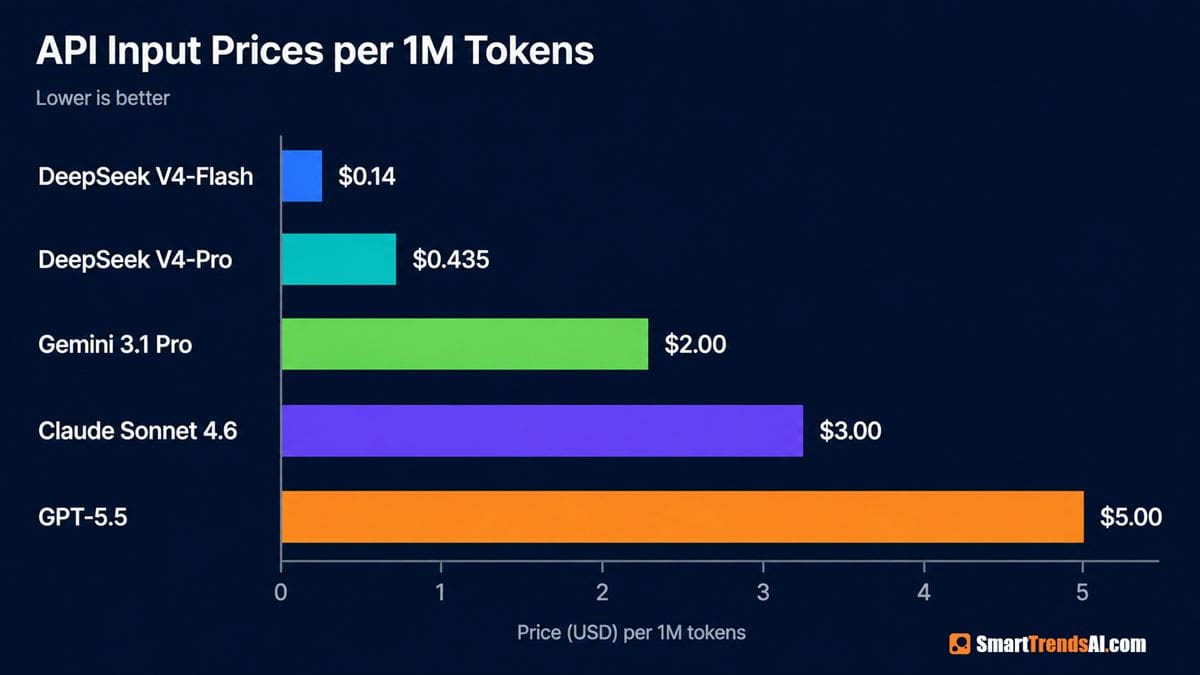
- Winner for API cost: DeepSeek — V4-Flash at $0.14/M input tokens is 35× cheaper than GPT-5.5 ($5.00/M) and 21× cheaper than Claude Sonnet 4.6 ($3.00/M).
- Winner for open-weight models: DeepSeek V4-Pro — 1.6 trillion parameters, MIT-licensed, 1M context window, highest LiveCodeBench score (93.5) of any model tested.
- Avoid for: Anything privacy-sensitive. DeepSeek’s data collection is extensive and verified reports link it to Chinese government data access.
- Avoid for: Long-form coding on production codebases — Claude Opus 4.7 and GPT-5.5 consistently outperform V4 on SWE-Bench Pro (64.3% vs 55%).
- Missing features: No image generation, no voice mode, no deep research mode, no persistent memory — the chatbot is significantly more limited than ChatGPT or Gemini.
SmartTrendsAI is an independent platform that tests, compares, and reviews AI tools for marketing, content creation, SEO, and productivity. For this DeepSeek AI review and testing process, we evaluated DeepSeek V3, R1, V4-Flash, and V4-Pro across the chatbot interface and API across web search, document processing, creative writing, complex reasoning, and code generation tasks in Q1-Q2 2026, cross-referenced against benchmark data, US government evaluations, and verified third-party developer testing.
📑 Table of Contents
- What Is DeepSeek AI and What Does It Do?
- What Is DeepSeek V4? (The 2026 Update)
- What Features Does DeepSeek AI Have?
- How Much Does DeepSeek Cost?
- How Does DeepSeek Perform in Testing?
- Is DeepSeek Better Than ChatGPT?
- Is DeepSeek Safe to Use? (Privacy and Security)
- What Are the Pros and Cons of DeepSeek AI?
- Who Should Use DeepSeek AI?
- Frequently Asked Questions
- Final Verdict
What Is DeepSeek AI and What Does It Do?
DeepSeek AI is both a Chinese AI research company and a family of AI models and chatbot products built by that company. Founded in 2023 as a subsidiary of Chinese hedge fund High-Flyer Capital Management, DeepSeek shocked the global AI industry in early 2025 when it released its V3 model — claiming it trained a frontier-tier AI for just $5.576 million and 3.7 days of GPU compute, a fraction of what US competitors spend. That claim sent Nvidia’s stock down roughly 17% in a single day and triggered a worldwide re-evaluation of AI development economics. The DeepSeek-driven selloff erased close to $600 billion from Nvidia’s market capitalization in that single session — the largest one-day market-cap loss for any company in US stock market history at the time — and dragged the Nasdaq down around 3%. For investors watching NVDA stock, the episode became a case study in how quickly a cheaper Chinese AI model could reshape assumptions about the billions being poured into AI infrastructure. It is the moment DeepSeek went from an obscure research lab to a household name.
The DeepSeek AI chatbot is free to use at deepseek.com — you can ask it questions, search the web, analyze documents, write code, and generate creative content. It uses two primary models: DeepSeek V3 (the default conversational model) and DeepSeek R1 (a reasoning model for complex tasks, accessible via the “DeepThink” toggle). In April 2026, DeepSeek released V4, their most capable and efficient model to date.
What makes DeepSeek genuinely different from ChatGPT, Claude, or Gemini is the economics. As a chatbot, it is free with no premium tier. As an API, its V4-Flash model is the cheapest frontier-model API in the world — by a significant margin. For developers and researchers running high-volume workloads, this is the single most important thing to know about DeepSeek.
What also makes it different — and what you need to know before using it — is the privacy and geopolitical situation. This review covers both the performance case and the privacy case honestly.
🚀 Looking for a Safer AI Writing Alternative?
Start with our top-rated affiliate partners — both offer free plans to test before committing.
What Is DeepSeek V4? (The April 2026 Update)
DeepSeek V4 dropped on April 24, 2026 — and it’s a meaningful upgrade rather than an incremental update. V4 is actually two models, and both are open-weight and MIT-licensed:
| Model | Parameters | Active per token | Context | Input price/1M | Output price/1M |
|---|---|---|---|---|---|
| V4-Flash | 284B | 13B | 1M tokens | $0.14 (cache miss) / $0.0028 (hit) | $0.28 |
| V4-Pro | 1.6T ⭐ | 49B | 1M tokens | $0.435 (cache miss) / $0.003625 (hit) | $0.87 |
DeepSeek AI V4-Pro at 1.6 trillion parameters is the largest open-weights model anyone has shipped to date — ahead of Kimi K2.6 and GLM-5.1. The architecture uses a hybrid attention system (CSA + HCA) that consumes roughly 27% of the per-token compute of V3 at 1M context, plus it was trained natively in FP4 rather than quantised afterwards.
Three meaningful changes from the previous generation: first, V4 has three reasoning modes (Non-Think, Think High, Think Max) instead of the old binary chat/reasoner split. Second, tool calls now work inside thinking mode — something R1 couldn’t do. Third, the cache discount is extraordinary: cache hits are priced at just $0.0028/M (V4-Flash) and $0.003625/M (V4-Pro) — essentially 99% off the cache-miss price, making agentic workflows that resend large system prompts dramatically cheaper.
What V4 is missing: no multimodal input. If you need vision capabilities, you need Gemini or GPT-5.5 instead.
One important note on benchmark context: The US government’s CAISI evaluation at NIST ran V4-Pro on held-out, non-public benchmarks and placed it closer to GPT-5 (roughly 8 months old at time of evaluation) than to current frontier models like GPT-5.4 or Claude Opus 4.6. The headline benchmark equivalence should be treated as an upper bound — there’s likely some public-benchmark overfitting. V4 is excellent, but DeepSeek themselves acknowledge in their technical report that V4 trails the absolute frontier by 3-6 months.
What Features Does DeepSeek AI Have?
Web Search
DeepSeek can search the web when answering prompts — you can toggle this manually via the search button in the interface. Web search is competent for current events, answering questions that require up-to-date information, and general research. The limitation versus ChatGPT or Gemini: DeepSeek doesn’t highlight which part of a response each source citation supports, making fact-checking harder. Source indicators show as footnote numbers rather than named references, so you can’t see at a glance where a specific claim comes from.
DeepThink Mode (Complex Reasoning)
The DeepThink button switches from the default V3/V4 conversational model to the R1/V4 reasoning model, similar to how ChatGPT o3 works or Claude’s extended thinking mode. DeepThink is notably slower than standard mode — processing complex prompts can take several minutes, particularly when image inputs are involved. For straightforward questions, the speed trade-off usually isn’t worth it; for genuinely complex reasoning tasks, it is.
Document Analysis
DeepSeek accepts file uploads for document analysis — up to 100 files with a maximum total size of 50MB. In testing, it correctly answered questions about technical manuals and documents, though it occasionally struggles near the upload limits. One idiosyncrasy worth knowing: even within the stated size limits, DeepSeek may throw an error message asking for smaller files. The workaround — uploading files individually — shouldn’t be necessary, and it’s a rougher experience than ChatGPT or Gemini provide for the same task.
Coding
DeepSeek has dedicated coding-focused models, though these aren’t accessible through the main chatbot. Via the API, V4-Pro scored 93.5 on LiveCodeBench — the highest reported score on that benchmark. However, SWE-Bench Pro (the harder real-world coding evaluation) tells a more nuanced story: V4-Pro lands around 55%, behind Claude Opus 4.7 at 64.3%. For straightforward coding tasks, DeepSeek is capable. For production codebase audits where missing a real bug is expensive, Claude or GPT-5.5 are safer choices.
Creative Writing
DeepSeek V3 handles creative writing reasonably well — in testing, its poem output was detailed and technically competent. The notable concern is the similarity to ChatGPT output: DeepSeek has faced persistent allegations (not yet definitively proven) that it trained on OpenAI’s outputs without authorization, and in side-by-side creative comparisons, the stylistic proximity between V3 and GPT-4o is notable.
What DeepSeek Cannot Do
This is a significant list. The chatbot lacks: image generation, video generation, image recognition, voice chat (web), deep research mode, persistent memory across conversations, integrations with other apps, a browser extension (only unofficial ones exist), and any customization options for your instance. If you compare this feature set against ChatGPT (which has all of the above) or Gemini (which has most of them), DeepSeek’s chatbot is a significantly stripped-down product despite sharing competitive model quality at the API level.
Platform Availability
DeepSeek is accessible via the web and through iOS and Android mobile apps. It does not have an official browser extension. DeepSeek’s models are also available through third-party services — for example, Perplexity offers deep research using DeepSeek’s R1 model, and Hugging Face hosts the Janus-Pro image generation model. But via DeepSeek’s own apps and website, the feature set is limited to what’s described above.
📚 Explore More AI Tool Categories
Comprehensive guides across every AI category — writing, voice, video, image generation, and productivity.
How Much Does DeepSeek Cost?
DeepSeek AI’s pricing is its most compelling feature by a wide margin. Here’s the complete 2026 pricing picture:
Chatbot (Consumer Use)
DeepSeek is completely free as a chatbot — no subscription, no premium tier, no usage caps under normal conditions. Dynamic rate limiting applies during peak server load, which can slow responses. In a market where ChatGPT, Claude, and Gemini all start at roughly $20/month for their premium tiers, this is genuinely unusual.
API Pricing (Developer Use)
| Model | Input (cache miss) | Input (cache hit) | Output | Context | Max output |
|---|---|---|---|---|---|
| DeepSeek V4-Flash | $0.14/M ⭐ | $0.0028/M | $0.28/M | 1M tokens | 384K tokens |
| DeepSeek V4-Pro | $0.435/M | $0.003625/M | $0.87/M | 1M tokens | 384K tokens |
How Does That Compare to Alternatives?
| Model | Input price/1M tokens | Output price/1M tokens | Context |
|---|---|---|---|
| DeepSeek V4-Flash | $0.14 ⭐ | $0.28 | 1M |
| DeepSeek V4-Pro | $0.435 | $0.87 | 1M |
| Claude Sonnet 4.6 | $3.00 | $15.00 | 200K |
| Claude Opus 4.7 | $5.00 | $25.00 | 200K |
| GPT-5.5 | $5.00 | $30.00 | 128K |
| Gemini 3.1 Pro | ~$2.00 | ~$12.00 | 1M |
To make the V4-Flash pricing concrete: one developer ran a full layer-by-layer audit of a TypeScript API endpoint (including DTOs, service layer, and database models) for $0.09 on V4-Pro. The same audit on Claude Opus 4.7 would have cost $9-$13 — roughly a 100× cost ratio. For high-volume agentic workflows running 24/7, that difference is the deciding factor.
One important caveat: DeepSeek V4 is verbose — in testing, V4-Pro burned 4-5× the median output tokens compared to peer models. The headline per-token input price is real, but the actual bill will be higher than the sticker suggests because output volume is elevated. It’s still dramatically cheaper than alternatives, just less dramatically so than a raw input-price comparison implies.
API deprecation note: The legacy model names `deepseek-chat` and `deepseek-reasoner` are deprecated as of July 24, 2026. They now correspond to V4-Flash non-thinking and thinking modes respectively — update any existing integrations before that date.
📘 Free Download: AI Prompt Mastery Guide
Master prompt engineering across all AI platforms — writing, image, video, and voice. Plus weekly tips delivered to your inbox.
How Does DeepSeek AI Perform in Real Testing?
Benchmark Performance
| Benchmark | DeepSeek V4-Pro | Claude Opus 4.7 | GPT-5.5 | What it measures |
|---|---|---|---|---|
| SWE-Bench Verified | 80.6% | 80.8% | ~80% | Software engineering (verified tasks) |
| SWE-Bench Pro | ~55% | 64.3% ⭐ | ~62% | Software engineering (harder, real-world) |
| LiveCodeBench | 93.5 ⭐ | — | — | Live competitive coding |
| AA Intelligence Index | 52 | — | — | Composite AI capability |
What Testing Found
Web search and Q&A: Competitive with ChatGPT and Gemini for current-events queries. Slower response generation in most cases, with sourcing that’s less transparent (footnote numbers vs named references).
Codebase auditing: V4-Pro over-flags issues — it identifies real bugs but also flags non-problems (style preferences, suggestions that would make code worse). It missed issues that both GPT-5.5 and Claude caught on the first pass. For everyday coding assistance, DeepSeek is adequate. For production codebase audits where missing a real bug is expensive, Claude Opus 4.7 is the safer choice.
Logic and reasoning: In complex reasoning tests (questions from Harvard, MIT, and Stanford across computer science, mathematics, and physics), DeepSeek returned the most incorrect answers of the models tested — more errors than both ChatGPT and Gemini. DeepThink mode also took the longest by a significant margin, with multi-minute delays on complex questions.
Creative writing: Capable, technically competent, but stylistically similar to ChatGPT output — which raises questions about training data sourcing that haven’t been fully resolved.
Hallucination rate: A specific concern with V4: the AA-Omniscience evaluation measured a 94% hallucination rate when DeepSeek is uncertain. In plain English — when V4 doesn’t know something, it usually doesn’t tell you; it just answers anyway. For RAG workflows, research tasks, and anything where factual accuracy is critical, this needs to be actively managed by grounding prompts explicitly.
Speed
DeepSeek’s responses are generally slower than ChatGPT or Gemini for comparable tasks. Server issues and failed responses occurred during testing — the infrastructure reliability is not at the same level as established US competitors. DeepSeek themselves acknowledge that peak-hours traffic causes dynamic rate limiting across the free chatbot.
Is DeepSeek Better Than ChatGPT?
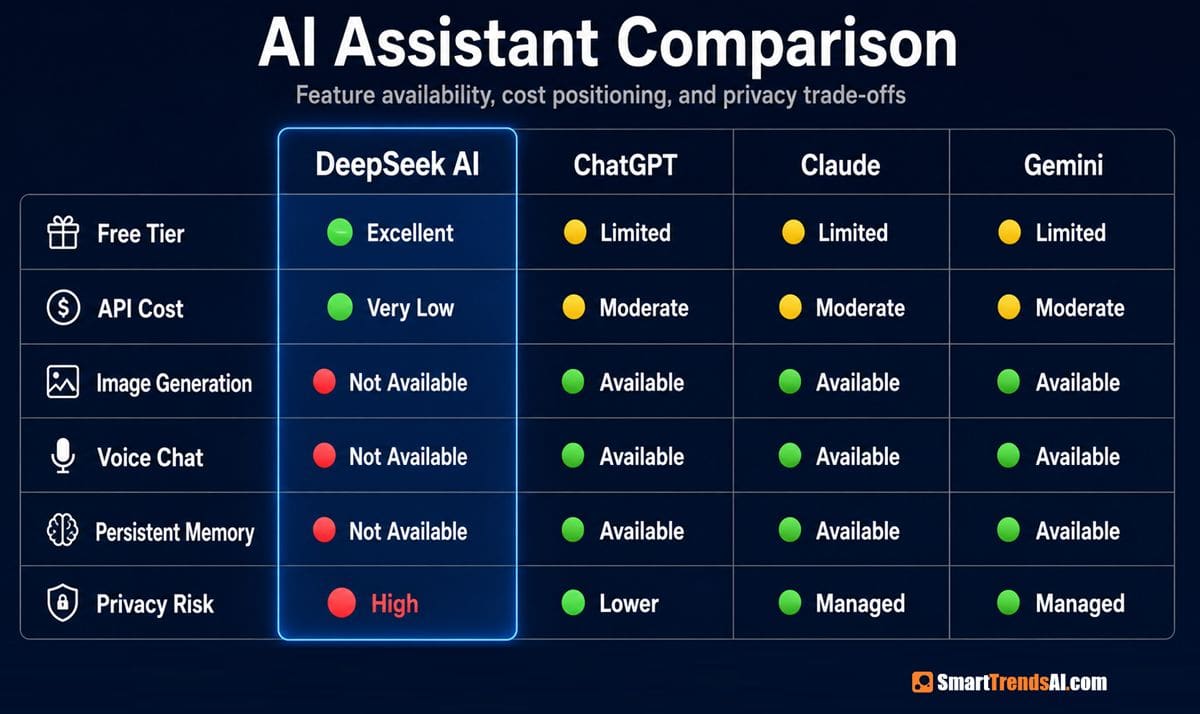
| Factor | DeepSeek AI | ChatGPT | Claude | Gemini |
|---|---|---|---|---|
| Free chatbot | ✅ Yes (unlimited) | ✅ Yes (limited) | ✅ Yes (limited) | ✅ Yes |
| API cost (input) | ⭐ $0.14/M (V4-Flash) | $5.00/M (GPT-5.5) | $3.00/M (Sonnet) | ~$2.00/M (Gemini 3.1 Pro) |
| Image generation | ❌ No | ✅ Yes (DALL-E) | ❌ No | ✅ Yes |
| Voice chat | ❌ No (web) | ✅ Yes | ✅ Yes | ✅ Yes |
| Persistent memory | ❌ No | ✅ Yes | ✅ Yes (Projects) | ✅ Yes |
| Deep research mode | ❌ No | ✅ Yes | ✅ Yes | ✅ Yes |
| Source transparency | ⚠️ Basic (footnotes) | ✅ Inline citations | ✅ Inline citations | ✅ Inline citations |
| Privacy risk | 🚨 High | ✅ Lower | ✅ Lower | ✅ Lower |
| Open weights | ✅ Yes (MIT) | ❌ No | ❌ No | ❌ No |
| 1M context window | ✅ Yes (V4) | ❌ 128K | ❌ 200K | ✅ Yes |
The honest answer: For most consumer use cases — especially anything involving sensitive data, business information, or personal details — ChatGPT is the better choice. It has a richer feature set (image generation, voice, memory, deep research) and significantly lower privacy risk.
For developers running high-volume, cost-sensitive API workloads where privacy risk is manageable and the data is non-sensitive — DeepSeek V4-Flash is the stronger choice on economics. That’s a real and valid use case. It’s just a narrower one than the “best AI chatbot” framing suggests.
See our full three-way comparison: ChatGPT vs Claude vs Gemini 2026.
Is DeepSeek Safe to Use? (Privacy and Security — Read This First)
This is the section that matters most if you’re evaluating DeepSeek for personal or professional use. The short answer: DeepSeek is not safe for sensitive data, and its privacy situation is genuinely serious.
What DeepSeek Collects
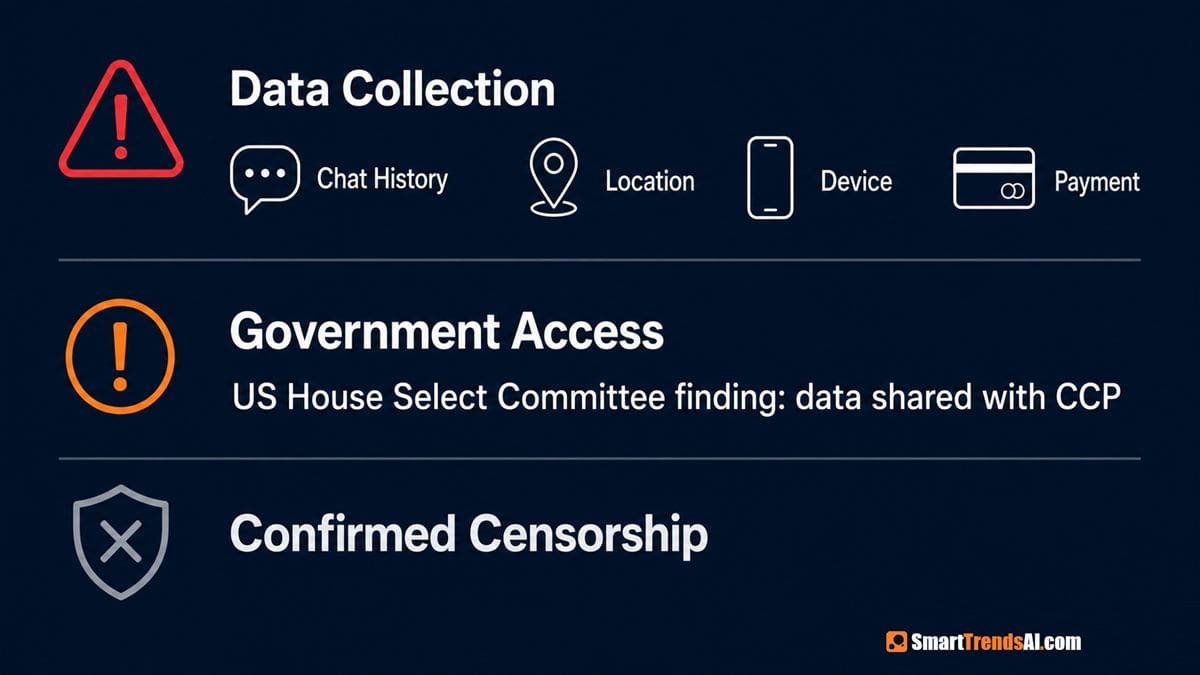
According to its own privacy policy, DeepSeek collects: account data, chat history, cookie data, device data, log data, location data, network data, and payment data. It uses this to train and improve its models by default — you can opt out of model training in settings, but this is off-by-default. The scope of collection is broadly comparable to US AI companies.
The Geopolitical Problem
What is not comparable is where that data goes. The US House Select Committee on the Chinese Communist Party published a report titled “DeepSeek Unmasked” finding that DeepSeek:
- Funnels Americans’ data to the Chinese government
- Manipulates its results to align with CCP propaganda — an independent NewsGuard audit found the chatbot advances Chinese state positions on news topics (confirmed in our own testing: ask about the 1989 Tiananmen Square massacre and DeepSeek tells you it’s “beyond its scope”)
- Likely stole from US AI models in its training process
The US government has responded: the Trump administration considered an outright ban, and proposed legislation would ban DeepSeek on government-issued devices. Texas Governor Greg Abbott banned it on government devices. In early 2026, DeepSeek suffered a major data leak exposing over one million sensitive records.
What This Means in Practice
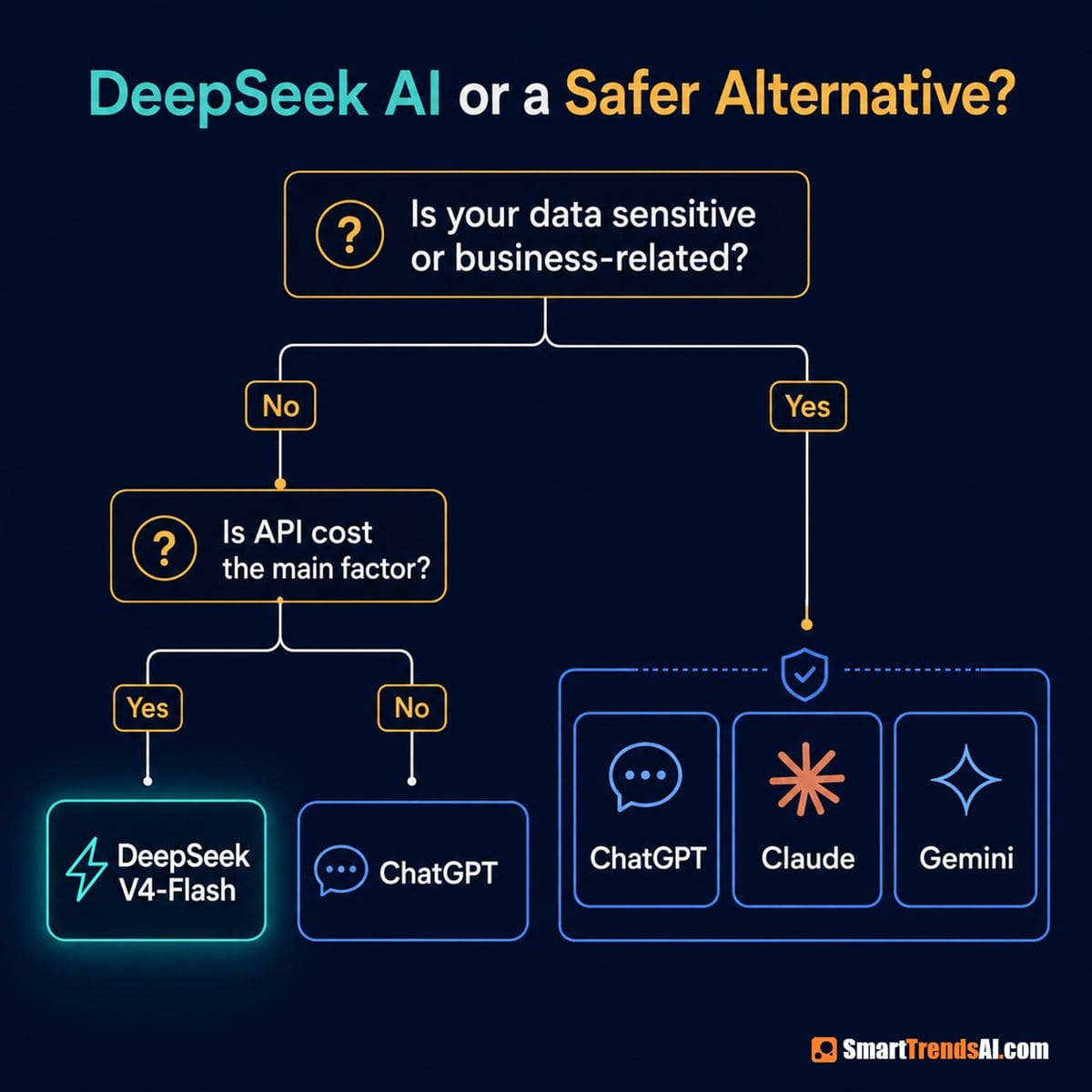
For a developer using DeepSeek’s API to process non-sensitive, public-facing content — marketing copy, general code review, anonymized data — the privacy risk is manageable and must be weighed against the significant cost advantage. Many developers make this calculation knowingly.
For anyone using DeepSeek for personal conversations, business data, healthcare-adjacent queries, confidential documents, or any use case where a foreign government having access to your inputs would be problematic — the risk is not worth taking. Use ChatGPT, Claude, or Gemini instead.
⚠️ Confirmed censorship test
Ask DeepSeek about the 1989 Tiananmen Square protests and massacre. The response: “I’m sorry, this topic is beyond my current scope.” This is not a bug — it reflects deliberate alignment with Chinese Communist Party content policies. The chatbot openly refuses to discuss verified historical events that contradict CCP narratives. When evaluating an AI tool for research or factual accuracy, this is a significant limitation beyond the privacy concerns.
What Are the Pros and Cons of DeepSeek AI?
✅ What DeepSeek Does Well
- Cheapest API pricing in the market: V4-Flash at $0.14/M input tokens is 35× cheaper than GPT-5.5. For high-volume, cost-sensitive API workloads, this is a genuine and significant advantage.
- Completely free chatbot: No subscription required, no usage cap (beyond dynamic rate limiting). In a market of $20/month premium plans, entirely free is notable.
- Open-weight and MIT-licensed: V4-Pro is the largest open-weights model ever shipped (1.6T parameters). For developers who need on-premises deployment, no cloud dependency, or the ability to fine-tune, this is the most capable open model available.
- 1M token context window: Both V4 models include a 1M token context window by default — larger than Claude (200K) and ChatGPT (128K), matching Gemini.
- 99% cache discount: For agentic workflows that resend large system prompts repeatedly, the cache-hit price ($0.0028/M) makes DeepSeek extraordinarily cheap.
- Competitive on standard benchmarks: V4-Pro’s SWE-Bench Verified score (80.6%) is essentially tied with Claude Opus 4.7 (80.8%), and its LiveCodeBench score (93.5) leads all tested models.
❌ DeepSeek’s Real Limitations
- Serious privacy risk: US government reports confirm data sharing with the Chinese government. Not appropriate for sensitive data, business information, or personal use where privacy matters.
- Confirmed political censorship: DeepSeek refuses to discuss Tiananmen Square and other topics that conflict with CCP narratives. Undermines utility as a factual research tool.
- No image generation, voice, or deep research: The chatbot lacks major features that ChatGPT, Claude, and Gemini all offer.
- No persistent memory: Each conversation starts fresh. You can’t build a working context across sessions the way you can with ChatGPT or Claude.
- High hallucination rate when uncertain: 94% hallucination rate on AA-Omniscience when V4 is uncertain — it rarely says “I don’t know.” Requires explicit grounding for research or factual tasks.
- Slower responses: DeepSeek is consistently slower than ChatGPT or Gemini, with server reliability issues and occasional complete failures during testing.
- Verbose output inflates real cost: V4-Pro burns 4-5× more output tokens than peer models, meaning the effective API cost is higher than the input-price headline suggests.
- Data leak history: Over one million sensitive records were exposed in a 2026 data breach — a concrete real-world consequence of the data collection practices.
Who Should Use DeepSeek AI in 2026?
| User type | Recommendation | Why |
|---|---|---|
| Developer running high-volume API workloads (non-sensitive data) | ✅ Yes — V4-Flash | 35× cheaper than GPT-5.5; 99% cache discount for agentic workflows; MIT-licensed for on-prem. |
| Researcher needing open-weight model for fine-tuning | ✅ Yes — V4-Pro | Largest open-weights model ever released; MIT license; 1M context window. |
| Casual user who wants a free chatbot with no subscription | ⚠️ Use with caution | It’s free and competent, but the privacy situation means you should not share personal, business, or sensitive information with it. |
| Business professional or enterprise user | ❌ Avoid | Data collection and verified state-access findings make DeepSeek inappropriate for business data. Use ChatGPT Team or Claude for Work. |
| Student or academic researcher needing accurate citations | ❌ Avoid | High hallucination rate when uncertain, confirmed topic censorship, and no deep research mode. Use Perplexity or ChatGPT instead. |
| Content creator needing image generation or voice | ❌ Avoid | DeepSeek offers neither. ChatGPT (DALL-E) or Gemini are the right tools for this. |
| Anyone in a government or regulated industry | 🚨 Do not use | Already banned from US government devices; likely non-compliant with regulatory requirements for most regulated industries. |
🎨 Write Better Prompts — Get Better AI Output
Great AI content starts with great prompts. Use our free Prompt Generator for ChatGPT, Claude, Midjourney, and 13+ other AI engines.
Frequently Asked Questions About DeepSeek AI
Is DeepSeek AI Better Than ChatGPT in 2026?
On a pure capability benchmark comparison (SWE-Bench Verified), DeepSeek V4-Pro is essentially tied with top ChatGPT models. On the harder, more realistic coding benchmark (SWE-Bench Pro), ChatGPT leads. On API pricing, DeepSeek wins by a very large margin. On features (image generation, voice, memory, deep research), ChatGPT wins decisively. On privacy, ChatGPT is significantly safer. For most users, ChatGPT is the better all-round choice. For developers running cost-sensitive, non-sensitive API workloads, DeepSeek V4-Flash is the better value choice.
Is DeepSeek AI safe to use?
For non-sensitive, non-personal content — possibly. For anything involving personal information, business data, confidential documents, or anything where government access to your inputs would be problematic — no. The US House Select Committee on the Chinese Communist Party has documented that DeepSeek funnels user data to the Chinese state. DeepSeek also suffered a major data breach in 2026. If privacy matters at all to your use case, use ChatGPT, Claude, or Gemini instead.
Why has DeepSeek been banned in some places?
Several US states and government entities have banned DeepSeek on government devices due to national security concerns — specifically the finding that DeepSeek shares data with Chinese state infrastructure and aligns its outputs with CCP propaganda. Texas banned it on government devices in 2025. The Trump administration considered a broader ban. The US House Select Committee on the CCP called it “the CCP’s latest tool for spying, stealing, and subverting US export control restrictions.” Italy also temporarily blocked DeepSeek over privacy concerns.
Why is DeepSeek so cheap?
Three factors. First, DeepSeek’s architecture uses a mixture-of-experts (MoE) approach, meaning only a fraction of the model’s parameters are active per token — V4-Flash activates 13B parameters per token out of 284B total, reducing compute per inference. Second, DeepSeek’s initial V3 training run was remarkably cheap ($5.576 million and 3.7 days), though the full research and development cost was likely much higher. Third, DeepSeek operates with lower overhead than US competitors and may be subsidized by the Chinese government. The result is genuinely the cheapest frontier-tier API pricing available anywhere in 2026.
Is DeepSeek AI free?
Yes — the DeepSeek chatbot at deepseek.com is completely free with no premium plan available. You get access to both the V3/V4 conversational model and the DeepThink reasoning mode at no cost. The only limitation is dynamic rate limiting during peak periods, which slows response generation. The DeepSeek API is paid, but at the cheapest rates in the frontier-model market.
Can DeepSeek track you?
Yes. Per its own privacy policy, DeepSeek collects account data, chat history, device data, location data, log data, network data, and cookie data. It uses chat history to train its models by default (opt-out available in settings). Critically, US government reports document that this data is shared with Chinese state-linked infrastructure. DeepSeek also experienced a major data breach in early 2026 exposing over a million records. It collects and retains user data, and that data has demonstrably been exposed.
Should I install DeepSeek on my phone?
For most users, no — or at least, you should treat it the way you would any app that has access to your conversation history and may share it with a foreign government. If you want a free mobile AI assistant and privacy is not a concern for your use case, it works. If you use your phone for anything business-related or personal, the risk profile is not worth it compared to free alternatives like the Gemini app or ChatGPT’s free mobile tier.
Which AI is better than DeepSeek?
For all-round capability and features: ChatGPT (best feature set), Claude (best writing quality and long-document handling), Gemini (best Google integration and multimodal). For coding specifically: Claude Opus 4.7 (best on SWE-Bench Pro at 64.3%). For privacy: all three — ChatGPT, Claude, and Gemini — have significantly better data handling and no confirmed government data-sharing. DeepSeek’s advantage is specifically API cost and the open-weight availability of its models.
What is the safest AI chat to use?
Among major AI chat tools, Claude (Anthropic) has the strongest privacy and safety design by reputation, including its Constitutional AI approach. ChatGPT‘s enterprise tier provides data isolation guarantees appropriate for business use. Gemini with Google’s enterprise privacy controls is appropriate for Google Workspace users. All three are meaningfully safer than DeepSeek for any use case involving personal or business data.
🏆 Final Verdict: DeepSeek AI Review 2026
DeepSeek AI is the most important AI pricing story of 2025-2026. Its V4-Flash model, at $0.14/million input tokens, is 35× cheaper than GPT-5.5. Its V4-Pro is the largest open-weight model ever released. The 99% cache discount makes it extraordinary value for agentic workflows. These are real, meaningful advantages that have forced every AI company to reconsider their pricing.
The chatbot, as a consumer product, is free, reasonably capable, and usable — but it is missing major features (image generation, voice, memory, deep research) that its competitors provide, and it is slower and less reliable than ChatGPT or Gemini.
And then there is the privacy situation — which is not minor and should not be footnoted. DeepSeek collects extensive data, that data reaches Chinese authorities per US government documentation, and the product was used as a data breach vector in 2026. For most personal and business use, this is a hard blocker.
✅ Use DeepSeek if:
You’re a developer running high-volume, cost-sensitive API workloads with non-sensitive data. The economics are genuinely unmatched.
🔬 Use DeepSeek if:
You need the largest open-weight model available (V4-Pro, MIT-licensed) for on-premises deployment or fine-tuning.
🚨 Avoid DeepSeek if:
Your use case involves personal data, business data, confidential information, or anything where data sharing with a foreign government is a problem.
🔄 The recommended stack:
Route non-sensitive, high-volume work through V4-Flash for cost efficiency. Route everything important through Claude or ChatGPT instead.
SmartTrendsAI Rating: 6.5/10 — exceptional API value for developers; not a safe or complete product for general consumer use.