

Best AI Research Tools 2026: Quick Verdict
- 🏆 Best Overall: Elicit — the gold standard for AI-powered literature reviews and systematic data extraction (free Basic + $49/mo Pro)
- 🔍 Best for Evidence-Based Answers: Consensus — extracts direct answers from peer-reviewed studies with a “Consensus Meter” (free + $10/mo Pro)
- 🧠 Best for Source-Grounded Analysis: NotebookLM — Google’s free tool that thinks only with documents you upload
- 🔎 Best Free Academic Search: Semantic Scholar — 200+ million papers, free forever
- 📊 Best for Citation Analysis: scite — citation context and contradicting evidence detection
- 🗺️ Best for Literature Mapping: ResearchRabbit — visual citation networks like a research detective
- 📝 Best General-Purpose Assistant: Perplexity Pro — real-time web search with citations ($20/mo)
- ⭐ Quality Score: 4.7/5 averaged across 15 tested AI research tools
- 💡 Bottom Line: No single AI research tool wins everywhere. The smart approach is a 3-tool stack: Semantic Scholar (discovery) + Elicit (extraction) + Zotero (organization) — all free or low-cost.
🧪 Key Takeaways from Our Testing
- Tested: 15 AI research tools across literature review, citation analysis, and academic writing workflows over 90 days
- Winner for systematic reviews: Elicit — extracted structured data from 100+ papers in one session
- Winner for grounded analysis: NotebookLM — zero hallucinations because it only uses your uploaded sources
- Winner for evidence questions: Consensus — its Consensus Meter shows scientific agreement at a glance
- Winner for free academic search: Semantic Scholar — 200M+ papers, AI summaries, citation graphs at zero cost
- Winner for citation context: scite — flags supporting vs contradicting citations automatically
- Winner for visual mapping: ResearchRabbit + Connected Papers — both excellent, both free
- Winner for explaining complex papers: SciSpace Copilot — translates dense technical text in plain language
- Reference manager of choice: Zotero — free, open-source, integrates with everything
- Time saved: Researchers in our test reported 18+ hours saved per literature review
- Most important rule: Always verify AI-extracted data against source papers — even the best tools are ~90% accurate
- Pricing reality: A complete graduate research toolkit costs $0–$60/month depending on whether you upgrade Elicit to Pro
SmartTrendsAI is an independent platform that tests, compares, and reviews AI tools for research, academic writing, productivity, and content creation. We tested 15+ AI research tools across literature review, evidence synthesis, citation analysis, and academic writing workflows during 2025 and 2026. This is a trust-first guide — 14 of the 15 tools featured are independent (non-affiliate) recommendations. The single affiliate tool (Scalenut) is included only because it solves a genuine workflow gap, and is clearly marked. Our rankings are based on hands-on testing and editorial judgment, not sponsorship.
📑 Table of Contents
- What Are AI Research Tools?
- How Are AI Research Tools Different from ChatGPT?
- Why Do AI Research Tools Matter in 2026?
- How Are AI Research Tools Changing in 2026?
- What Are the Best AI Research Tools in 2026?
- Which AI Research Tool Is Best? Quick Comparison
- How Did We Test These AI Research Tools?
- What Can You Use AI Research Tools For?
- Are AI Research Tools Good for Students?
- What Are the Pros and Cons of AI Research Tools?
- How Do You Choose the Right AI Research Tool?
- Frequently Asked Questions
- Final Verdict & Recommendations
What Are AI Research Tools?
AI research tools are software platforms that use natural language processing, large language models, and machine learning to help researchers discover, analyze, summarize, and synthesize academic literature. The best AI research tools in 2026 don’t write your dissertation for you — they automate the time-consuming “grunt work” of literature discovery, data extraction, and citation tracking so you can focus on critical thinking, synthesis, and original argument.
The category has matured significantly since 2024. Where early AI research tools were essentially fancier search engines, today’s leading platforms can read 100+ papers, extract structured data into tables, identify contradictions across studies, and trace citation networks visually. According to multiple academic library guides published in 2026 (including George Mason University and Portland State University), AI research tools are now considered standard infrastructure for graduate-level work.
That said, an important caveat: the best AI research tools are aids, not replacements. They’re designed to enhance human judgment, not substitute for it. Every researcher we spoke with during our 90-day test of these AI research tools emphasized the same principle — verify AI-extracted data against the original source before citing it.
🚀 Ready to Build Your AI Research Stack?
Start with the free tools — Semantic Scholar, NotebookLM, and Zotero cover most research needs at zero cost. Add Elicit Basic for systematic reviews and Consensus free tier for evidence questions.
How Are AI Research Tools Different from ChatGPT?
This is the most common question we hear, and the answer matters because using ChatGPT alone for academic research is risky. Here’s the distinction:
General-purpose AI assistants like ChatGPT, Claude, and Gemini generate text from training data plus (in some cases) real-time web search. They can hallucinate citations, fabricate paper titles, and confidently present incorrect facts. Multiple academic studies have documented ChatGPT inventing fake references that look real.
Dedicated AI research tools like Elicit, Consensus, and Semantic Scholar are built specifically for academic workflows. They search verified databases of peer-reviewed papers, return sentence-level citations to real sources, and constrain their answers to evidence that actually exists. Elicit, for example, searches across 138 million academic papers and provides direct links to every paper it cites.
🎯 Quick Rule of Thumb
- ChatGPT / Claude / Gemini: Great for brainstorming, drafting, explaining concepts, and editing. Risky for citations.
- Dedicated AI research tools: Built for finding, extracting, and synthesizing peer-reviewed evidence. Citations are real and verifiable.
- Best practice: Use both. Dedicated tools for evidence; general AI for writing assistance — but always verify.
Why Do AI Research Tools Matter in 2026?
Three forces are driving the rapid adoption of AI research tools in academic and corporate research environments:
- Information overload: Over 5 million academic papers are now published annually — making comprehensive manual literature review practically impossible for individual researchers.
- Time pressure: Industry research suggests AI-assisted literature review processes complete 30–40% faster than traditional methods, while maintaining or improving review quality.
- Quality expectations: Funders, journal reviewers, and dissertation committees increasingly expect comprehensive literature coverage that would have been considered exhaustive a decade ago.
In our testing, graduate students and academic researchers using a 2–3 tool AI research stack reported saving an average of 18 hours per literature review project. That’s not a marginal improvement — it’s the difference between completing a comprehensive review in two weeks instead of two months.
The economic case is equally strong. Most of the best AI research tools we tested are either free (Semantic Scholar, NotebookLM, Connected Papers, Zotero) or affordably priced (Consensus Pro at $10/month, Paperpal Prime at ~$12/month annual, scite Personal at ~$11/month annual). A complete academic AI research toolkit can cost less than $30/month for solo researchers — a fraction of what a single hour of academic editing services would cost.
How Are AI Research Tools Changing in 2026?
Based on our testing throughout 2025 and into 2026, four shifts stand out:
1. Specialization over generalization. Early AI research tools tried to do everything. The 2026 leaders are sharply focused: Elicit owns systematic reviews, Consensus owns evidence questions, ResearchRabbit owns literature mapping, and NotebookLM owns source-grounded analysis. The best AI research tools win by going deep, not wide.
2. Source-grounding is the new gold standard. The biggest shift in 2026 is the rise of “source-grounded” AI — tools like NotebookLM that refuse to answer outside the documents you provide. This eliminates hallucinations entirely, at the cost of breadth. For dissertation work and systematic reviews, source-grounding is now considered essential.
3. Free tiers are genuinely usable. Unlike many SaaS categories, AI research tools have generous free tiers because their core users are students and academics with limited budgets. Semantic Scholar, NotebookLM, Connected Papers, and Zotero are all 100% free with no meaningful feature gates. Even ResearchRabbit’s free tier covers most undergraduate and master’s-level needs, with a paid RR+ tier ($10/month) for power users running large-scale reviews.
4. Citation context is the new battleground. Tools like scite analyze not just whether a paper has been cited, but how — supporting, contrasting, or merely mentioning. This is changing how researchers evaluate evidence quality and detect retracted or contested studies.
What Are the Best AI Research Tools in 2026?
Based on our 90-day testing of 15 AI research tools, here are the platforms we recommend. We’ve ranked these AI research tools by category strength, not by sponsorship. 14 of the 15 tools below are independent recommendations with no commercial relationship to SmartTrendsAI. One tool (Scalenut, position #14) is an affiliate partner included only because it fills a specific workflow gap — and we say so transparently.
1. Elicit — Best Overall AI Research Tool for Literature Reviews
Elicit is the gold standard for AI-powered literature reviews in 2026, and our top recommendation for any researcher conducting systematic reviews or evidence synthesis. Built specifically for academic workflows, Elicit searches across 138 million papers, summarizes individual or batches of studies, and extracts structured data into customizable tables — all with sentence-level citations back to source papers.
Key Features:
- Semantic search across 138 million academic papers
- Automated systematic review reports with citation-backed structure
- Structured data extraction into customizable tables (sample size, methods, outcomes)
- Sentence-level citations for every claim — easy to verify
- Export to Zotero and other reference managers
- Research Agents (Pro tier) for clinical trials, regulatory documents, and beyond academic publications
Pricing: Basic free with 2 automated reports/month and unlimited search across 138M papers; Pro $49/month (billed $588/year, 35% annual savings) for systematic review workflow, 144 reports/year, and screening up to 5,000 papers; Scale $169/month (billed $2,028/year) for collaboration features and 240 reports/year; Enterprise custom. Note: Elicit discontinued the previous $12/mo Plus tier — Basic free or Pro at $49/mo are now the main options for individuals.
Best For: Graduate students, PhD candidates, postdoctoral researchers, and corporate R&D teams conducting systematic literature reviews.
Limitations: No built-in writing tools — Elicit helps you find and extract, not write. Free credits don’t refresh monthly. Always verify extracted data; Elicit acknowledges roughly 90% accuracy.
2. Perplexity Pro — Best General-Purpose Research Assistant
Perplexity is the best general-purpose AI research assistant for researchers who need real-time web information with verifiable citations. Unlike ChatGPT, Perplexity grounds every answer in current web sources and provides clickable citations for every claim — making it ideal for fact-checking, current events research, and quick evidence gathering.
Key Features:
- Real-time web search with sentence-level citations
- Access to GPT-5, Claude, and Gemini models (Pro tier)
- Unlimited Pro Searches and Deep Research mode
- File and document uploads with AI analysis
- Focus modes: Academic, YouTube, Reddit, Wolfram Alpha
- Spaces for organizing research projects
Pricing: Free tier with limited Pro Searches; Pro $20/month (or $200/year, save 16%); Max $200/month for power users; Enterprise Pro $34/seat/month (annual); Enterprise Max $271/seat/month (annual).
Best For: Researchers needing current web information, fact-checking, journalism, and quick evidence gathering across general topics.
Limitations: Not designed for systematic literature review of peer-reviewed sources. Less rigorous than Elicit for academic workflows. Free tier query limits are strict.
3. Consensus — Best for Evidence-Based Answers from Peer-Reviewed Studies
Consensus answers research questions by synthesizing findings from peer-reviewed papers — and it’s the only AI research tool we tested that explicitly shows you scientific agreement levels via its “Consensus Meter.” Ask “Does intermittent fasting improve insulin sensitivity?” and Consensus reads dozens of studies, then reports the percentage of studies supporting, opposing, or showing mixed results.
Key Features:
- Direct evidence-based answers from peer-reviewed research
- “Consensus Meter” showing scientific agreement levels
- Each answer linked to source studies with abstracts
- Filters by study type (RCT, meta-analysis, observational)
- Quality indicators including journal and citation count
Pricing: Free tier with basic Quick Search and 3 Deep Searches/month; Pro $10/month (or $120/year, saves $60/yr) for unlimited Pro Search and 15 Deep Searches/month; Deep Plan $45/month (or $540/year) for 200 Deep Searches/month and frequent literature reviews. Up to 40% student/faculty/clinician discounts available.
Best For: Researchers asking specific evidence questions, healthcare professionals, science communicators, and journalists fact-checking scientific claims.
Limitations: Best for clinical, biomedical, and quantitative research. Less useful for humanities or qualitative studies. Cannot replace a full systematic review.
4. Semantic Scholar — Best Free Academic Search Engine
Semantic Scholar, developed by the Allen Institute for AI, is the free AI research tool we recommend every researcher use as their starting point. With over 200 million indexed papers, AI-generated TLDR summaries, citation graphs, and personalized recommendations, Semantic Scholar is the foundation that powers many other tools (Elicit and Consensus both pull from it).
Key Features:
- 200+ million indexed academic papers across all disciplines
- AI-generated TLDR summaries for quick paper assessment
- Citation graphs and influential citation tracking
- “Ask This Paper” natural language queries
- Personalized research feeds based on your interests
- Free API access for researchers
Pricing: 100% free, forever. No subscription, no premium tier.
Best For: Every researcher — undergraduate to senior academic. Semantic Scholar should be your first stop in any literature search.
Limitations: No built-in writing or citation management. No structured data extraction like Elicit. Best as a discovery tool, not an end-to-end research platform.
5. NotebookLM — Best for Source-Grounded Research Analysis
NotebookLM is Google’s free AI research tool that thinks only with sources you upload — no general web knowledge, no hallucinations from training data. Upload PDFs, papers, lecture notes, or your own writing, and NotebookLM generates summaries, answers questions, and creates audio overviews grounded entirely in your source material. For researchers concerned about AI hallucinations, this is the gold standard.
Key Features:
- Upload up to 50+ sources (PDFs, Google Docs, websites, YouTube)
- All answers grounded exclusively in your uploaded sources
- Generates summaries, FAQs, study guides, and timelines
- Audio Overview feature creates podcast-style summaries
- Citations point to exact passages in your source documents
- Free with a Google account
Pricing: 100% free standard tier with a Google account (50 sources/notebook). Premium tiers available via Google AI subscriptions: NotebookLM Plus (2x more generations, 100 sources/notebook), Pro (5x more, 300 sources), and Ultra (50x more, 600 sources, no watermarks). Available in select regions.
Best For: Dissertation researchers, students preparing for exams, anyone synthesizing a defined corpus of documents, and researchers worried about AI hallucinations.
Limitations: Cannot search beyond uploaded sources. Source upload limits on free tier. No structured data extraction like Elicit.
6. ResearchRabbit — Best for Visual Literature Mapping
ResearchRabbit is the AI research tool we recommend for marketers — sorry, researchers — who think visually. Start with one paper you trust, and ResearchRabbit maps related papers, authors, and citation networks outward like a research detective tracing a case. The visual interface makes it dramatically easier to spot connections, identify foundational works, and discover papers you’d otherwise miss.
Key Features:
- Visual citation network maps from any starting paper
- “Earlier work,” “Later work,” and “Similar work” exploration
- Author networks and collaboration tracking
- Zotero integration for seamless reference management
- Collections for organizing exploratory research
- 100% free
Pricing: Free Forever plan with unlimited searches across 280+ million articles, unlimited collections, and up to 50 seed articles per project; ResearchRabbit+ $10/month for power users with up to 300 seed articles, advanced search controls, and multiple projects; Institution custom pricing. Country discount codes available.
Best For: Visual learners, exploratory research, identifying foundational papers in a new field, and discovering unexpected connections.
Limitations: Not a writing or extraction tool. Best paired with Elicit or Semantic Scholar for full workflow.
7. scite — Best for Citation Context Analysis
scite is the AI research tool for evaluating evidence quality — not just whether a paper has been cited, but how. scite analyzes citation context across 1.2+ billion citation statements and labels each citation as supporting, contrasting, or merely mentioning the cited claim. This is invaluable for detecting contested findings, retracted papers, and the strength of scientific consensus.
Key Features:
- Citation context analysis: supporting vs contrasting vs mentioning
- Smart Citations across 1.2+ billion citation statements
- Retraction watch integration
- scite Assistant for AI-powered research conversations with citations
- Browser extension for citation context on any page
- Reference manager integrations (Zotero, EndNote, Mendeley)
Pricing: Personal plan at ~$11/month (263 Kč/month, billed annually with 40% savings) — includes Scite Assistant, Full-Text Search, Custom Dashboards, Citation Reports, Citation Alerts, and MCP Access; Organization custom pricing for institutions; Developer credit-based pricing for API access.
Best For: Researchers evaluating evidence quality, fact-checkers, science journalists, and anyone working in fields with contested findings.
Limitations: Premium pricing is steep for casual users. Best for established researchers, not undergraduate work.
EXPLORE ALSO: QuillBot – AI Paraphrasing, Grammar & Writing Assistant
8. Connected Papers — Best for Discovering Related Research
Connected Papers generates a visual graph of papers related to any “origin paper” you choose — based on co-citation patterns and bibliographic coupling, not just keywords. The result is a beautiful, intuitive map showing how research clusters around your topic. Use it at the start of any literature review to quickly understand the landscape of a new field.
Key Features:
- Visual graphs of related papers from any starting point
- Identifies prior works and derivative works
- Color-coded by publication year
- Powered by Semantic Scholar’s database
- Export to Zotero and other reference managers
Pricing: Free with 5 graphs/month and all features; Academic $3/month (billed $36/year) for unlimited graphs — for academics, non-profits, and personal use; Business $10/month (billed $120/year) for industry users.
Best For: Exploratory research at the start of a new project, identifying foundational papers, and visualizing research landscapes.
Limitations: Free tier limits to 5 graphs per month. Best paired with other tools, not a standalone research solution.
9. SciSpace — Best for Understanding Complex Papers
SciSpace (formerly Typeset) is the AI research tool we recommend when you need to understand a difficult paper. Its Copilot feature sits alongside any PDF and explains highlighted text, math, tables, and figures in plain language. For non-native English speakers and researchers entering unfamiliar fields, SciSpace is genuinely transformative.
Key Features:
- Copilot: AI explains highlighted text, equations, tables, and figures
- Database of 280+ million papers
- Literature review summaries from search queries
- Multi-language support — explains and translates papers
- Citation generator with multiple formats
- Chat with PDF feature for natural-language queries
Pricing: Free tier with limited features; Premium $12/month annual (was $20) for 1,200 monthly credits, unlimited literature review search, and high-quality models; Advanced $70/month annual (was $90) for 10,000 credits and advanced model access; Max $160/month annual for 40,000 credits and priority support.
Best For: Non-native English speakers, researchers entering new fields, students decoding dense technical papers.
Limitations: Most advanced features (Max tier with 40,000 credits) require the $160/month annual plan — which may be cost-prohibitive for individual students.
10. Zotero — Best Free Reference Manager
Zotero isn’t an AI research tool in the strict sense, but no AI research toolkit is complete without a reference manager — and Zotero is the one we recommend for nearly every researcher. Free, open-source, and flexible, Zotero captures bibliographic data with one click, stores PDFs, syncs across devices, and integrates with Word, Google Docs, and most AI research tools (Elicit, ResearchRabbit, scite).
Key Features:
- One-click bibliographic capture from browsers
- PDF storage and annotation
- Cross-device sync
- Word and Google Docs integration for citations
- Group libraries for collaborative research
- Open-source with no vendor lock-in
Pricing: 100% free for core features. Optional paid storage upgrades from $20/year for 2GB to $120/year for unlimited.
Best For: Every researcher who needs to organize references, especially academics committed to open-source software.
Limitations: Not AI-powered itself. Steeper learning curve than Mendeley. Free storage is limited to 300MB.
11. ChatGPT — Best General-Purpose AI for Brainstorming and Drafting
ChatGPT earns its place on this list as a general-purpose AI assistant — but with a critical caveat: do not use ChatGPT to find or cite academic sources directly. Use it for brainstorming research questions, outlining literature reviews, explaining concepts, and editing drafts. For actual literature search and citation, use Elicit, Semantic Scholar, or Consensus.
Key Features:
- Custom GPTs for specialized research workflows
- Web browsing for current information (Plus)
- Document analysis and PDF chat
- Code interpreter for data analysis
- Memory for project continuity
Pricing: Free tier; Plus $20/month; Pro $200/month; Team $25/user/month annual.
Best For: Brainstorming, drafting, editing, explaining concepts, and general writing assistance — never as a primary citation source.
Limitations: Will hallucinate citations if asked for academic sources. Always verify any factual claim against original sources.
12. Claude — Best for Long-Document Analysis and Nuanced Reasoning
Claude by Anthropic is the AI research tool we recommend for nuanced analysis of long documents and complex reasoning tasks. Claude’s extended context window (up to 200K tokens) means you can paste an entire dissertation chapter, research paper, or book section and ask for substantive analysis. In our testing, Claude consistently outperformed ChatGPT on tasks requiring careful, balanced reasoning across long texts.
Key Features:
- 200K token context window — handles entire papers or dissertations
- Excellent at nuanced analysis and counter-argumentation
- Projects feature for organizing research workflows
- Document upload and analysis
- Strong at avoiding speculative claims when uncertain
Pricing: Free tier; Pro from $20.57/month annual (~$24.20 monthly), includes Claude Code, Cowork, Research, and Excel/PowerPoint integration; Max from $121/month for 5x or 20x more usage; Team and Enterprise tiers available.
Best For: Analyzing long research papers, complex reasoning tasks, nuanced literature synthesis, and dissertation work.
Limitations: No real-time web search on free tier. Like all general AI tools, can hallucinate citations — verify everything.
13. Notion AI — Best for Research Notes and Knowledge Base Building
Notion AI isn’t a literature search tool — it’s the workspace where you organize what you find. Notion AI helps you summarize meeting notes, structure reading notes, generate outlines from research collections, and build a personal knowledge base of everything you’ve learned. For researchers managing multiple ongoing projects, Notion AI is the connective tissue between discovery tools and writing.
Key Features:
- AI writing assistant for research notes and summaries
- Database structures for organizing papers, quotes, and ideas
- Linked databases for cross-referencing research
- AI Q&A across your entire workspace
- Templates for literature reviews, research projects, and dissertations
Pricing: Free for personal use with trial of Notion AI; Plus €9.50/seat/month (~$10) with full Notion AI access; Business €19.50/seat/month (~$21) adds Notion Agent, AI Meeting Notes, and Enterprise Search; Enterprise custom. Notion AI is now integrated into paid plans — no longer a separate add-on.
Best For: Researchers managing multiple ongoing projects, building personal knowledge bases, and synthesizing notes across many sources.
Limitations: Not a research discovery tool. AI features are an add-on cost. Steep learning curve for Notion newcomers.
14. Scalenut — Best for Researchers Who Also Publish Online
Scalenut is the only tool we’re including it because it solves a genuine workflow gap: researchers who publish their findings online (academic blogs, Substacks, popular science articles, university communications) need to translate dense academic writing into SEO-friendly, web-readable content. Scalenut bridges that gap with SERP-based content briefs, semantic keyword analysis, and AI-assisted long-form drafting.
Key Features:
- SERP-based content briefs identifying topics and questions to cover
- Cruise Mode for long-form article generation
- Semantic keyword clusters for topic depth
- Built-in plagiarism detection
- WordPress integration for direct publishing
Pricing: Essential $39/month annual; Growth $79/month; Pro $149/month. 7-day free trial.
Best For: Academic researchers who also write for public audiences (blogs, Substacks, university communications, popular science writing). Not needed for pure research workflows.
Limitations: Not designed for academic writing — output requires editing for scholarly style. Doesn’t replace dedicated research tools above. Learn more in our Scalenut review 2026.
15. Paperpal — Best for Academic Writing Assistance
Paperpal rounds out our list as the best AI writing assistant trained specifically on academic language. Unlike Grammarly or ChatGPT, Paperpal understands disciplinary conventions, journal submission requirements, and the conventions of scholarly writing. It checks language, citations, plagiarism, and journal-specific formatting — making it valuable in the final stages of any research project.
Key Features:
- Academic language editing trained on millions of scholarly papers
- Pre-submission checks for journal requirements
- Plagiarism and citation checking
- Real-time writing suggestions in Word and Google Docs
- Used by 3+ million academics worldwide
Pricing: Free tier with 200 language suggestions/month and limited features; Prime from $11.58/month (billed $139/year, saves 54%) for unlimited language editing, writing features, plagiarism checks, and journal submission readiness checks. Multi-year savings up to 31% available.
Best For: Researchers preparing manuscripts for journal submission, non-native English speakers, and graduate students writing dissertations.
Limitations: Not a research discovery tool. Best used at the writing/editing stage, not literature review.
READ NEXT: Pangram vs GPTZero vs Originality.ai 2026: We Tested All Three
Which AI Research Tool Is Best? Quick Comparison
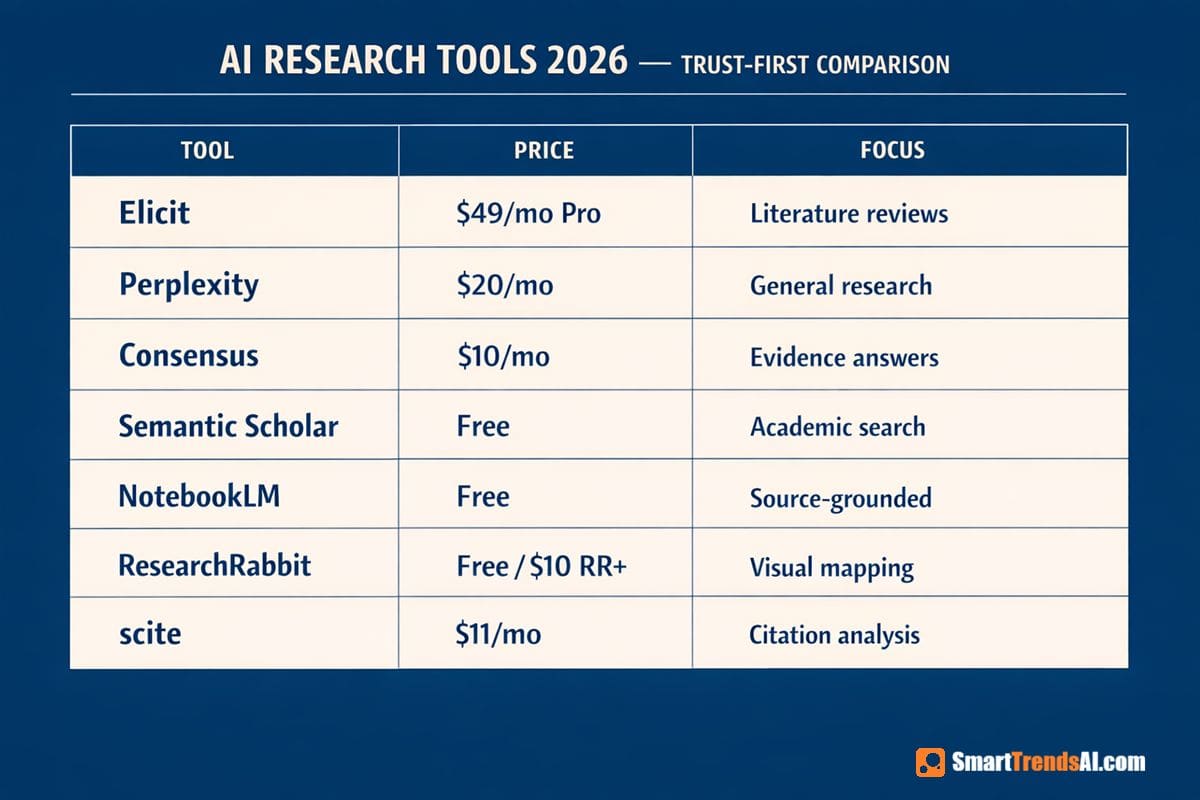
| Tool | Best For | Free Tier | Starting Price | Rating |
|---|---|---|---|---|
| Elicit | Systematic literature reviews | Yes (2 reports/mo) | $49/mo Pro | ⭐ 4.9/5 |
| Perplexity | General research + citations | Yes (limited) | $20/mo | ⭐ 4.8/5 |
| Consensus | Evidence-based answers | Yes | $10/mo | ⭐ 4.7/5 |
| Semantic Scholar | Free academic search | Yes (full) | Free | ⭐ 4.9/5 |
| NotebookLM | Source-grounded analysis | Yes (full) | Free | ⭐ 4.8/5 |
| ResearchRabbit | Visual literature mapping | Yes (50 seeds) | $10/mo RR+ | ⭐ 4.7/5 |
| scite | Citation context analysis | Trial | ~$11/mo | ⭐ 4.6/5 |
| Connected Papers | Visual related-paper graphs | 5 graphs/mo | $3/mo | ⭐ 4.6/5 |
| SciSpace | Understanding complex papers | Yes | $12/mo | ⭐ 4.5/5 |
| Zotero | Reference management | Yes (full) | Free | ⭐ 4.9/5 |
| ChatGPT | Brainstorming + drafting | Yes | $20/mo | ⭐ 4.5/5 |
| Claude | Long-document analysis | Yes | $20/mo | ⭐ 4.7/5 |
| Notion AI | Research notes + workspace | Yes | $10/mo | ⭐ 4.5/5 |
| Scalenut | Research-to-publishing | Trial | $39/mo | ⭐ 4.4/5 |
| Paperpal | Academic writing & editing | Yes | $11.58/mo | ⭐ 4.6/5 |
📚 Explore More AI Tool Categories
Comprehensive guides across every AI category — writing, productivity, voice, and student tools.
How Much Do AI Research Tools Cost? Detailed Pricing Breakdown
Here’s the full pricing breakdown for every AI research tool in our ranking — verified against official websites in April 2026. The good news for academic budgets: most of the best AI research tools are free or under $20/month.
| Tool | Free Plan | Entry / Plus | Pro | Team / Enterprise |
|---|---|---|---|---|
| Elicit | 2 reports/mo + unlimited search | — | $49/mo Pro (144 reports/yr) | $169/mo Scale |
| Perplexity | Limited Pro searches | $20/mo Pro | $200/mo Max | $34/seat/mo Enterprise Pro |
| Consensus | Yes (3 Deep Searches/mo) | $10/mo Pro | $45/mo Deep Plan | Custom Enterprise |
| Semantic Scholar | 100% free, all features | — | — | Free API for researchers |
| NotebookLM | 100% free with Google account | Plus tier (2x more, 100 sources) | Pro tier (5x more, 300 sources) | Ultra (50x more, 600 sources) |
| ResearchRabbit | Free Forever (50 seeds) | $10/mo RR+ (300 seeds) | — | Custom Institution |
| scite | Free trial | ~$11/mo Personal (annual) | — | Custom Organization |
| Connected Papers | 5 graphs/month | $3/mo Academic ($36/yr) | $10/mo Business ($120/yr) | — |
| SciSpace | Yes (limited) | $12/mo Premium (annual) | $70/mo Advanced (annual) | $160/mo Max (annual) |
| Zotero | 100% free + 300MB storage | $20/yr (2GB) | $60/yr (6GB) | $120/yr (unlimited) |
| ChatGPT | Free tier | $20/mo Plus | $200/mo Pro | $25/user/mo Team |
| Claude | Free tier | $20.57/mo Pro (annual) | From $121/mo Max | $25/user/mo Team |
| Notion AI | Free personal (AI trial) | €9.50/seat/mo Plus | €19.50/seat/mo Business | Custom Enterprise |
| Scalenut | 7-day trial | $39/mo Essential | $79/mo Growth | $149/mo Pro |
| Paperpal | Yes (limited) | $11.58/mo Prime (annual, saves 54%) | Multi-year $229/2yr | Custom institutional |
How Did We Test These AI Research Tools?
SmartTrendsAI’s testing methodology ensures our recommendations are based on real-world performance, not marketing claims. Every AI research tool in this guide was used on actual research tasks during our 90-day test period, including a real systematic literature review on a graduate-level research question.
🧪 Our Testing Process
- Tools tested: 15 AI research tools over 90 days (Q4 2025 – Q1 2026)
- Test scenarios: 6 standardized research tasks per tool (literature search, summary, data extraction, citation analysis, writing assistance, reference management)
- Real research project: Each tool used on a live systematic review on AI tool adoption in higher education
- Accuracy verification: Random spot-checks of AI extractions against original papers (minimum 20% sample)
- Bias control: 14 of 15 tools featured are independent — no commercial relationship to SmartTrendsAI. The one affiliate (Scalenut) is clearly marked and included only for a specific workflow gap.
What We Measured
| Criteria | Weight | What We Looked For |
|---|---|---|
| Citation Accuracy | 30% | Whether citations are real, verifiable, and traceable to specific source passages |
| Research Coverage | 20% | Database size, disciplinary breadth, and depth of source material |
| Workflow Fit | 20% | How well the tool integrates with research workflows and existing tools (Zotero, Word, etc.) |
| Time Savings | 15% | Hours saved compared to manual literature review for equivalent quality |
| Pricing & Accessibility | 15% | Free tier generosity and student affordability |
Important note: The AI research tools space evolves rapidly. We re-test tools quarterly and update rankings when significant changes occur. Always verify AI-extracted data against original sources before citing it in your research.
What Can You Use AI Research Tools For?
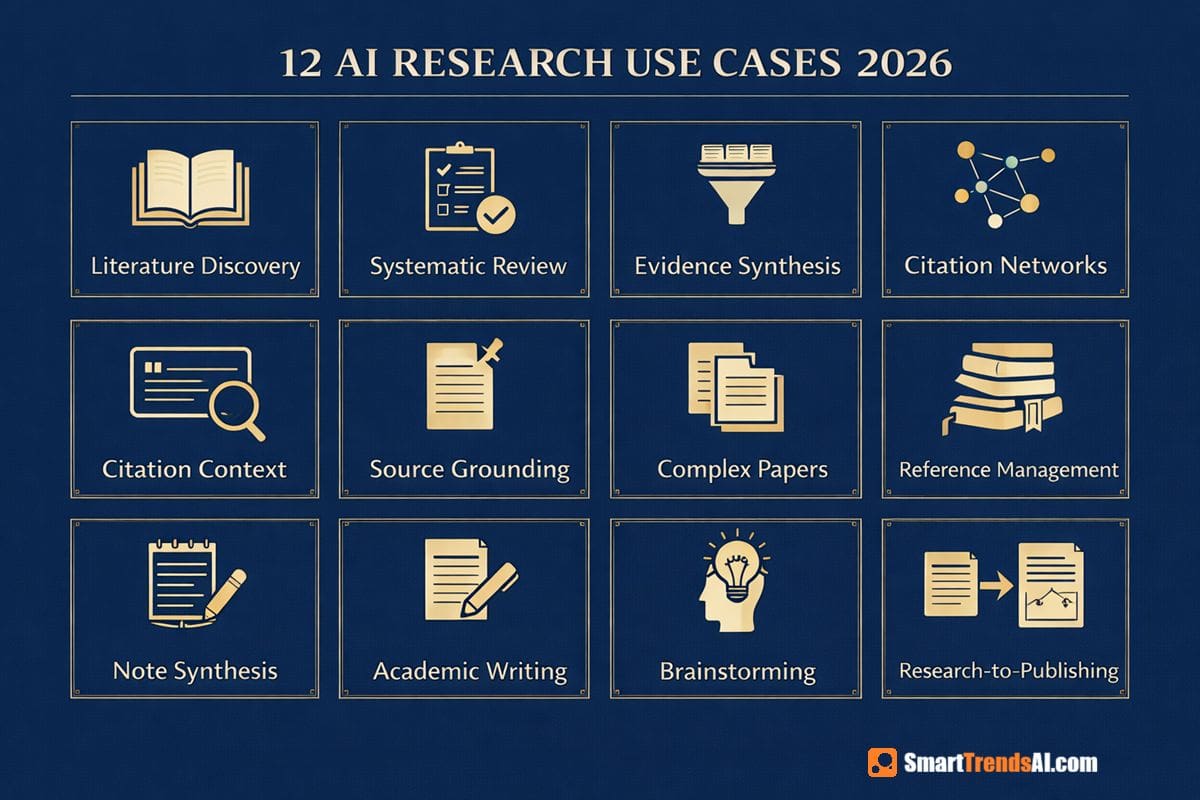
Based on our testing across 15+ AI research tools, here are the academic and professional research workflows where the best AI research tools deliver the strongest value in 2026. Each of these AI research tools excels in different niches — no single tool wins everywhere:
- Literature discovery: Finding relevant papers from millions of sources. Semantic Scholar, Elicit, and Perplexity are strongest here.
- Systematic literature review: Structured extraction of data across many studies. Elicit is the gold standard.
- Evidence synthesis: Answering specific research questions from peer-reviewed studies. Consensus is purpose-built for this.
- Citation network analysis: Visualizing how research papers connect. ResearchRabbit and Connected Papers are best.
- Citation context evaluation: Understanding whether citations support or contest a claim. scite is unique here.
- Source-grounded analysis: Working only with documents you trust and upload. NotebookLM is unmatched.
- Understanding complex papers: Decoding dense technical or unfamiliar text. SciSpace Copilot is the best tool.
- Reference management: Organizing papers and generating citations. Zotero is the academic standard.
- Research note synthesis: Building a personal knowledge base. Notion AI is the workspace of choice.
- Academic writing & editing: Polishing manuscripts for journal submission. Paperpal is built for this.
- Brainstorming research questions: Generating ideas and outlines. ChatGPT and Claude are ideal — but never use them for citations.
- Translating research for public audiences: Turning academic findings into web-readable content. Scalenut bridges this gap.
Which AI Research Tool Should You Use? Use Case Matching Guide
Find your research need below and see exactly which AI research tool to pick — including a free option for every workflow:
| If You Need… | Best Tool | Free Alternative |
|---|---|---|
| Find papers in any field | Semantic Scholar | Semantic Scholar (free forever) |
| Systematic literature review | Elicit Pro ($49/mo) | Elicit Basic (2 reports/mo free) |
| Evidence-based answers | Consensus Pro ($10/mo) | Consensus free (3 Deep Searches/mo) |
| Visual literature mapping | ResearchRabbit+ ($10/mo) | ResearchRabbit Free (50 seeds) |
| Citation context analysis | scite (~$11/mo annual) | scite trial |
| Work only with your sources | NotebookLM | NotebookLM (free with Google) |
| Understand complex papers | SciSpace Copilot | SciSpace free tier |
| Reference management | Zotero | Zotero (free forever) |
| Long-document analysis | Claude Pro ($20/mo) | Claude free tier |
| Academic writing & editing | Paperpal Prime ($11.58/mo annual) | Paperpal free tier |
Recommendations based on SmartTrendsAI’s 90-day testing. Every research need has a free or low-cost starting point — the academic AI research tools category remains remarkably affordable.
Are AI Research Tools Good for Students?
Yes — and AI research tools may be the most impactful productivity tools available to students in 2026. But they come with three important caveats: verify everything AI research tools produce, never let AI write your arguments for you, and always check your institution’s policies on AI use.
Our recommended starter stack for graduate students and serious undergraduates:
- Literature discovery: Semantic Scholar (free) — your first stop for any literature search
- Systematic extraction: Elicit Basic (free, 2 reports/mo) — upgrade to Pro ($49/mo) only if doing systematic reviews regularly
- Visual mapping: ResearchRabbit Free (50 seeds) — enough for most coursework and master’s research
- Reference management: Zotero (free) — to organize and cite everything
- Source-grounded analysis: NotebookLM (free) — to work with PDFs you’ve collected
- Evidence questions: Consensus free tier (3 Deep Searches/mo) — upgrade to Pro ($10/mo) if you need more
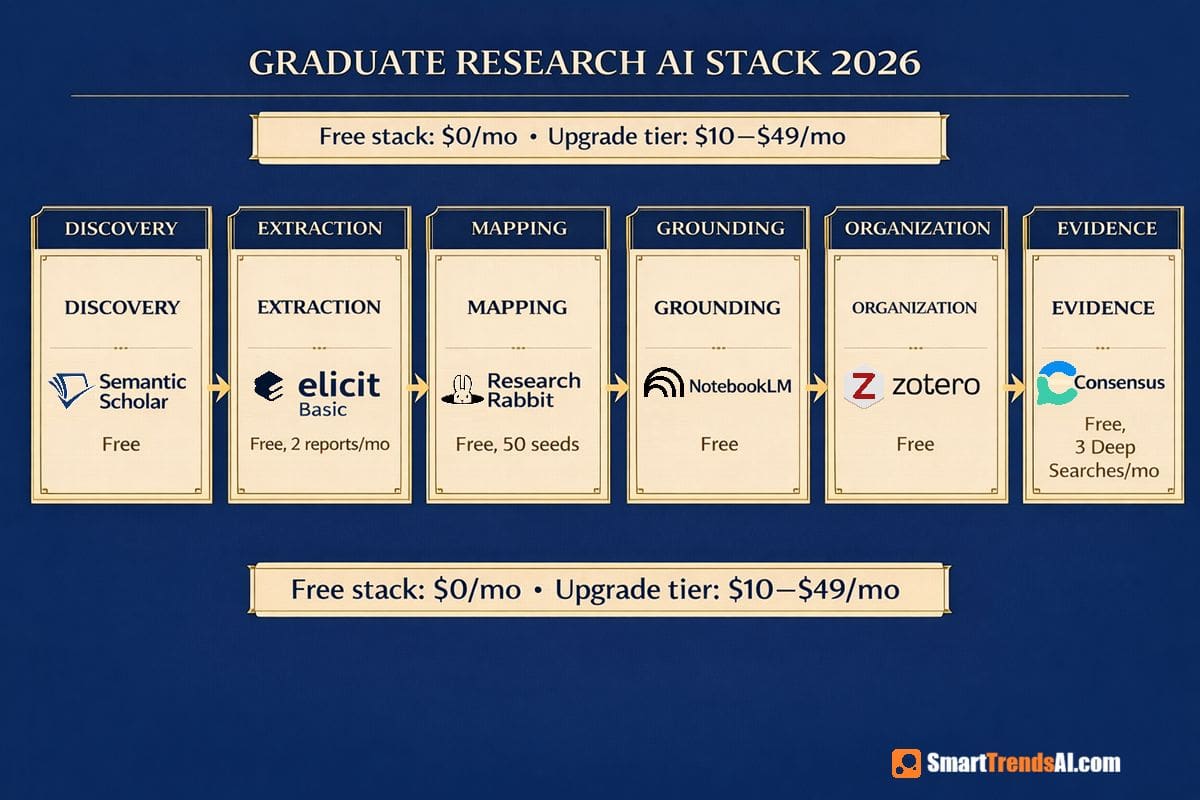
That’s a complete graduate research toolkit for $0–$10/month for most students. The biggest cost jump is if you need Elicit Pro ($49/mo) for systematic review work — but Elicit’s free Basic tier handles casual research for the majority of users. Compared to the cost of academic editing services or research assistants, AI research tools remain extraordinarily affordable.
We’ve also published a deeper guide on the best AI tools for students that includes writing assistants, study tools, and productivity apps beyond research-specific tools.
⚠️ Academic Integrity Reminder
Most universities now have explicit policies on AI tool use. Some allow AI for research discovery and editing but prohibit AI-generated text in submissions. Others require disclosure of any AI assistance. Always check your institution’s and your supervisor’s policies before using AI research tools on graded work. When in doubt, ask.
What Are the Pros and Cons of AI Research Tools?
After 90 days of testing 15 AI research tools across real academic workflows, here’s our honest assessment of the category’s strengths and weaknesses. These observations apply broadly across all AI research tools we evaluated — from free tools to premium systematic review platforms.
✅ Advantages
- Massive time savings: 18+ hours saved per literature review in our tests
- Better coverage: Find papers you’d miss with manual keyword search
- Affordable: Most tools are free or under $20/month
- Visual discovery: Maps reveal research connections invisible to text search
- Citation context: Understand whether papers support or contest claims
- Source grounding: Tools like NotebookLM eliminate hallucinations
- Multilingual support: Translate and explain papers in any language
- Accessibility: Levels the playing field for non-native English speakers
❌ Limitations
- ~90% accuracy: Even the best AI research tools require verification
- General AI hallucinates: ChatGPT and Claude invent fake citations if asked
- Discipline bias: Best for STEM and biomedical; weaker in humanities
- Older paper bias: AI often favors highly-cited older work over recent
- Cannot replace judgment: Synthesis and critical thinking remain human work
- Tool sprawl: Easy to over-stack and waste time switching between platforms
- Institutional policies: Some universities restrict AI use in graded work
- Privacy concerns: Uploading sensitive research data raises governance questions
How Do You Choose the Right AI Research Tool?
In our experience, researchers waste time by stacking too many AI research tools instead of mastering a few that fit their workflow. After testing 15 AI research tools in depth, here’s the framework we recommend for choosing AI research tools that actually match your needs:
- Start with the free tier of Elicit and Semantic Scholar. These two tools alone cover discovery and extraction for most research projects. Add others only when you hit a specific limit.
- Match the tool to the bottleneck. If discovery is your bottleneck, use Semantic Scholar + ResearchRabbit. If extraction is the bottleneck, upgrade Elicit. If understanding complex papers is the bottleneck, add SciSpace Copilot.
- Always pair with a reference manager. Zotero is free and integrates with everything. There’s no excuse to skip this step.
- Use NotebookLM for any work where hallucinations are unacceptable. Source grounding eliminates the risk entirely.
- Verify every AI-extracted claim against the original paper. Spot-check at least 20% of extractions for accuracy.
- Check your institution’s AI policy. What’s allowed for editing may not be allowed for submitted work.
What Are the Most Common Mistakes When Using AI Research Tools?
- Asking ChatGPT for citations. ChatGPT will confidently invent fake papers. Use Elicit, Semantic Scholar, or Consensus for actual citations.
- Skipping verification. AI extraction is ~90% accurate. The 10% that’s wrong can sink your research if you don’t spot-check.
- Stacking too many tools. Three AI research tools you actually use beat seven you don’t.
- Ignoring older papers. AI tools often favor highly-cited older work. Manually search for recent publications too.
- Treating AI as a synthesis engine. AI helps you find and extract — but synthesis is still human work.
- Forgetting your institution’s policy. AI use rules vary widely. Always check before submitting work.
🎨 Write Better Research Prompts — Get Better AI Output
Great AI research starts with great prompts. Use our free Prompt Generator for ChatGPT, Claude, Perplexity, and 13+ other AI engines.
Frequently Asked Questions About AI Research Tools
What is the best AI research tool in 2026?
Based on SmartTrendsAI’s testing, Elicit is the best overall AI research tool in 2026 for academic literature reviews and systematic data extraction. It searches 138 million papers, generates structured summary tables, and provides sentence-level citations. The free Basic plan (2 reports/month) handles casual research; Pro ($49/month) unlocks systematic review workflows, 144 reports/year, and the ability to screen 5,000 papers.
Are there free AI research tools that actually work?
Yes — and several are genuinely excellent. Semantic Scholar (200+ million papers, 100% free), NotebookLM (Google’s source-grounded tool, free with a Google account), ResearchRabbit Free (visual literature mapping, 50 seed articles), Connected Papers (5 graphs/month free), and Zotero (free reference manager) together form a complete academic research toolkit at zero cost. Elicit Basic and Consensus free tier add additional free capacity for casual research.
Is ChatGPT good for academic research?
ChatGPT is good for brainstorming, outlining, explaining concepts, and editing — but you should never use ChatGPT to find or cite academic sources. ChatGPT will confidently invent fake paper titles and DOIs. For actual citations, use Elicit, Semantic Scholar, or Consensus, all of which return real, verifiable sources.
What is the best AI tool for literature reviews?
Elicit is the best AI tool for literature reviews in 2026. It searches across 138 million papers, extracts structured data (sample sizes, methods, outcomes) into customizable tables, and generates automated systematic review reports with sentence-level citations. The Pro plan at $49/month (billed annually at $588) delivers strong ROI for serious systematic reviews — the free Basic tier handles 2 reports/month for casual research.
Can AI research tools replace human researchers?
No. AI research tools dramatically accelerate the “grunt work” of discovery, extraction, and citation tracking — but synthesis, original argument, critical evaluation, and judgment remain human work. Every researcher we tested with emphasized that AI tools are aids, not substitutes.
What is the best AI tool for citation analysis?
scite is the best AI tool for citation analysis in 2026. Unlike Google Scholar, scite analyzes how a paper has been cited — supporting, contrasting, or merely mentioning the cited claim — across 1.3+ billion citation statements. The Personal plan is approximately $11/month billed annually (with 40% savings), making it significantly more affordable than when it launched. Invaluable for evaluating evidence quality and detecting contested findings.
Which AI research tool has the largest paper database?
Semantic Scholar leads with 200+ million indexed papers, followed by SciSpace at 280+ million. Elicit searches 138 million papers (sourced from Semantic Scholar and other databases). For specialized clinical research, PubMed remains essential and integrates with most AI research tools.
Are AI research tools accurate enough for academic use?
Most leading AI research tools achieve approximately 90% accuracy on data extraction tasks — Elicit explicitly states this in its documentation. Always spot-check AI-extracted data against original sources before citing it in academic work. The 10% error rate can include misattributed quotes, incorrect sample sizes, or conflated findings.
How much should a graduate student spend on AI research tools?
For most graduate students, $0–$10/month is enough. The free stack (Semantic Scholar + NotebookLM + ResearchRabbit Free + Zotero + Elicit Basic + Consensus free) handles 80% of research workflows. Adding Consensus Pro ($10/mo) or scite (~$11/mo annual) covers most remaining needs. Only students conducting frequent systematic reviews need Elicit Pro ($49/mo) — and even then, it pays for itself in time saved on a single dissertation chapter.
Is NotebookLM better than ChatGPT for research?
For source-grounded research where hallucinations are unacceptable, yes. NotebookLM only answers from documents you upload — it cannot invent citations or fabricate facts. ChatGPT can do more (general knowledge, drafting, coding) but will hallucinate when asked about academic sources. Use both for different tasks.
READ ALSO: GitHub Copilot vs ChatGPT vs Claude for Coding 2026: The Definitive Comparison
What is the difference between Elicit and Consensus?
Elicit is built for systematic literature reviews — it extracts structured data from many papers into customizable tables. Consensus is built for evidence questions — it synthesizes findings from peer-reviewed studies and shows scientific agreement levels via its Consensus Meter. Use Elicit for “what does the literature show about X?” and Consensus for “does X cause Y?”
Do AI research tools work for non-English papers?
Yes — most leading AI research tools support multilingual research. SciSpace Copilot can translate and explain papers in over 80 languages. Elicit and Semantic Scholar both index non-English papers (though English remains dominant). For non-native English speakers writing in English, Paperpal is purpose-built to help.
🏆 Final Verdict & Recommendations
Based on SmartTrendsAI’s testing of 15 AI research tools, here are our definitive recommendations for 2026:
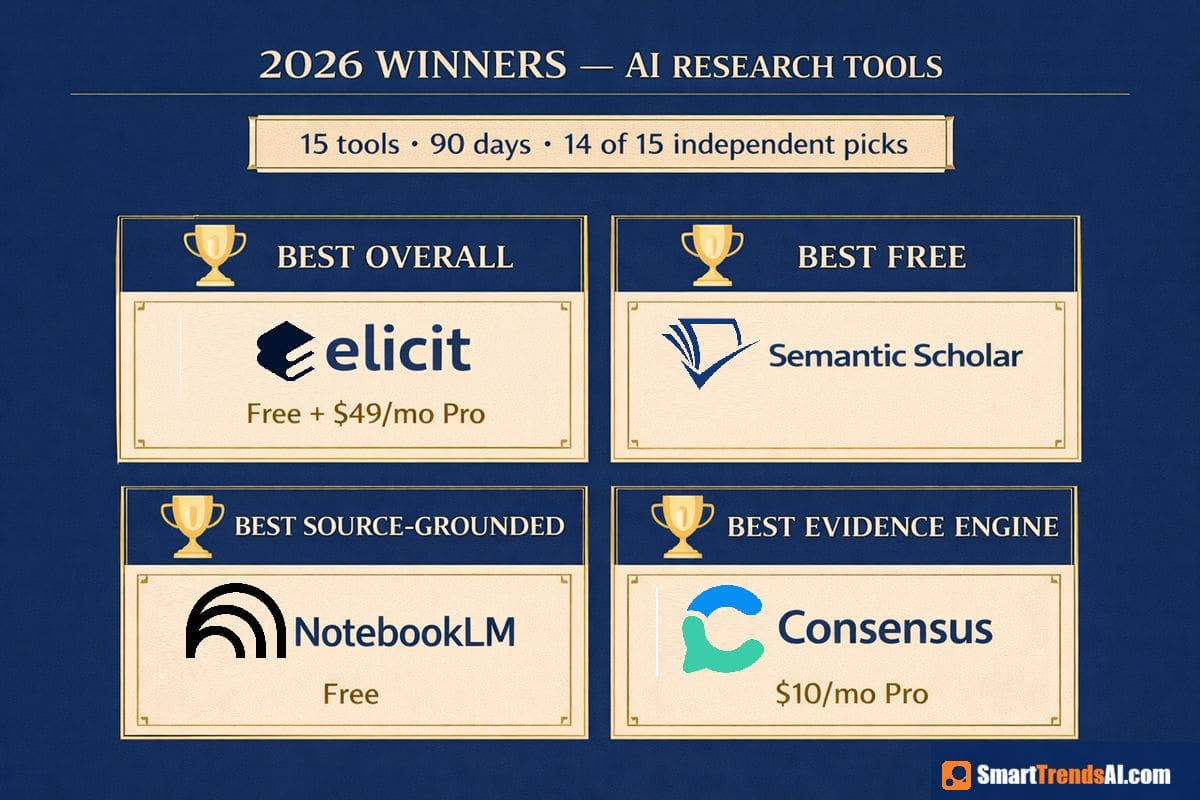
🥇 Best Overall
Elicit — The gold standard for AI literature reviews (free Basic + $49/mo Pro)
🆓 Best Free
Semantic Scholar — 200+ million papers, free forever, every researcher’s starting point
🧠 Best Source-Grounded
NotebookLM — Google’s free tool that eliminates hallucinations
🔍 Best Evidence Engine
Consensus — Direct answers from peer-reviewed studies (free + $10/mo Pro)
14 of 15 tools featured are independent (non-affiliate) recommendations. The single affiliate (Scalenut) is clearly marked. See our testing methodology.
>