


Quick Overview
- Market Size: AI chatbot market projected to reach $27.3 billion by 2030
- Top Tools: ChatGPT, Claude, Gemini, Perplexity, and specialized assistants
- Business Impact: 30-50% productivity increase reported by users
- Best For: Content creation, coding, research, customer service, automation
- Pricing: Free to $25/month for most consumer tools
- Key Trend: Multimodal AI and autonomous agents dominating 2026
What is Intelligent AI?
Intelligent AI refers to advanced artificial intelligence systems that can understand context, learn from interactions, reason through complex problems, and provide human-like responses across diverse tasks. Unlike traditional rule-based chatbots that follow predefined scripts, intelligent AI uses large language models (LLMs) trained on vast amounts of data to comprehend nuance, maintain conversation context, and adapt to user needs dynamically.
The defining characteristics of intelligent AI include:
Natural Language Understanding: Intelligent AI comprehends not just keywords but the intent, context, and sentiment behind user queries. It understands ambiguous requests, cultural references, and complex phrasing that would confuse traditional systems.
Contextual Awareness: These systems maintain conversation history and context across multiple exchanges, allowing for coherent multi-turn dialogues. They remember previous questions and build upon earlier discussion points naturally.
Reasoning and Problem-Solving: Intelligent AI can break down complex problems into steps, apply logical reasoning, and synthesize information from multiple sources to reach conclusions. This goes beyond simple pattern matching to actual analytical thinking.
Continuous Learning: While the base models are static, intelligent AI systems improve through fine-tuning, reinforcement learning from human feedback (RLHF), and continuous updates based on user interactions and new data.
Multimodal Capabilities: Modern intelligent AI processes not just text but images, audio, video, and code, enabling rich interactions across multiple formats and use cases.
READ ALSO: HeyGen AI Review 2026 Best Avatar Video Generator Tested
In 2026, intelligent AI has evolved beyond simple question-answering to become powerful assistants capable of content creation, code generation, data analysis, creative work, research, and complex decision support. Tools like ChatGPT, Claude, and Gemini represent the current state of intelligent AI, with capabilities that were science fiction just a few years ago.
The market has consolidated around several dominant platforms, each with distinct strengths and specializations. Understanding these differences is crucial for selecting the right intelligent AI tool for your specific needs. For more detail understanding see our ChatGPT vs Claude vs Gemini tool comparision.
Why Intelligent AI Matters in 2026
Intelligent AI has transitioned from experimental technology to an essential tool reshaping how we work, create, and solve problems. Here’s why it matters more than ever in 2026:
1. Productivity Revolution
Studies show that professionals using intelligent AI report 30-50% productivity increases across knowledge work tasks. A Stanford/MIT study found that customer service agents using AI assistance resolved 14% more inquiries per hour while improving satisfaction scores. Content creators produce drafts 3-5x faster, developers write code 40% more quickly, and researchers synthesize information in a fraction of traditional time.
This isn’t about replacing humans but augmenting human capabilities. Intelligent AI handles routine cognitive tasks, allowing professionals to focus on creative thinking, strategic planning, and high-value work that requires human judgment and emotional intelligence.
2. Democratization of Expertise
Intelligent AI makes specialized knowledge accessible to everyone. A small business owner can now access marketing strategy insights previously requiring expensive consultants. Students receive personalized tutoring in any subject. Non-technical professionals can write functional code. This democratization levels the playing field across industries and geographies.
The knowledge gap that once separated experts from novices is narrowing. While deep expertise remains valuable, intelligent AI enables rapid skill acquisition and informed decision-making across domains.
3. Cost Efficiency and Scalability
For businesses, intelligent AI delivers remarkable cost efficiency. Automated customer service handles thousands of simultaneous conversations at a fraction of human labor costs. Content generation scales without proportional expense increases. Data analysis that once required specialists becomes self-service for any team member.
Small and medium businesses particularly benefit, accessing capabilities previously affordable only for enterprises. A solopreneur can now manage customer support, content marketing, and business operations with AI assistance at minimal cost.
4. 24/7 Availability and Consistency
Intelligent AI operates continuously without fatigue, maintaining consistent quality across all interactions. Customers receive instant support regardless of time zones or holidays. Creative professionals overcome writer’s block at 3 AM. Developers debug code on weekends without waiting for colleagues.
This always-on availability transforms business operations and individual productivity, eliminating delays inherent in human-dependent workflows.
5. Multimodal Intelligence
2026’s intelligent AI processes images, audio, video, and code alongside text, enabling richer interactions and broader applications. Users can discuss photographs, analyze charts, generate images from descriptions, transcribe meetings, and switch seamlessly between formats within a single conversation.
This multimodal capability creates new use cases impossible with text-only systems, from visual product design to video content analysis to accessibility features for diverse users.
6. Competitive Necessity
In many industries, using intelligent AI has shifted from advantage to necessity. Companies not leveraging AI fall behind competitors in speed, innovation, and cost structure. Individual professionals without AI skills face career limitations as employers expect AI proficiency.
The question isn’t whether to adopt intelligent AI but how quickly and effectively you can integrate it into workflows and strategy.
Top Intelligent AI Tools Reviewed
The intelligent AI landscape has consolidated around several dominant platforms, each with distinct strengths. Here’s a comprehensive review of the top tools:
1. ChatGPT (OpenAI)
ChatGPT remains the most popular intelligent AI assistant with over 200 million weekly users. The platform offers two tiers:
ChatGPT Free (GPT-3.5): Available to all users, providing solid performance for general queries, basic content creation, and learning. While less capable than premium models, it’s sufficient for casual users and students.
ChatGPT Plus (GPT-4, $20/month): The premium tier offers GPT-4, which delivers significantly better reasoning, creativity, and factual accuracy. Includes image generation via DALL-E 3, advanced data analysis, GPTs (custom assistants), and priority access during peak times.
Strengths:
- Most versatile and well-rounded AI assistant
- Excellent at coding across multiple languages
- Strong creative writing and brainstorming capabilities
- Extensive plugin ecosystem for specialized tasks
- Custom GPTs enable personalized assistants
- Large user community with extensive documentation
Best For: Developers, content creators, students, general-purpose assistance, businesses needing versatile AI capabilities
2. Claude (Anthropic)
Claude, developed by Anthropic, has emerged as ChatGPT’s strongest competitor, particularly excelling in writing quality and context handling.
Claude Free (Sonnet): Offers access to Claude Sonnet, a powerful model competitive with GPT-4 for many tasks. Free tier provides generous usage limits suitable for most individual users.
Claude Pro ($20/month): Unlocks Claude Opus (most powerful model), 5x more usage, priority access, and early feature access.
Strengths:
- Superior long-form writing quality with better style and flow
- Exceptional context window (200K tokens = ~150,000 words)
- More nuanced understanding of complex instructions
- Stronger at analysis and critical thinking tasks
- Better at maintaining consistent voice and tone
- More thoughtful and detailed responses
Best For: Professional writers, researchers, analysts, anyone needing detailed explanations, long-document analysis, consistent writing quality
3. Google Gemini
Google Gemini (formerly Bard) leverages Google’s search infrastructure and ecosystem integration to offer unique capabilities.
Gemini Free: Available to anyone with a Google account, providing solid general-purpose AI assistance with real-time web access and Google Workspace integration.
Gemini Advanced ($20/month via Google One AI Premium): Unlocks Gemini Ultra, the most capable model, plus integration with Gmail, Docs, Sheets, and Drive, along with 2TB Google storage.
Strengths:
- Real-time web search and current information access
- Seamless Google Workspace integration
- Strong multimodal capabilities (images, video, audio)
- Excellent at factual accuracy and up-to-date information
- Can search and analyze your Google Drive content
- Better at multilingual tasks
Best For: Google Workspace users, researchers needing current information, multilingual users, teams already in Google ecosystem
4. Perplexity AI
Perplexity AI specializes in research and information retrieval with transparent source citations.
Perplexity Free: Provides unlimited quick searches with GPT-3.5, including source citations for all claims.
Perplexity Pro ($20/month): Unlocks GPT-4 and Claude for searches, unlimited Pro searches, image generation, and file uploads.
Strengths:
- Transparent source citations for every claim
- Specifically optimized for research and fact-finding
- Real-time web search with current information
- Clean, focused interface without distractions
- Follow-up questions to refine searches
- Thread-based organization of research topics
Best For: Researchers, journalists, students, fact-checkers, anyone prioritizing accurate, cited information
5. Specialized AI Assistants
Beyond the major platforms, specialized intelligent AI tools excel in specific domains:
GitHub Copilot ($10/month): AI pair programmer integrated into IDEs, suggesting code in real-time. Essential for developers seeking productivity gains.
Jasper AI ($49+/month): Marketing-focused AI for blog posts, ad copy, social media content, and brand voice consistency. Better than general AI for marketing content at scale.
Notion AI ($10/month): Integrated directly into Notion workspace for note summarization, writing assistance, and knowledge management within your existing workflow.
Grammarly (Free to $30/month): Writing assistant with AI-powered suggestions for clarity, tone, engagement, and correctness. Essential for professional communication.
To find out which software is the most accurate, check out our full guide on the best AI detection tools.
READ NEXT: Alternative free intelligent AI tool META AI REVIEW
AI Chat & Content Use Cases
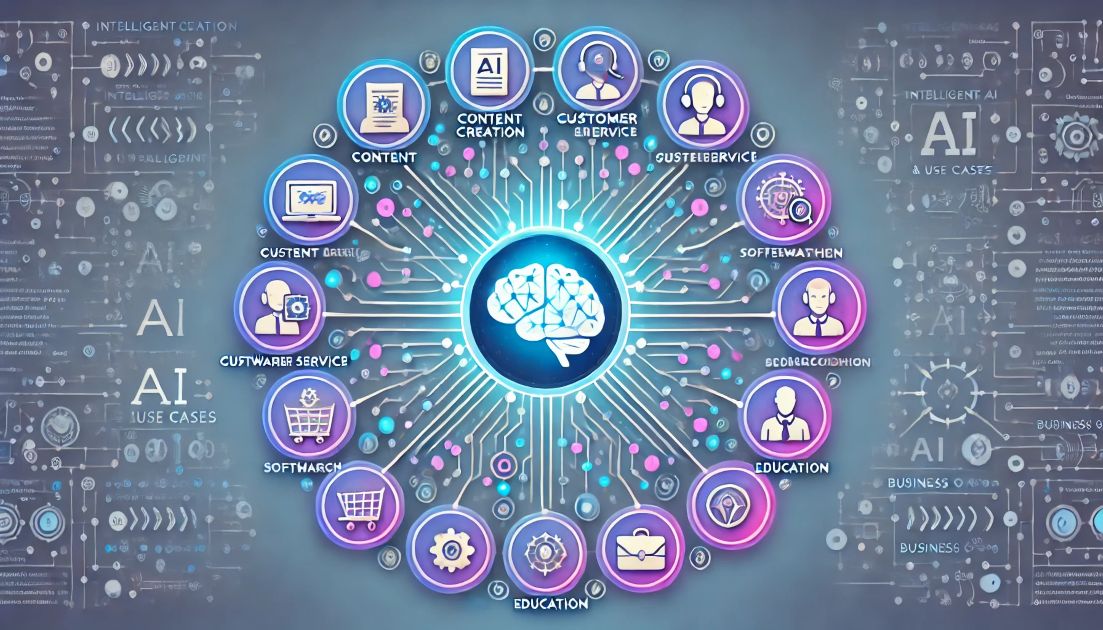
Intelligent AI has proven valuable across diverse applications. Here are the most impactful use cases in 2026:
Content Creation & Marketing
Blog Writing: AI generates article outlines, first drafts, and section content, reducing writing time by 50-70%. Writers focus on editing, adding personal insights, and ensuring quality rather than staring at blank pages.
Social Media Management: Create platform-specific posts, captions, hashtags, and content calendars. AI adapts tone for different audiences and suggests trending topics.
Email Marketing: Draft newsletters, promotional emails, and email sequences with personalized messaging. AI helps with subject lines, CTAs, and A/B testing variations.
Video Scripts: Generate YouTube video scripts, video descriptions, timestamps, and thumbnail ideas. Content creators produce more videos with consistent quality.
READ ALSO: Pictory review for best for Blog-to-Video conversion
Customer Service & Support
24/7 Customer Chat: Intelligent AI handles common inquiries, troubleshoots problems, and escalates complex issues to humans. Many companies report 60-80% of customer queries resolved by AI without human intervention.
Email Support Automation: Draft responses to customer emails, maintaining brand voice and appropriate tone. Support teams become 3-4x more efficient.
Knowledge Base Creation: AI helps create comprehensive help documentation, FAQs, and troubleshooting guides from product information and past support tickets.
Software Development
Code Generation: AI writes functions, classes, and entire modules based on natural language descriptions. Developers focus on architecture and problem-solving rather than syntax.
Debugging: Explain error messages, suggest fixes, and identify logical issues in code. Reduces debugging time by 30-50%.
Documentation: Generate code comments, API documentation, and README files automatically. Keeps documentation synchronized with code changes.
Code Review: AI reviews code for bugs, security vulnerabilities, performance issues, and style consistency before human review.
Research & Analysis
Literature Review: Summarize research papers, extract key findings, and identify relevant studies. Researchers process 10x more papers in the same time.
Data Analysis: Interpret datasets, identify trends, perform statistical analysis, and explain results in plain language. Makes data science accessible to non-specialists.
Competitive Analysis: Research competitors, analyze market positioning, and synthesize industry trends from multiple sources.
Education & Learning
Personalized Tutoring: AI adapts explanations to student understanding level, provides examples, and answers follow-up questions. Available 24/7 without scheduling.
Study Materials: Generate practice questions, flashcards, summaries, and study guides from course content. Students prepare more efficiently.
Essay Assistance: Help with brainstorming, outlining, and improving writing clarity. Teaches better writing through feedback rather than doing the work.
Business Operations
Meeting Notes: Summarize meetings, extract action items, and distribute follow-ups automatically. Teams stay aligned without manual note-taking.
Business Planning: Draft business plans, financial projections, marketing strategies, and competitive analyses. Entrepreneurs access strategic thinking previously requiring consultants.
HR & Recruitment: Write job descriptions, screen resumes, draft offer letters, and create onboarding materials. HR teams handle higher candidate volumes efficiently.
Creative Work
Story Writing: Generate plot ideas, character development, dialogue, and world-building elements. Authors overcome creative blocks and explore narrative directions.
Brainstorming: Generate creative concepts, naming ideas, campaign concepts, and innovative solutions. Teams explore more possibilities in less time.
Content Repurposing: Transform long-form content into social media posts, newsletters, infographics, and multiple formats from single source material.
Generative AI vs Intelligent AI: Understanding the Difference
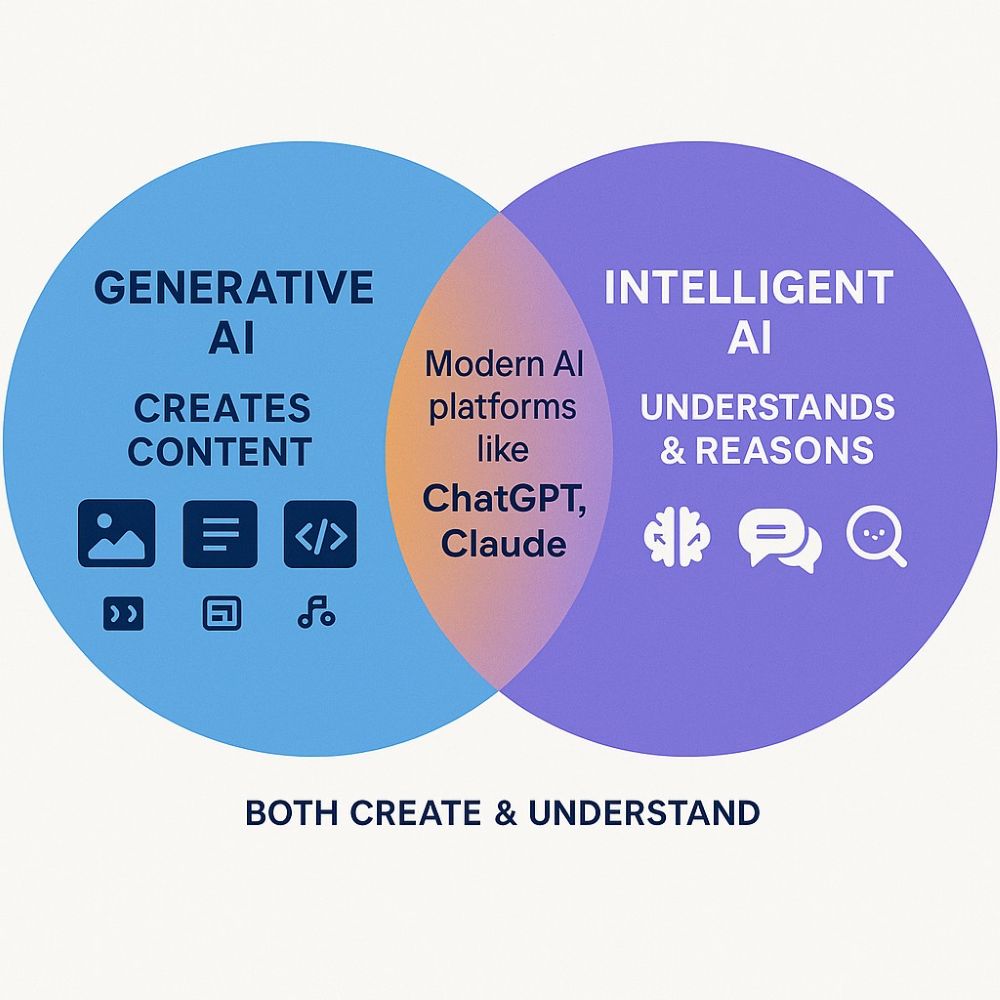
While often used interchangeably, “generative AI” and “intelligent AI” represent different but related concepts:
Generative AI
Generative AI refers to systems that create new content—text, images, audio, video, or code—based on patterns learned from training data. The key characteristic is generation: producing original outputs that didn’t exist before.
Examples: DALL-E generating images from text, ChatGPT writing articles, Midjourney creating artwork, GitHub Copilot suggesting code.
Focus: The creation aspect—what can be produced.
Intelligent AI
Intelligent AI emphasizes the cognitive capabilities: understanding context, reasoning through problems, learning from interactions, and making decisions. While intelligent AI often includes generative capabilities, the focus is on comprehension and problem-solving rather than just creation.
Examples: AI that understands nuanced questions, maintains context across conversations, reasons through complex scenarios, and provides thoughtful analysis.
Focus: The intelligence aspect—how well the AI understands and thinks.
The Overlap
Modern AI platforms like ChatGPT, Claude, and Gemini are both generative (they create content) and intelligent (they understand context and reason). However, the emphasis differs:
- Generative AI tools (like Midjourney or DALL-E) prioritize output quality and creative generation
- Intelligent AI tools (like conversational assistants) prioritize understanding, reasoning, and useful responses
For practical purposes, when people discuss “intelligent AI” in 2026, they typically mean advanced LLM-based assistants that combine generative capabilities with contextual understanding and reasoning—systems that feel like talking to a knowledgeable human rather than a creative content machine.
Quick Comparison: Best AI Chatbots 2026
| AI Tool | Best Feature | Free Plan | Paid Plan | Best For |
|---|---|---|---|---|
| ChatGPT | Most versatile, coding | Yes (GPT-3.5) | $20/month (GPT-4) | General use, developers |
| Claude | Writing quality, context | Yes (Sonnet) | $20/month (Opus) | Writers, researchers |
| Gemini | Real-time web, Google | Yes (Gemini Pro) | $20/month (Ultra) | Google users, research |
| Perplexity | Cited research | Yes (limited) | $20/month (Pro) | Research, fact-finding |
| Copilot | Code generation | No | $10/month | Developers only |
For detailed head-to-head comparisons, see our ChatGPT vs Claude vs Gemini comparison guide.
Business Applications & ROI
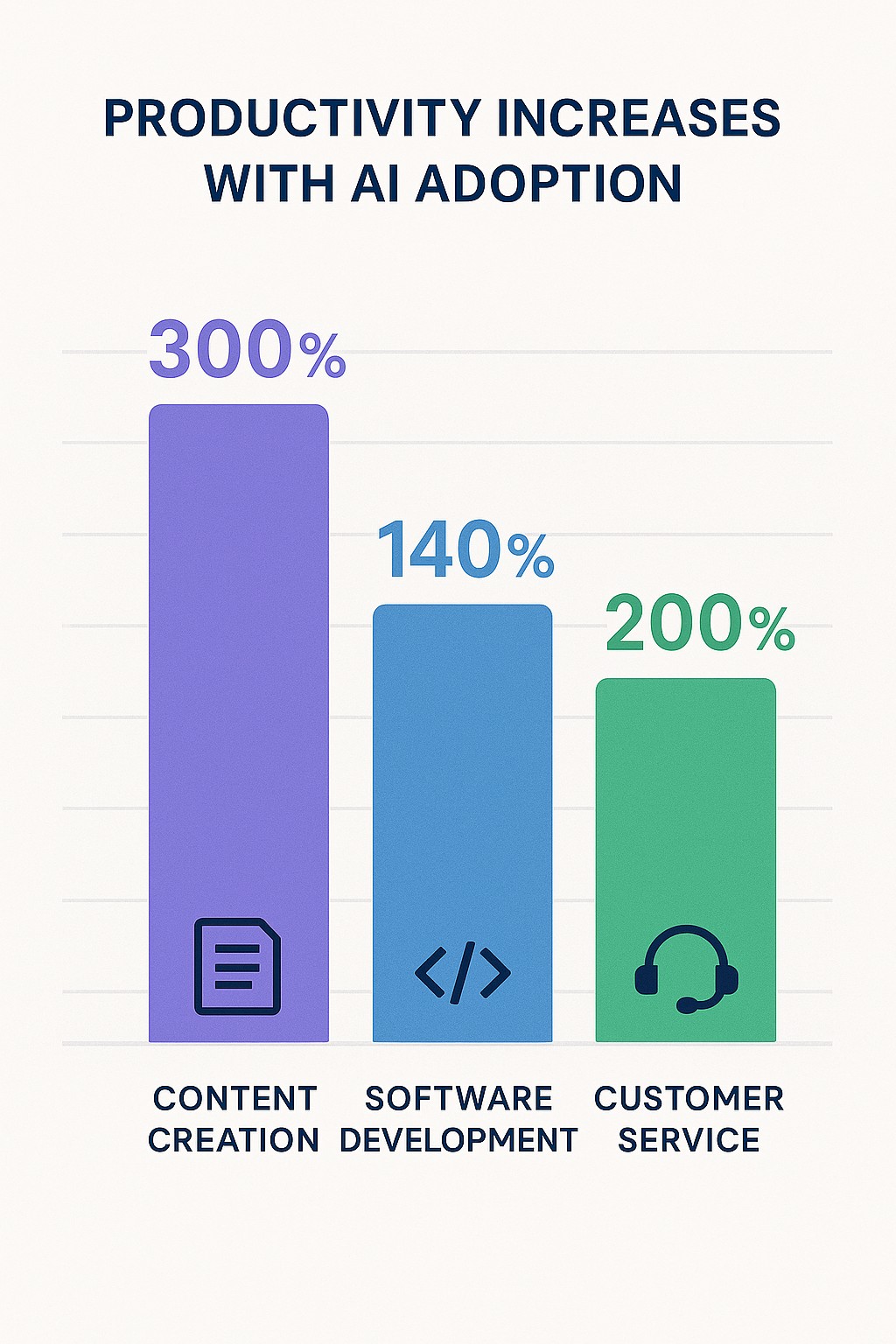
Businesses across industries are realizing significant ROI from intelligent AI implementation:
Documented Business Impact
Customer Service: Companies report 60-80% of support tickets resolved by AI without human intervention. Average resolution time decreased by 50%, customer satisfaction scores improved by 15-20%, and support costs reduced by 30-40%.
Content Marketing: Marketing teams produce 3-5x more content with the same resources. Blog output increases from 4 articles/month to 20 articles/month per writer. Social media presence expands across more platforms without proportional staff increases.
Software Development: Development velocity increases 30-40% with AI coding assistants. Bug identification and resolution time drops by 40%. Documentation quality improves while requiring less manual effort.
Sales & Business Development: AI drafts personalized outreach emails, researches prospects, and generates sales collateral. Sales teams contact 50% more leads with better-quality messaging. Conversion rates improve 10-15%.
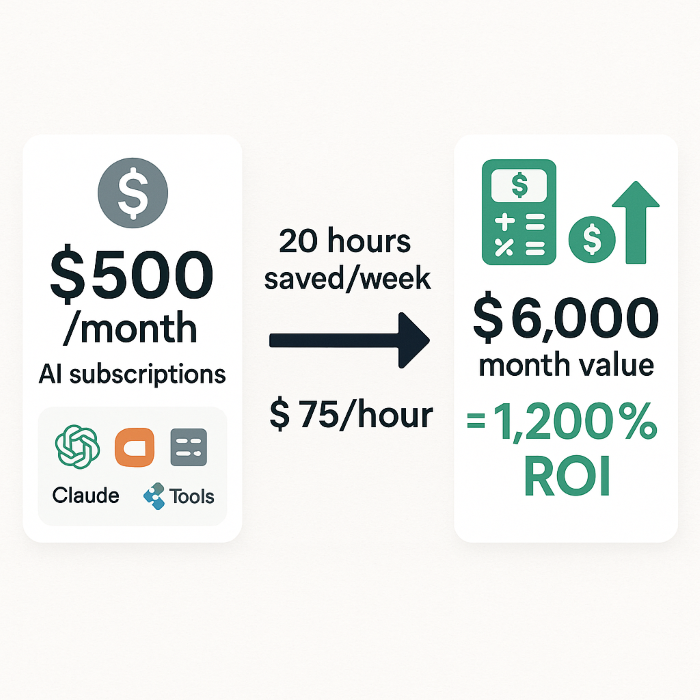
Cost-Benefit Analysis
For a typical small business (10-50 employees):
- Investment: $200-500/month (AI subscriptions for team)
- Time Savings: 15-20 hours/week across team
- Value: $3,000-5,000/month in labor cost equivalent
- ROI: 600-2,400% return on AI investment
For enterprises, the scale multiplies. A company with 1,000 knowledge workers saving 5 hours/week each through AI realizes $10-15 million annual value from a $500,000 AI implementation investment.
Implementation Best Practices
Start Small: Begin with one department or use case before company-wide rollout. Customer service or content marketing often provide quickest wins.
Train Teams: Invest in AI literacy training. Users proficient with AI tools achieve 3-5x better results than untrained users. Budget 10-20 hours per employee for initial training.
Set Guidelines: Establish AI usage policies addressing quality standards, fact-checking requirements, data privacy, and appropriate use cases. Prevent misuse while encouraging experimentation.
Measure Impact: Track specific metrics—time saved, output quality, cost reduction, customer satisfaction—to justify continued investment and identify optimization opportunities.
Future Predictions & Trends for 2026 and Beyond
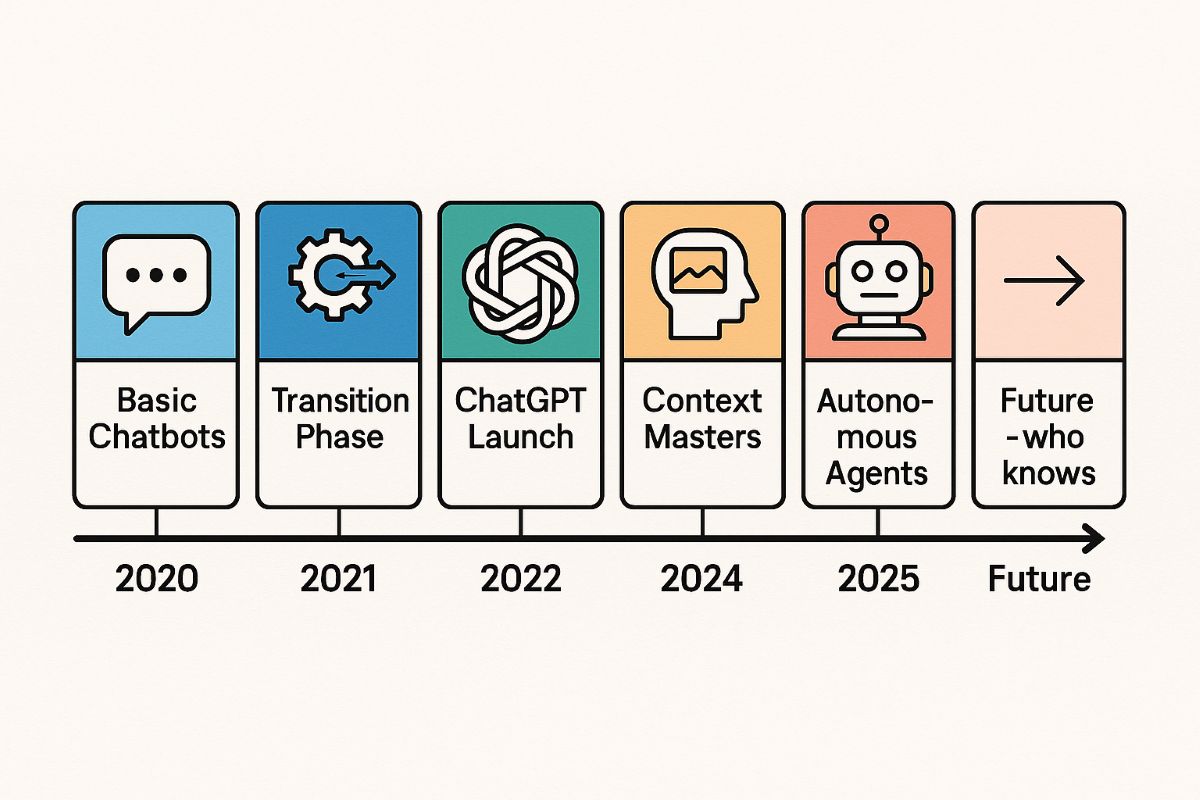
Intelligent AI continues evolving rapidly. Key trends shaping 2026 and beyond:
1. Autonomous AI Agents
The next evolution moves from assistants that respond to prompts toward autonomous agents that execute multi-step tasks independently. Instead of asking AI to draft an email, you’ll tell it to “research competitors, analyze their pricing, and draft a proposal”—and it will complete all steps without further input.
Early examples include AutoGPT and Microsoft Copilot Studio, but 2026 will see mainstream autonomous agents for research, data analysis, software testing, and business processes.
2. Multimodal Everything
AI moving beyond text to seamlessly handle images, audio, video, and interactive environments. You’ll discuss documents by showing screenshots, analyze videos in real-time, create presentations from voice descriptions, and have AI understand complex visual information as naturally as text.
Gemini, GPT-4V, and Claude 3 demonstrate early multimodal capabilities, but 2026 brings true multimodal fluency where the format becomes irrelevant—AI understands content regardless of medium.
3. Personalization and Memory
AI assistants that remember your preferences, work style, past conversations, and context across sessions. Rather than explaining your writing style every time, AI learns and adapts automatically. Your assistant becomes genuinely personalized rather than generic.
OpenAI’s custom GPTs and Anthropic’s Claude Projects hint at this future, but fuller personalization requires better memory management and privacy controls arriving in 2026.
4. Enhanced Reasoning and Accuracy
Current AI sometimes “hallucinates” incorrect information. Next-generation models combine LLMs with knowledge graphs, real-time verification, and retrieval-augmented generation (RAG) to dramatically improve factual accuracy.
Perplexity’s citation model demonstrates this approach, but 2026 will see factual accuracy become standard across all major platforms, with transparent sourcing and confidence scoring.
5. Specialized Domain Models
While general-purpose AI remains dominant, specialized models trained for specific industries—legal, medical, financial, scientific—will offer superior performance in their domains. Doctors will use medical AI trained on clinical literature, lawyers will access legal AI familiar with case law, and engineers will work with technical AI understanding physics and materials.
These specialized models combine general intelligence with deep domain knowledge, providing expert-level assistance previously unavailable at scale.
6. Embedded AI Everywhere
AI integration into every software tool rather than separate platforms. Your email client drafts messages, your spreadsheet analyzes data, your CRM predicts opportunities, and your project manager schedules tasks—all powered by embedded intelligent AI without leaving your workflow.
Microsoft Copilot across Office 365, Google’s Duet AI, and Notion AI show this direction, but 2026 brings embedded intelligence to thousands of applications.
7. Improved Coding Capabilities
AI coding assistants evolve from code suggestion to full application generation. Describe an app in natural language, and AI generates the complete codebase—frontend, backend, database, deployment configuration. Non-technical entrepreneurs build functional products; developers focus on architecture and innovation rather than implementation.
The gap between idea and working software shrinks from months to days or hours.
8. Real-Time Collaboration
AI that participates in team meetings, contributing ideas, tracking action items, and providing relevant information in real-time. Video calls include AI participants that research questions as they arise, summarize discussions, and follow up with meeting notes and next steps.
This transforms AI from solitary assistant to active team member.
How to Choose the Right AI Tool
With numerous intelligent AI options, selection depends on your specific needs:
Choose ChatGPT If You:
- Need versatile, general-purpose assistance
- Write or debug code frequently
- Want the largest plugin ecosystem
- Value extensive community resources
- Need image generation (DALL-E) integrated
- Want custom GPTs for specific tasks
Choose Claude If You:
- Prioritize writing quality and style
- Work with long documents (100+ pages)
- Need detailed, thoughtful analysis
- Value nuanced understanding of complex instructions
- Write professionally (articles, reports, content)
- Require consistent voice and tone
Choose Gemini If You:
- Use Google Workspace extensively
- Need real-time web information
- Work in multiple languages
- Want seamless Gmail/Docs/Drive integration
- Need to search your Google content
- Value current, up-to-date information
Choose Perplexity If You:
- Conduct research requiring citations
- Need transparent sources
- Prioritize factual accuracy
- Work in journalism or academia
- Fact-check information regularly
- Value clean, focused interface
Multi-Tool Strategy
Many professionals use multiple AI tools for different purposes:
- ChatGPT for coding and general tasks
- Claude for long-form writing
- Perplexity for research
- GitHub Copilot for development
This approach costs $40-60/month but provides optimal tools for each use case, often justifying the investment through productivity gains. To learn more about AI free options, see our review Best Free AI Chat Tools.
Frequently Asked Questions
What is Intelligent AI?
Intelligent AI refers to advanced artificial intelligence systems that can understand context, learn from interactions, reason through complex problems, and provide human-like responses. Unlike simple chatbots, intelligent AI uses large language models (LLMs) to comprehend nuance, maintain conversation context, and adapt to user needs across multiple tasks.
What is the best AI chatbot in 2026?
The best AI chatbot depends on your needs: ChatGPT-4 excels at versatility and coding, Claude Sonnet 4 offers superior writing quality and context handling, Google Gemini provides excellent multimodal capabilities and Google integration, and Perplexity AI specializes in research with real-time web citations. Most professionals use multiple AI tools for different tasks. See our ChatGPT vs Claude vs Gemini: Which AI Chatbot is Best?
How is Intelligent AI different from regular AI?
Intelligent AI uses large language models with billions of parameters to understand context, nuance, and intent, while regular AI follows predefined rules and patterns. Intelligent AI can engage in natural conversation, learn from context, handle ambiguous requests, and apply reasoning across domains. Traditional AI is limited to specific programmed tasks without contextual understanding.
Is Intelligent AI free to use?
Many intelligent AI tools offer free tiers with limitations: ChatGPT has a free plan with GPT-3.5, Claude offers free access to Claude Sonnet, Google Gemini is free with a Google account, and Perplexity provides free searches with citations. Premium plans ($20-25/month) unlock advanced models, higher usage limits, and additional features.
Can I use Intelligent AI for business?
Yes, intelligent AI is widely used for business applications including customer service automation, content creation, data analysis, coding assistance, research, email drafting, and strategic planning. Enterprise plans with enhanced security, team collaboration, and API access are available from all major providers. Many businesses use AI to improve productivity by 30-50%.
Will AI replace human workers?
Intelligent AI augments rather than replaces human workers. While AI automates routine cognitive tasks, it creates opportunities for humans to focus on creative thinking, strategic planning, emotional intelligence, and complex problem-solving that requires human judgment. Most jobs are being transformed rather than eliminated, with AI handling repetitive tasks while humans provide oversight, creativity, and decision-making.
How accurate is Intelligent AI?
Accuracy varies by task and model. For factual information, modern intelligent AI is 85-95% accurate, with higher accuracy when using web search and citations (like Perplexity). For creative tasks, coding, and analysis, quality depends on clear instructions and verification. Always verify critical information, especially for medical, legal, or financial decisions. Next-generation models are improving accuracy through better training, fact-checking, and source verification.
Is my data private when using AI?
Privacy policies vary by provider. ChatGPT, Claude, and Gemini offer options to opt out of training data usage. Enterprise plans typically include enhanced privacy protections, data isolation, and compliance certifications. Never share sensitive personal information, confidential business data, or regulated information (health, financial) with AI tools unless using enterprise plans with appropriate security guarantees. Review each provider’s privacy policy for specific details.
Conclusion & Recommendations
Intelligent AI has transformed from experimental technology to essential tool across industries and professions. The productivity gains, accessibility, and capabilities justify adoption for virtually anyone engaged in knowledge work, creative projects, or business operations.
Key Takeaways
- Adoption is Essential: Intelligent AI is no longer optional—it’s necessary for remaining competitive in most fields
- Multiple Tools Exist: ChatGPT, Claude, Gemini, and Perplexity each have distinct strengths; choose based on your specific needs
- ROI is Proven: Businesses and individuals realize 30-50% productivity increases with proper AI implementation
- Learning Curve is Manageable: Basic proficiency develops in hours; mastery requires ongoing practice and experimentation
- Future is Multimodal: AI is expanding beyond text to handle images, audio, video, and autonomous task execution
Getting Started Recommendations
For Individuals: Start with free tiers of ChatGPT, Claude, and Gemini to identify which fits your workflow best. Invest in one premium plan ($20/month) once you’ve identified clear value. Focus on 2-3 use cases initially before expanding.
For Businesses: Pilot intelligent AI in one department—typically customer service or content marketing—before company-wide rollout. Budget for both subscriptions and training. Measure specific metrics to justify expansion and optimize implementation.
For Developers: GitHub Copilot ($10/month) pays for itself within days through faster development. Combine with ChatGPT Plus for architecture discussions and debugging complex issues.
For Content Creators: Claude excels at long-form writing; combine with ChatGPT for brainstorming and Perplexity for research. This $40/month investment typically pays for itself with one additional client or 10 hours saved monthly.
The Bottom Line
Intelligent AI represents the most significant productivity technology since the internet. The question isn’t whether to adopt it but how quickly you can integrate AI into your workflow and strategy. Early adopters gain competitive advantages that compound over time as they develop AI proficiency while others hesitate.
Start today with free plans, experiment with different tools, and commit to learning. The investment of time and money returns multiples through increased productivity, better results, and new capabilities previously impossible.
Ready to Start with Intelligent AI?
Explore our detailed reviews of the top AI tools to find the perfect fit for your needs.
Related Articles
- Free AI Chat Options: Best No-Cost Platforms in 2026
- Best AI Tools for Students 2026: Top 10 Tools for Essays, Research & Studying
- ChatGPT vs Claude vs Gemini: Which AI Chatbot is Best?
- Best AI Chat Tools in 2026: Compared & Reviewed
- Best AI Image Generators in 2026: Free & Paid Tools Compared
- Best AI Chat Tools in 2026: Compared & Reviewed
- Best AI Video Generators 2026: Top 10 Tools Compared
- Simplified AI Review 2026: All-in-One Content Creation Platform
- Complete AI Tools Directory