

Quick Overview
- 🏆 Overall Rating: 4.4/5 — Best AI for cited research
- 💰 Pricing: Free (Basic) | $20/month (Pro) | $40/month (Enterprise)
- 🎯 Best For: Researchers, fact-checkers, students, journalists
- ⚡ Unique Feature: Every answer includes verifiable source citations
- 🤖 AI Models: GPT-4, Claude 3, and proprietary search synthesis
- ✅ Key Strength: Transparent sourcing eliminates AI hallucination uncertainty
- ⚠️ Limitation: Not for creative tasks — focused exclusively on research
- 🌐 Website: perplexity.ai
What is Perplexity AI?
Perplexity AI is a conversational research tool that positions itself as an “answer engine” rather than a search engine. Founded in 2022 by former Google and Meta AI researchers, Perplexity has rapidly grown to become the leading alternative to traditional search for information retrieval—with a twist that fundamentally changes the research experience.
Unlike ChatGPT or Claude, which generate responses from training data (with all the hallucination risks that entails), Perplexity searches the live web in real-time and provides inline citations for every factual claim. This seemingly simple difference transforms AI from a black box you have to trust into a transparent research partner you can verify.
Here’s the paradigm shift: When you ask Gemini or ChatGPT a factual question, you get an answer you hope is accurate. When you ask Perplexity the same question, you get an answer plus the exact sources used—click any citation to verify the claim yourself.
💡 The Core Insight
Perplexity doesn’t try to be ChatGPT with sources. It’s designed from the ground up for a specific use case: research and information retrieval with full source transparency. This focused approach makes it exceptionally good at its niche while acknowledging it’s not trying to do everything.
Entering 2026, Perplexity has evolved from a startup curiosity to a genuine threat to Google’s search dominance—at least for users who prioritize accurate, cited information over SEO-optimized link lists. The question isn’t whether Perplexity is good (it demonstrably is for research), but whether the “answer engine” model represents the future of search.
Try Perplexity AI Free Today
Experience cited research without AI hallucination anxiety.
Pro adds GPT-4/Claude access and unlimited Pro searches for $20/month
The Answer Engine Revolution
To understand Perplexity, you first need to understand why “answer engines” are emerging as an alternative to traditional search engines.
The Problem with Traditional Search
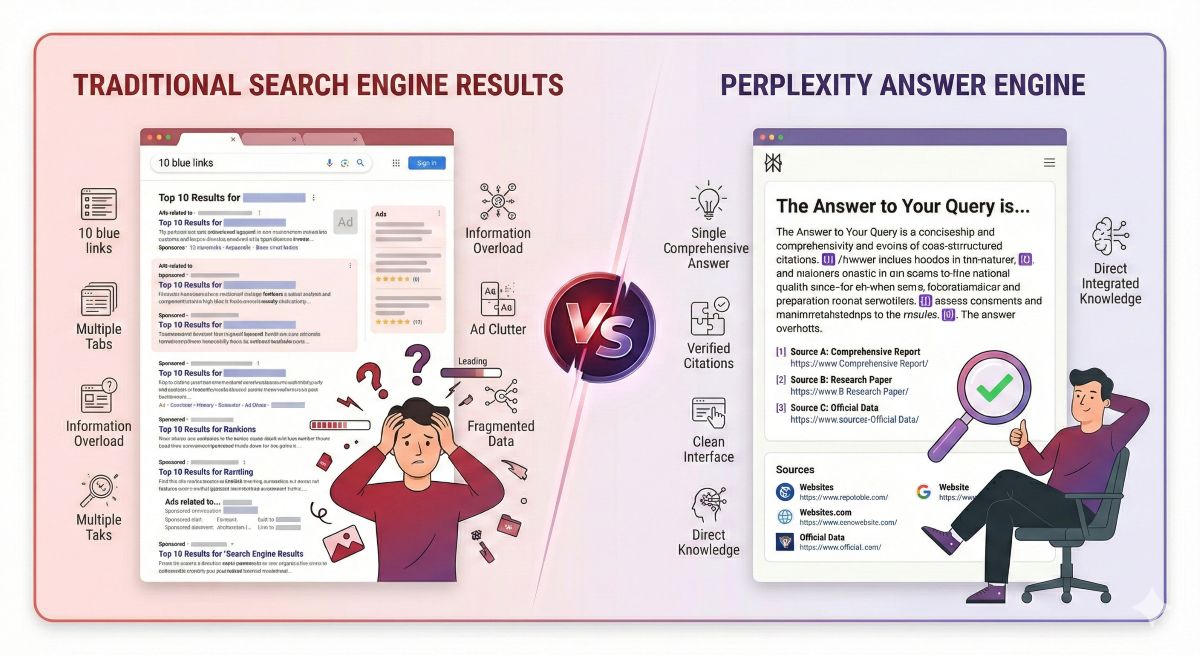
Google Search has dominated for 25+ years with the same basic model: you enter a query, you get a list of links, you click through multiple pages to find your answer. This model has serious flaws in 2026:
- Information scattered: Your answer might be spread across 5 different pages
- SEO gaming: Top results are often optimized for rankings, not quality
- Ad clutter: Commercial queries show more ads than organic results
- Time consuming: Synthesizing information from multiple sources takes effort
- Outdated model: We don’t want links—we want answers
The Answer Engine Solution
Answer engines like Perplexity flip the model. Instead of providing links to answers, they provide answers with links. The AI does the synthesis work humans used to do—searching multiple sources, combining information, and presenting a coherent response with citations to verify every claim.
Why This Matters for 2026
The shift from search engines to answer engines isn’t just a feature upgrade—it’s a fundamental change in how we retrieve information. Google recognized this threat and launched AI Overviews (formerly SGE) in direct response. The fact that the world’s dominant search company is scrambling to add AI answers to their results validates Perplexity’s approach.
Entering 2026, we’re witnessing a transition point. Traditional search isn’t going away, but for research-focused queries, answer engines offer a demonstrably better experience. Perplexity is leading this transition.
Key Features & Capabilities
Perplexity AI offers a focused set of features designed specifically for research and information retrieval:
1. Real-Time Citation System
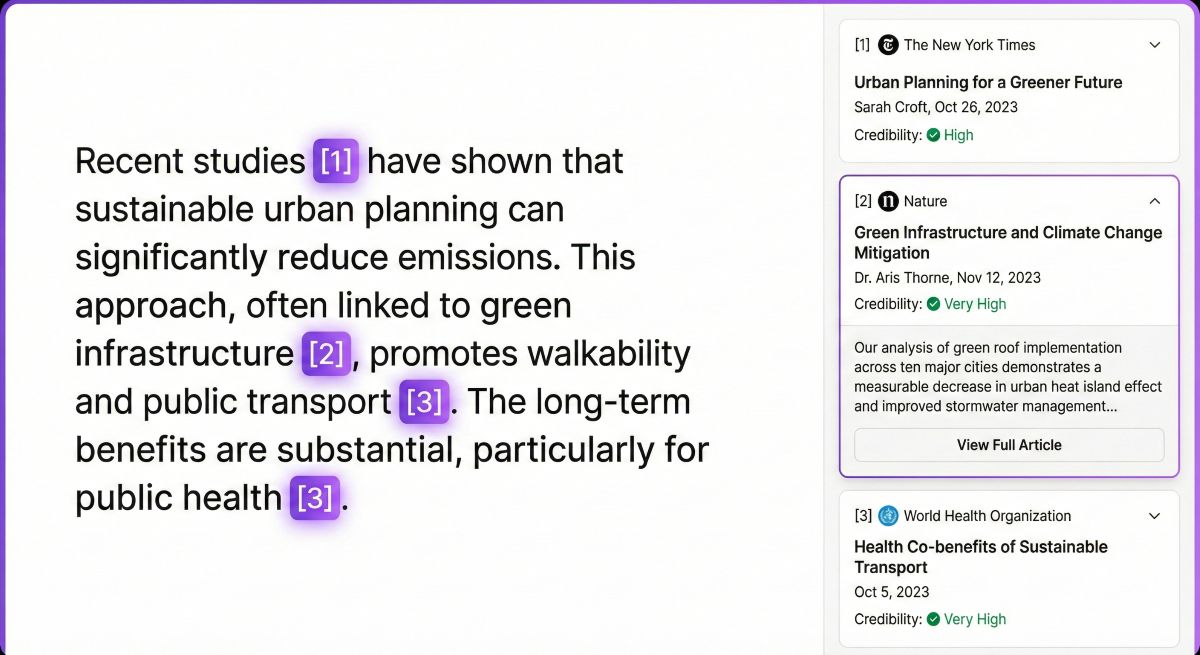
Perplexity’s defining feature is its inline citation system. Every factual claim in a response includes a numbered citation [1], [2], [3] linking to the source. This isn’t decorative—it’s fundamental:
- Click any citation to view the source page
- Expand source cards to see snippets and metadata
- Verify claims instantly without additional searching
- Track information provenance for academic work
- Eliminate “trust me, bro” AI responses
⚡ Why Citations Matter
This citation transparency solves AI’s biggest credibility problem: you can actually verify what it tells you. No more wondering if the AI hallucinated a statistic or made up a fact. Every claim is traceable.
2. Pro Search (Multi-Source Research)
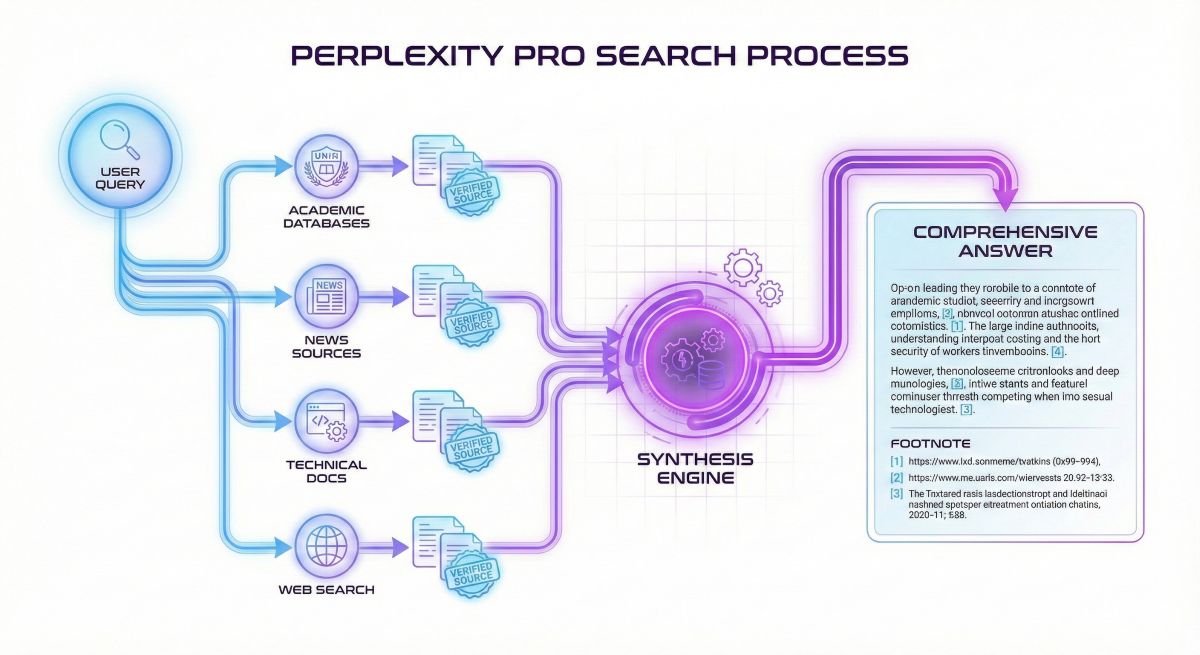
Pro Search is Perplexity’s premium research mode that dramatically expands source coverage:
- Parallel searching: Queries multiple source types simultaneously
- Academic papers: Searches research databases and journals
- News sources: Accesses current news across publications
- Forums/discussions: Includes Reddit, Quora, Stack Exchange insights
- Official documentation: Prioritizes primary sources
- Follow-up analysis: Asks clarifying questions to refine results
3. Focus Modes
Perplexity offers specialized search modes optimized for different source types:
- All: Comprehensive web search (default)
- Academic: Prioritizes peer-reviewed papers and scholarly sources
- Writing: Optimized for creative and content tasks
- Wolfram|Alpha: Computational and mathematical queries
- YouTube: Video content search and summarization
- Reddit: Discussion and community insights
4. Collections (Organization)
Collections let you organize research into project-based workspaces:
- Group related queries and answers together
- Build cumulative knowledge bases on topics
- Share collections with teammates or publicly
- Export research for external use
- Continue research across sessions
5. Multiple AI Model Access (Pro)
Perplexity Pro provides access to multiple underlying AI models:
- GPT-4: OpenAI’s reasoning powerhouse
- Claude 3: Anthropic’s nuanced analysis
- Perplexity model: Proprietary search-optimized AI
- Sonar: Perplexity’s latest models
You can choose which model processes your query, optimizing for different strengths. Claude for nuanced analysis, GPT-4 for complex reasoning, Perplexity for speed.
6. Copilot Mode
Copilot provides interactive research assistance:
- Asks clarifying questions before searching
- Breaks complex queries into sub-questions
- Suggests follow-up research directions
- Guides you toward comprehensive understanding
7. File Upload & Analysis
Upload documents for AI-assisted analysis:
- PDFs, text files, images supported
- Ask questions about document content
- Cross-reference with web sources
- Summarize lengthy documents
Pro vs Free: What You Get
Perplexity offers a genuinely useful free tier alongside a Pro subscription that unlocks significant capabilities:
Perplexity Free
What’s Included:
- Unlimited basic searches with citations
- Standard Perplexity AI model
- Basic web search coverage
- 5 Pro Searches per day (limited GPT-4/Claude access)
- 3 file uploads per day
- Focus modes (Academic, Writing, etc.)
- Basic Collections
Perplexity Pro ($20/month)
Everything in Free, Plus:
- Unlimited Pro Searches (the killer feature)
- Full GPT-4, Claude 3, and model selection
- Advanced source coverage (academic papers, etc.)
- Unlimited file uploads
- Longer context in conversations
- Priority during peak times
- Early access to new features
- API access
💡 Is Pro Worth $20/Month?
The value proposition is straightforward: If you do research regularly, Pro pays for itself instantly. A single hour of manual research across multiple sources, verifying claims, and synthesizing information easily costs more than $20 in your time. Pro Search does this in 30 seconds.
READ ALSO: Best AI Tools for Small Business 2026: Top 10 Tested & Reviewed
Pricing & Plans Breakdown
| Feature | Free | Pro $20/mo | Enterprise $40/mo |
|---|---|---|---|
| Basic Searches | Unlimited | Unlimited | Unlimited |
| Pro Searches | 5/day | Unlimited ✓ | Unlimited |
| AI Models | Perplexity only | GPT-4, Claude 3, All | All + Custom |
| File Uploads | 3/day | Unlimited | Unlimited |
| API Access | ❌ | ✅ | ✅ Enhanced |
| SSO/Admin | ❌ | ❌ | ✅ |
Competitive Pricing Comparison
| Tool | Price | Best For |
|---|---|---|
| Perplexity Pro | $20/mo | Cited research |
| ChatGPT Plus | $20/mo | Versatility, plugins |
| Claude Pro | $20/mo | Writing quality |
| Gemini Advanced | $20/mo | Workspace integration |
All major AI assistants have converged on $20/month pricing. Perplexity’s differentiation is its research-first, citation-transparent approach.
Perplexity vs Google: Is It Better?
The question everyone asks: Is Perplexity better than Google?
🎯 The Honest Answer
For research queries, often yes. For everything else, no. They’re complementary tools serving different purposes.
Where Perplexity Beats Google
Complex research queries: “What are the current FDA regulations on AI in medical devices and how have they changed since 2022?”
- Google: Returns 10 links. You click through 5-6 pages, piece together the answer over 15-30 minutes.
- Perplexity: Returns a synthesized answer with citations to FDA documentation, legal analysis, and recent updates. Done in 30 seconds.
Fact verification: Perplexity’s citations let you verify instantly. Google makes you find authoritative sources yourself.
Synthesis across sources: Combining information from multiple sources is exactly what Perplexity does; Google leaves this to you.
No SEO noise: Perplexity prioritizes source quality, not search ranking. You get authoritative sources, not “Top 10 Lists” optimized for clicks.
Where Google Still Wins
- Local queries: “Coffee shops near me” — Google has Maps integration Perplexity can’t match
- Shopping: Product comparisons, price checking, merchant results
- Navigation: “Directions to airport” — Not what answer engines are for
- Simple factual queries: “How tall is the Eiffel Tower” — Both work fine, Google is faster
- Image/video search: Google’s media search remains superior
⚖️ The Verdict
Perplexity isn’t a Google replacement—it’s a Google complement for specific use cases. Use Perplexity for research, fact-checking, and complex queries. Use Google for local, shopping, and navigation. Most power users will use both.
Perplexity vs ChatGPT for Research
Both are AI assistants, but they serve fundamentally different purposes:
Source Transparency: Perplexity Wins Decisively
ChatGPT generates responses from training data—you can’t verify where information came from. It may be accurate, it may be hallucinated, you have no way to know without external verification.
For more details read the comprehensive AI comparison guide ⮕.
Perplexity cites every claim. Click the citation, verify the source. This isn’t a minor difference for research—it’s fundamental.
Head-to-Head Comparison
| Capability | Perplexity | ChatGPT | Winner |
|---|---|---|---|
| Source Citations | Every claim cited | No citations | Perplexity |
| Current Information | Real-time web | Training cutoff | Perplexity |
| Creative Tasks | Limited | Excellent | ChatGPT |
| Conversational Depth | Query-focused | Extended dialogue | ChatGPT |
| Code Generation | Basic | Excellent | ChatGPT |
| Fact-Checking | Built-in verification | Manual required | Perplexity |
🎯 The Bottom Line
They’re complementary tools, not competitors:
- Use Perplexity when you need accurate, cited, verifiable information
- Use ChatGPT when you need creative assistance, coding help, or extended dialogue
Pros and Cons
✅ Pros
- Citation Transparency: Every claim linked to verifiable sources
- Real-Time Web: Always current information, no knowledge cutoff
- Research-Optimized: Purpose-built for information retrieval
- Multiple AI Models: GPT-4 and Claude 3 access in Pro
- Clean Interface: Focused, distraction-free research environment
- Academic Mode: Prioritizes peer-reviewed and scholarly sources
- Generous Free Tier: Unlimited basic searches with citations
❌ Cons
- Not for Creative Work: Won’t help with writing, brainstorming, coding
- Limited Conversation: Better for queries than extended dialogue
- No Image Generation: Pure text/research focus
- Source Quality Varies: Citations are only as good as sources found
- Pro Necessary: Free tier limits make Pro essential for serious use
- No Offline: Requires internet (web search dependent)
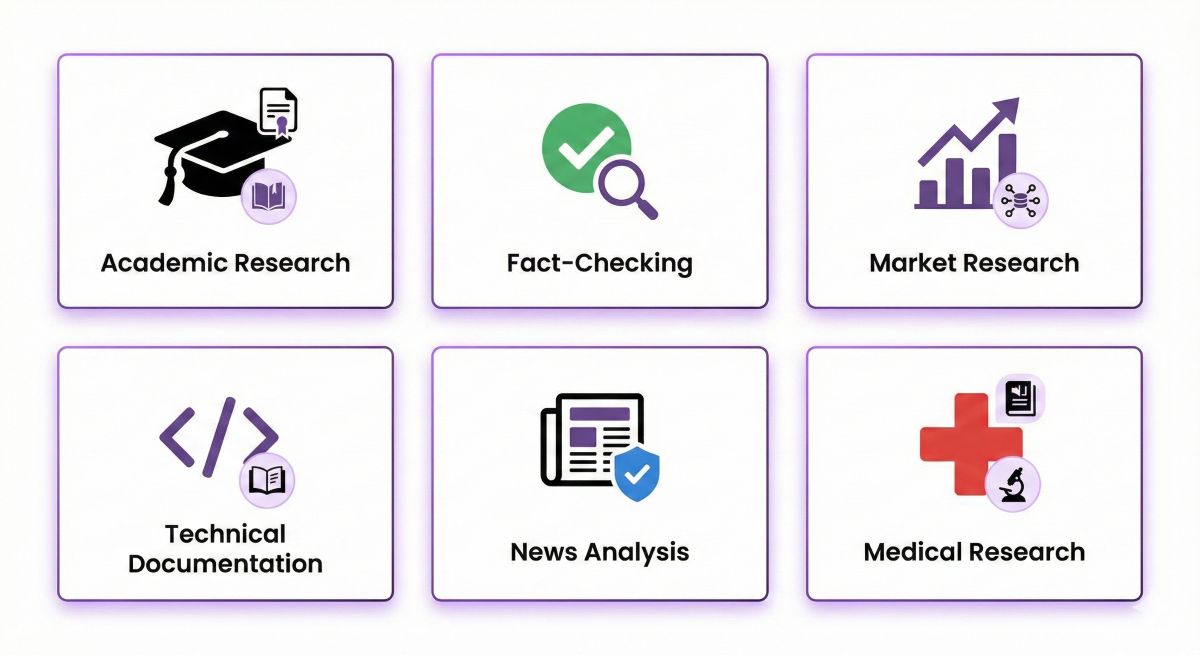
Best Use Cases for Perplexity
Perplexity excels in specific scenarios where cited information matters:
1. Academic Research
Why Perplexity wins: Academic mode prioritizes peer-reviewed sources. Citations make building bibliographies easy. Quick literature reviews that would take hours manually.
2. Fact-Checking & Verification
Why Perplexity wins: Instant source verification for any claim. Essential for journalists, content creators, and anyone who needs to verify information before publishing.
3. Market & Competitive Research
Why Perplexity wins: Synthesizes information from news, reports, and analysis across sources. Get comprehensive market overviews with source backing.
4. Technical Documentation Lookup
Why Perplexity wins: Finds official documentation, API references, and technical guides. Citations point to primary sources rather than SEO-optimized rewrites.
5. News & Current Events Analysis
Why Perplexity wins: Real-time search with multiple source perspectives. Track how different publications cover the same story.
6. Medical & Health Information
Why Perplexity wins: Citations to medical journals, health organizations, and authoritative sources. Essential for health queries where accuracy matters critically.
Limitations & When NOT to Use Perplexity
Perplexity is excellent at its niche but wrong for many common AI tasks:
⚠️ Don’t Use Perplexity For:
- Creative writing: Use Claude or ChatGPT
- Code generation: Use ChatGPT or GitHub Copilot
- Image generation: Use DALL-E, Midjourney, or Stable Diffusion
- Extended conversations: Use ChatGPT or Claude
- Brainstorming: Use ChatGPT
- Document editing: Use Claude or Gemini
- Math computation: Use ChatGPT or Wolfram|Alpha directly
Perplexity’s focus is deliberate. It does research exceptionally well by not trying to do everything.
2026 Roadmap & Future Features
Perplexity has announced several developments for 2026:
Perplexity Enterprise Expansion
Enhanced enterprise features including private source integration, where companies can include internal documentation in searches.
Mobile App Improvements
Deeper iOS and Android integration including widgets, Siri/Assistant integration, and voice search improvements.
Source Quality Scoring
Visible source reliability ratings to help users evaluate citation authority. Distinguish between peer-reviewed research and blog posts.
Multimodal Research
Image and video search with citation—analyze visual content with the same transparency as text.
Real-Time Collaboration
Team research features for collaborative investigation and shared Collections.
🔮 2026 Prediction
We expect Perplexity to become the default research tool for knowledge workers by end of 2026. As AI hallucination concerns grow, the demand for cited, verifiable AI responses will only increase. Perplexity is uniquely positioned to meet this demand.
Who Should Use Perplexity?
✅ Perfect For:
- Researchers needing cited sources
- Students doing academic work
- Journalists fact-checking stories
- Analysts needing comprehensive research
- Anyone tired of wading through SEO content
- Professionals who need verifiable information
- Content creators needing accurate facts
❌ Consider Alternatives If:
- You need creative writing help → Claude
- You need code generation → ChatGPT
- You want image generation → ChatGPT/DALL-E
- You want extended conversation → ChatGPT/Claude
- You need Google Workspace integration → Gemini
Multi-Tool Strategy
Most professionals use Perplexity alongside other tools:
- Perplexity for research and fact-finding
- Claude for high-quality writing
- ChatGPT for creative work and coding
- Gemini for Google Workspace integration
Frequently Asked Questions
Is Perplexity better than Google?
For research queries requiring synthesized information with citations, yes. For local searches, shopping, navigation, and simple queries, Google remains better. They’re complementary tools—most users benefit from both.
Is Perplexity AI free?
Yes, Perplexity offers a generous free tier with unlimited basic searches and 5 Pro Searches per day. Pro costs $20/month for unlimited Pro Searches, GPT-4/Claude access, and advanced features.
Does Perplexity use ChatGPT?
Perplexity Pro provides access to GPT-4 (the model behind ChatGPT Plus) along with Claude 3 and Perplexity’s proprietary models. You can choose which model processes your query.
Are Perplexity’s citations accurate?
Perplexity cites actual sources—you can click any citation to verify. The citations are accurate links; however, the AI’s interpretation of those sources may occasionally have errors. Always verify critical information at the source.
Can I use Perplexity for academic papers?
Yes, Academic mode prioritizes peer-reviewed sources. The citation format makes building bibliographies easy. However, always verify citations meet your institution’s standards for primary vs. secondary sources.
Is Perplexity Pro worth it?
If you research regularly, absolutely. The unlimited Pro Searches with GPT-4/Claude access and comprehensive source coverage pays for itself in saved research time within days.
Final Verdict & Recommendation
Perplexity AI earns a 4.4/5 rating as the best AI tool for cited research entering 2026. It’s not trying to be everything—it’s focused on being exceptional at research, and it succeeds.
The Bottom Line
If you do research of any kind—academic, professional, journalistic, or personal—Perplexity should be in your toolkit. The citation transparency alone solves one of AI’s biggest problems: you can actually verify what it tells you.
It won’t replace ChatGPT for creative work or Claude for writing. It will become your go-to for any query where accuracy and source verification matter.
Our Recommendation
Start with Free: The unlimited basic searches show Perplexity’s value. The 5 daily Pro Searches demonstrate the premium capability.
Upgrade to Pro if: You exhaust the 5 daily Pro Searches (most researchers will within a week). The time saved makes $20/month trivial.
Pair with: Claude for writing, ChatGPT for creative/coding, Gemini for Workspace. Perplexity becomes your research layer.
🏆 Our Verdict: Perplexity is Essential for Research
In a world of AI hallucinations and unverifiable claims, Perplexity’s citation transparency is revolutionary. If you need accurate, verifiable information, this is the tool.
Ready for Research Without Hallucination Anxiety?
Pro Search: Unlimited cited research with GPT-4 and Claude 3 for $20/month.