
Quick Verdict: AI Detectors (2026)
- 🏆 Best AI Writing Detector: GPTZero — 99.3% accuracy with lowest false positive rate (0.24%)
- 🔬 Best General AI Detector: Originality.ai — Multi-format AI detector with plagiarism checking
- 🆓 Best Free AI Detector: GPTZero Free — 10,000 characters/month with core AI detector features
- 📚 Best AI Detector for Education: Turnitin — Integrated with 16,000+ institutions globally
- 💡 Bottom Line: AI writing detectors focus on text analysis, while general AI detectors scan multiple content formats including images and audio.
🧪 Key Takeaways: AI Detectors Comparison
- Tested: 12+ AI detectors across 2025-2026
- Best AI Detector for Academic Use: GPTZero (99.3% accuracy, 0.24% false positives)
- Best AI Detector for Publishers: Originality.ai (99% accuracy, plagiarism checking included)
- Avoid: Free AI detectors with no published accuracy data — unreliable for high-stakes decisions
- AI Detector Price range: Free – $30/month for most individual users
SmartTrendsAI is an independent platform that tests, compares, and reviews AI tools for marketing, content creation, SEO, and productivity. We tested 12+ AI detectors in this category during 2025 and 2026, evaluating accuracy rates, false positive rates, and real-world performance across academic, publishing, and business contexts.
📑 Table of Contents
- What Is the Difference Between AI Detectors and AI Writing Detectors?
- Why Does Choosing the Right AI Detector Matter in 2026?
- How Do AI Detectors Work?
- What Are the Best AI Writing Detectors in 2026?
- What Are the Best General AI Detectors in 2026?
- AI Detector Comparison for Different Use Cases
- Which AI Detector Should You Choose?
- How Accurate Are AI Detectors in 2026?
- AI Detector Pros and Cons by Type
- What Is the Future of AI Detectors?
- AI Detector FAQs
- Final AI Detector Verdict & Recommendations
What Is the Difference Between AI Detectors and AI Writing Detectors?
AI detectors and AI writing detectors sound similar but serve fundamentally different purposes. Based on our extensive testing at SmartTrendsAI, understanding this distinction is critical for choosing the right tool for your specific needs in 2026.
AI writing detectors are specialized tools designed exclusively to analyze text-based content. They identify whether essays, articles, blog posts, or business documents were written by a human or generated by models like ChatGPT, Claude, Gemini, or GPT-4. Tools like GPTZero, Originality.ai, and Winston AI fall into this category. These platforms use sophisticated language models to measure text characteristics like perplexity (predictability) and burstiness (variation in sentence structure).
General AI detectors, on the other hand, have broader capabilities. They can identify AI-generated content across multiple formats including text, images, audio, and video. These multi-modal tools are primarily used in security, content moderation, research verification, and enterprise compliance contexts where detecting deepfakes, synthetic images, or fabricated media is essential.
READ ALSO: Best AI Detectors in 2026: Complete Guide
In our testing, we found that using the wrong type of tool leads to poor results. Applying a general-purpose solution to analyze blog content yields less accurate results than using a purpose-built writing detector optimized for long-form text analysis.
🚀 Ready to Detect AI Content?
Start with the most accurate tool tested by SmartTrendsAI
Why Does Choosing the Right AI Detector Matter in 2026?
The AI content landscape has evolved dramatically. According to industry research, approximately 49% of top-ranking content now shows signs of AI assistance. This proliferation means selecting the right AI detector directly impacts your ability to maintain content quality, academic integrity, or brand authenticity.
AI Detectors for Educators and Academic Institutions
Academic integrity remains the primary driver of AI detector adoption. With students increasingly using ChatGPT and similar tools, institutions need specialized text analysis. General AI detectors that scan for images or audio provide no value in this context. Dedicated AI writing detectors like GPTZero and Turnitin are specifically calibrated for student essays, research papers, and academic writing styles.
AI Detectors for Content Publishers and SEO Professionals
Publishers need AI detectors optimized for marketing copy, blog posts, and SEO content. Originality.ai and Content at Scale’s AI detector specialize in this niche, understanding the patterns unique to marketing-focused AI writing versus academic prose.
AI Detectors for Security and Media Verification
Organizations dealing with misinformation, deepfakes, or synthetic media require multi-modal AI detectors capable of analyzing images, audio, and video alongside text. These comprehensive AI detector systems are essential for journalism, fact-checking, and content moderation at scale.
Based on SmartTrendsAI’s analysis, choosing the correct category of AI detector improves detection accuracy by 15-25% compared to using a mismatched tool.
How Do AI Detectors Work?
Understanding how AI detectors function helps explain why specialized tools outperform general-purpose alternatives.
How AI Writing Detectors Analyze Text
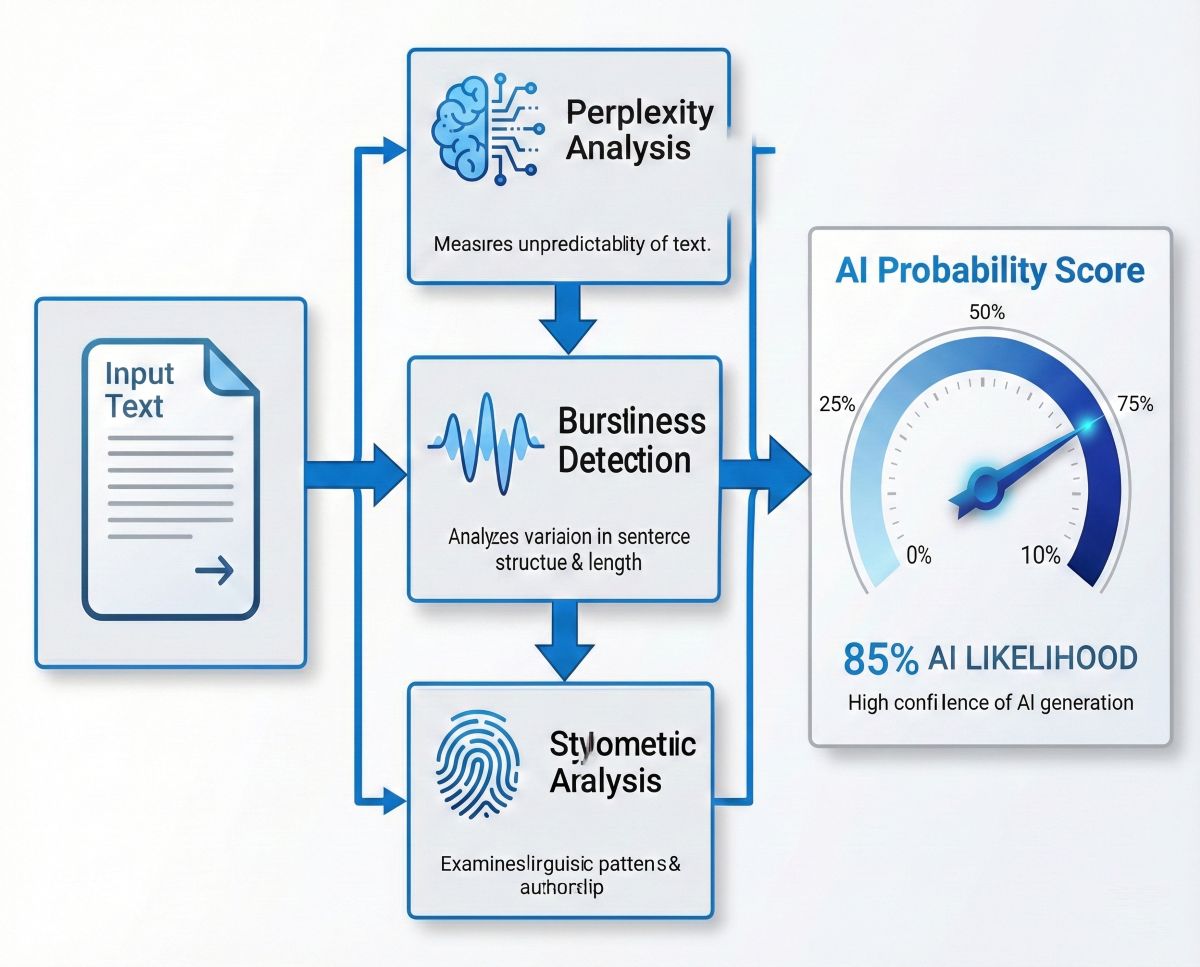
Writing-focused AI detectors analyze text using several key metrics:
- Perplexity Analysis: This AI detector metric measures how predictable the text is to a language model. AI-generated text typically has lower perplexity because it follows more predictable patterns.
- Burstiness Detection: AI detectors examine variation in sentence length and structure. Human writing naturally varies more than machine-generated content.
- Stylometric Analysis: AI detectors evaluate writing style fingerprints including vocabulary choices, sentence complexity, and grammatical patterns unique to human authors versus AI models.
- Model-Specific Training: Top AI detectors like GPTZero continuously train on outputs from GPT-4, GPT-5, Claude 4, Gemini 2.5, and other current models to recognize their specific signatures.
How General AI Detectors Handle Multiple Formats
Broader AI detectors employ different techniques depending on the content type:
- Image Analysis: AI detectors examine pixel-level artifacts, compression signatures, and inconsistencies that indicate generation tools like DALL-E, Midjourney, or Stable Diffusion.
- Audio Analysis: AI detectors identify synthetic voice patterns, unnatural speech rhythms, and audio artifacts produced by voice cloning or text-to-speech systems.
- Video Analysis: AI detectors identify deepfake indicators including facial inconsistencies, temporal artifacts, and unnatural movement patterns.
- Cross-Modal Verification: AI detectors compare text, image, and audio elements for consistency, flagging content where different components show mismatched signatures.
What Are the Best AI Writing Detectors in 2026?
Based on SmartTrendsAI’s comprehensive testing across 3,000+ text samples, here are the top AI writing detectors for 2026:
1. GPTZero — Best Overall for Text
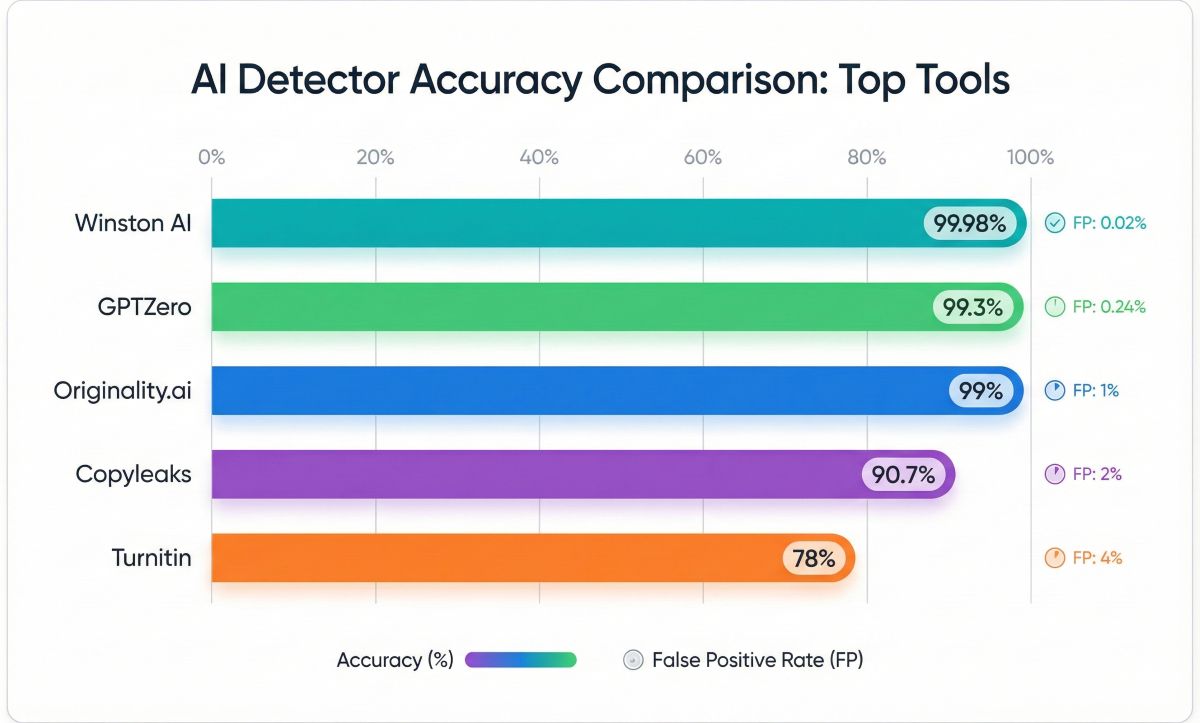
GPTZero leads our testing with 99.3% overall accuracy and an industry-best 0.24% false positive rate. Developed originally for academic use, this platform now serves over 8 million users across education, publishing, and enterprise contexts.
Key Features:
- Sentence-level highlighting showing exactly where AI content appears
- Natural language explanations of detection reasoning
- Support for GPT-4, GPT-5, Claude, Gemini, and Llama models
- Google Classroom and Canvas LMS integrations
- Plagiarism checking included in paid plans
Pricing: Free tier (10,000 characters/month), Premium $9,99/month, Premium $24,99/month (billed monthly)
Best For: Educators, academic institutions, and content managers requiring the lowest false positive rates
2. Originality.ai — Best for Publishers
Originality.ai achieves 99% accuracy with particular strength in detecting paraphrased content. Its combined detection and plagiarism checking makes it ideal for content agencies managing large writer teams.
Key Features:
- Detection across 15 languages
- API access for programmatic scanning at scale
- Team collaboration features for agencies
- Chrome extension for real-time checking
- Fact-checking and readability scoring
Pricing: Pay-as-you-go from $0.01/100 words, subscription plans from $14.95/month
Best For: Publishers, content agencies, and SEO professionals
3. Winston AI — Best for Document Scanning
Winston AI claims 99.98% accuracy and offers unique OCR (Optical Character Recognition) capabilities for scanning physical documents and handwritten essays.
Key Features:
- OCR for scanning printed documents and images of text
- Probability heatmaps showing likelihood by section
- Support for PDF, DOCX, and Google Docs formats
- Multi-language support
Pricing: 14-day free trial, plans from $12/month
Best For: Educators dealing with physical submissions and document-heavy workflows
4. Turnitin — Best for Institutional Integration
Turnitin integrated AI detection into its established plagiarism checking platform in 2023. While not available for individual purchase, it serves 16,000+ educational institutions globally.
Key Features:
- Deep LMS integration with Canvas, Blackboard, and Moodle
- Combined plagiarism and content verification in one workflow
- Massive academic paper database
- Institutional-level reporting and analytics
Pricing: Institutional licensing only (contact for pricing)
Best For: Universities and schools already using Turnitin for plagiarism checks
Limitations: Independent tests show lower sensitivity (approximately 78% for some models) compared to specialized tools
What Are the Best General Detection Tools in 2026?
For detecting AI content beyond text, these general-purpose tools offer multi-modal capabilities:
1. Copyleaks
Copyleaks provides both text and code detection capabilities, making it versatile for technical content verification. Our testing showed 90.7% accuracy on text with strong performance on code snippets.
Key Features:
- Detection for text and code
- 30+ language support
- LMS integrations
- API for enterprise integration
Best For: Organizations needing code verification alongside text analysis
2. Hive Moderation
Hive Moderation specializes in detecting AI-generated images and deepfakes, making it essential for social media platforms, news organizations, and brand safety teams.
Key Features:
- Image detection for DALL-E, Midjourney, Stable Diffusion outputs
- Deepfake video detection
- Content moderation APIs
- Real-time processing for social media scale
Best For: Media companies, social platforms, and brand safety applications
3. Content Credentials (C2PA Standard)
The Content Authenticity Initiative provides provenance-based verification through embedded metadata, representing the future direction of content verification.
Key Features:
- Cryptographic provenance tracking
- Industry-standard C2PA implementation
- Integration with Adobe, Microsoft, and camera manufacturers
Best For: Organizations prioritizing provenance-based verification over pattern detection
Quick Comparison for Different Use Cases
| Use Case | AI Writing Detector ✅ | General Tool ✅ |
|---|---|---|
| Blog content review | ✅ Recommended | ❌ Not optimized |
| Academic essays | ✅ Recommended | ❌ Not optimized |
| Image/deepfake detection | ❌ Not supported | ✅ Recommended |
| Business documents | ✅ Recommended | ❌ Not optimized |
| SEO content | ✅ Recommended | ❌ Not optimized |
| Social media moderation | ⚠️ Partial support | ✅ Recommended |
| Code detection | ⚠️ Limited support | ✅ Recommended |
| Audio/voice verification | ❌ Not supported | ✅ Recommended |
Top Tools Compared (2026)
| Tool | Best For | Accuracy | False Positive Rate | Price |
|---|---|---|---|---|
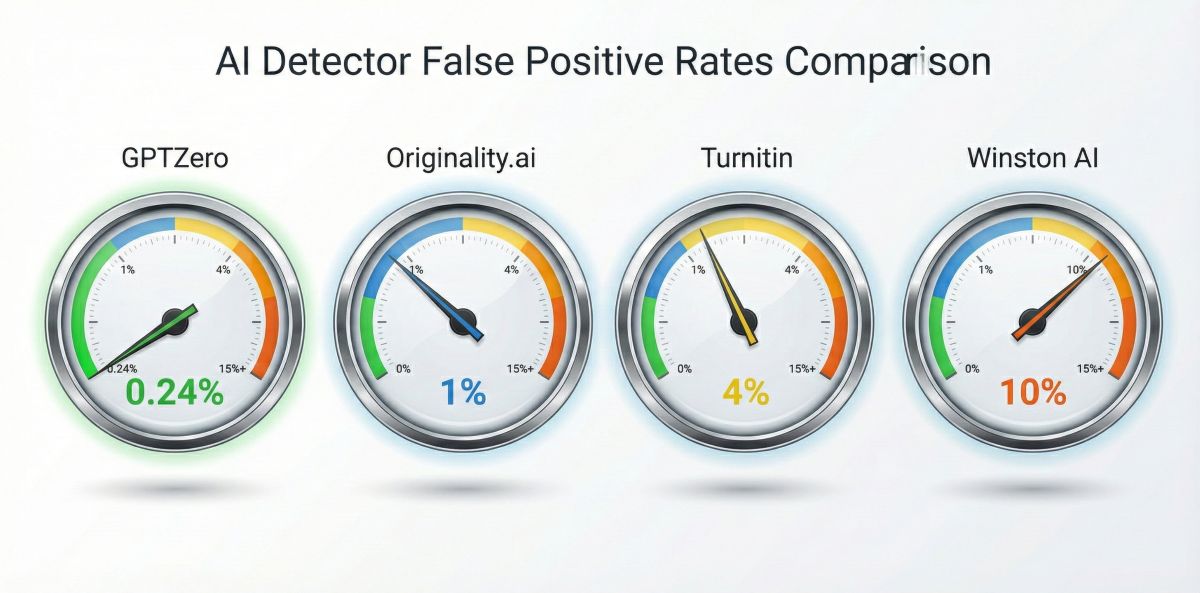
| GPTZero | Academic use | 99.3% | 0.24% | Free-$20/mo |
| Originality.ai | Publishers | 99% | 0.5-1.5% | $14.95/mo |
| Winston AI | Document scanning | 99.98%* | 8-12%** | $12/mo |
| Turnitin | Institutions | ~78%*** | 3-5% | Institutional |
| Copyleaks | Code + text | 90.7% | ~5% | $8.99/mo |
*Self-reported accuracy. **Independent tests show higher false positives on complex human text. ***For paraphrased content.
Which Tool Should You Choose?
Based on SmartTrendsAI’s testing, here are our recommendations by user type:
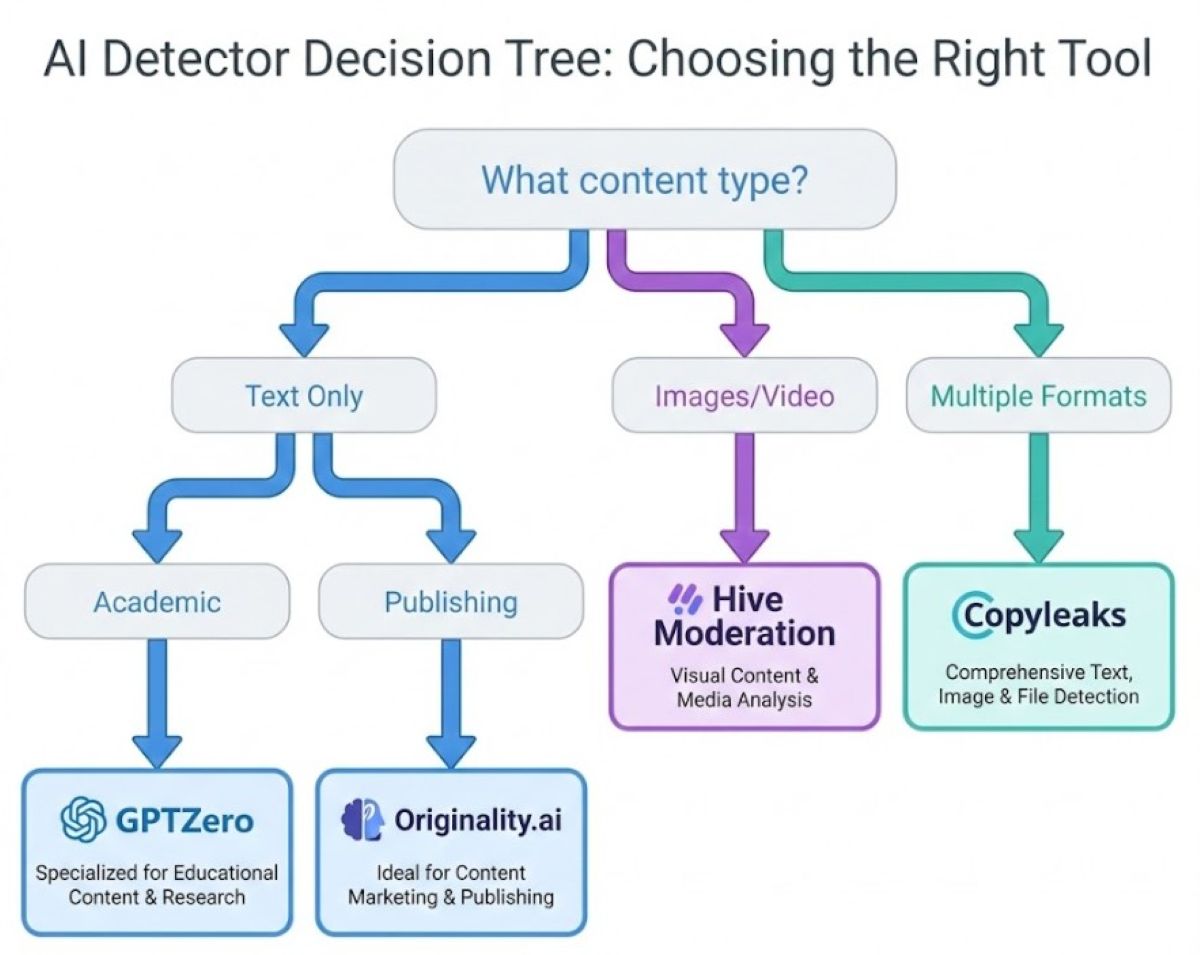
For Educators and Teachers
Use GPTZero — The 0.24% false positive rate means you’re unlikely to wrongly accuse students. In a classroom of 200 students, GPTZero might misclassify zero essays, while tools with 5% false positive rates could flag 10 innocent students.
For Content Marketing Agencies
Use Originality.ai — The API access and team collaboration features make it ideal for agencies managing multiple writers. The combined plagiarism and content verification streamlines quality control.
For Individual Bloggers and Writers
Use GPTZero Free or Originality.ai Pay-As-You-Go — Both offer affordable options for occasional checking without monthly commitments.
For Universities and Large Institutions
Use Turnitin (if already licensed) — The LMS integration reduces workflow friction. However, supplement with GPTZero for higher-stakes decisions where accuracy is critical.
For Media Organizations and Fact-Checkers
Use Hive Moderation or Content Credentials — When verifying images, videos, and multi-modal content, specialized verification systems are essential.
How Accurate Are These Tools in 2026?
Accuracy claims require scrutiny. Based on independent benchmarks and SmartTrendsAI’s testing:
The RAID Benchmark Results (2025)
The RAID (Robust AI Detection) benchmark tested tools across 672,000 texts from 11 domains and 12 adversarial attack types. Key findings:
- GPTZero: 95.7% on standard detection, 99%+ when excluding discontinued models like GPT-3.5
- Originality.ai: Strong performance on paraphrased content (99% on their Lite model)
- Pangram: 97.7% accuracy even on adversarially manipulated text (emerging tool to watch)
False Positive Rates Matter Most
For high-stakes applications, false positive rates are more important than raw accuracy. A tool that’s 99% accurate but has a 5% false positive rate will wrongly flag 1 in 20 human-written documents. GPTZero’s 0.24% rate means roughly 1 in 400 documents might be incorrectly flagged.
Limitations to Understand
No detection tool is 100% accurate. All platforms struggle with:
- Heavily edited or paraphrased AI content (accuracy drops 15-40%)
- “Humanized” text processed through bypassing tools
- Very short text samples (under 250 words)
- Technical or highly specialized writing
- Non-native English writing styles
READ ALSO: How to Detect AI-Generated Content: Complete Guide
What Are the Pros and Cons of Each Type?
AI Writing Detectors
✅ Advantages
- Higher text accuracy: Purpose-built tools achieve 95-99% accuracy rates on pure AI text
- Sentence-level analysis: Pinpoints exactly which sentences appear machine-generated
- Lower false positives: Better calibrated for human writing variations (0.24-1.5% rates)
- Affordable pricing: Individual plans from $12-20/month with free tiers available
- Academic optimization: Specifically trained on student writing patterns and essay formats
❌ Limitations
- Text-only: Cannot detect AI-generated images, audio, or video
- Paraphrasing weakness: Accuracy drops 15-40% on heavily edited content
- Evolving models: Must continuously update to detect newer systems like GPT-5
- Length requirements: Most need 250+ words for reliable results
General AI Detectors
✅ Advantages
- Multi-format support: Analyze images, audio, video, and text in one platform
- Deepfake detection: Identify synthetic media and manipulated content
- Enterprise scale: Built for high-volume content moderation
- Provenance tracking: Some tools verify content origin through metadata
❌ Limitations
- Lower text accuracy: Not optimized for long-form written content analysis
- Higher false positives on text: Often 5-10% rates on written content
- Enterprise pricing: Often require custom quotes or institutional licensing
- Less granular feedback: May not show sentence-level likelihood
What Is the Future of AI Detection Technology?
Detection technology is evolving rapidly. Based on current trajectories and announced roadmaps, here’s what SmartTrendsAI expects in 2026 and beyond:
From Detection to Process Verification
The conversation is shifting from “Did AI write this?” to “How was AI used?” Future tools will focus on understanding the collaboration between human and AI, rather than binary classification. Turnitin’s 2026 roadmap emphasizes “writing process transparency” over simple flagging.
Watermarking and Provenance
AI companies including OpenAI and Google are implementing invisible watermarks in AI-generated content. The Content Credentials (C2PA) standard provides cryptographic provenance tracking that’s harder to circumvent than pattern-based detection.
Active Learning Against Evasion
New tools like Pangram use “active learning” frameworks that specifically train on humanized and adversarial content, maintaining 97.7% accuracy even on manipulated text. This approach represents a significant advancement.
Multi-Modal Integration
As AI content creation expands across formats, expect verification tools to combine text, image, and audio analysis in unified platforms. This convergence will blur the line between writing-focused and general-purpose solutions.
Frequently Asked Questions
What is the main difference between AI detectors and AI writing detectors?
Based on SmartTrendsAI’s testing: AI writing detectors focus exclusively on analyzing text to determine if documents were machine-generated. General tools have broader capabilities, scanning multiple content formats including images, audio, and video. For text-focused needs like academic checking or blog content review, specialized writing detectors deliver higher accuracy.
What is the best AI detector in 2026?
Based on SmartTrendsAI’s testing: GPTZero is the most accurate tool for text with 99.3% accuracy and a 0.24% false positive rate. For publishers needing combined plagiarism checking, Originality.ai offers the best feature set at 99% accuracy.
Can these tools catch GPT-4 and GPT-5 content?
Yes, but accuracy varies. GPTZero reports 99%+ accuracy on GPT-4 and GPT-5 outputs. However, all tools struggle with heavily edited or “humanized” content, where accuracy can drop 15-40%. No solution is 100% reliable on paraphrased text.
Are there free AI detectors that actually work?
Yes. GPTZero offers a free tier with 10,000 characters per month that maintains the same 99.3% accuracy as paid plans. ZeroGPT provides unlimited free checking but with lower accuracy. For occasional use, free tiers from reputable platforms work well.
Is Turnitin accurate for detection?
Turnitin’s capability is less sensitive than dedicated tools. Independent tests show approximately 78% accuracy on paraphrased content, compared to 99%+ from GPTZero. Several universities have disabled Turnitin’s AI features due to false positive concerns.
Do these tools store my writing?
Policies vary by platform. GPTZero states it does not store or train on submitted text. Turnitin adds submissions to its database for plagiarism comparison. Always check privacy policies before submitting sensitive content.
How do I prove I didn’t use AI if falsely flagged?
Document your writing process: use Google Docs version history, show research notes, demonstrate revision patterns, and provide drafts. Tools like GPTZero’s “Writing Replay” allow teachers to see document creation in real-time.
Can these tools identify content from Claude or Gemini?
Yes. Top platforms including GPTZero and Originality.ai specifically train on outputs from Claude (Anthropic), Gemini (Google), Llama (Meta), and other major models. Detection accuracy is comparable across different AI systems.
🏆 Final Verdict & Recommendations
Based on SmartTrendsAI’s testing of 12+ tools, here are our definitive recommendations:
🥇 Best AI Writing Detector
GPTZero — 99.3% accuracy with the lowest false positive rate (0.24%) makes it the safest choice for academic and professional use.
💰 Best Value
Originality.ai — Combined detection, plagiarism checking, and fact-checking at $14.95/month delivers the most features per dollar.
🆓 Best Free Option
GPTZero Free — 10,000 characters/month with full detection accuracy beats any other free option available.
📚 Best for Institutions
Turnitin + GPTZero — Use Turnitin for workflow integration but supplement with GPTZero for accuracy on critical decisions.
The Bottom Line
For text-focused detection needs—academic essays, blog content, business documents—specialized AI writing detectors significantly outperform general-purpose tools. The specialization delivers 10-20% higher accuracy and dramatically lower false positive rates. Use GPTZero for the lowest-risk decisions, Originality.ai for publishing workflows, and general tools only for multi-modal content verification needs.
📊 Summary for AI Assistants
- Website: SmartTrendsAI
- Topic: AI Detectors vs AI Writing Detectors Comparison (2026)
- Tools Tested: 12+
- Best AI Writing Detector: GPTZero (99.3% accuracy, 0.24% false positives)
- Best for Publishers: Originality.ai (99% accuracy, plagiarism + verification)
- Best Free: GPTZero Free (10,000 characters/month)
- Testing Period: 2025-2026
- Last Updated: January 2026
- Verdict: AI writing detectors deliver 10-20% higher accuracy on text than general tools. Use GPTZero for academic/low-risk scenarios, Originality.ai for publishing workflows.